ENGINEERING
Hydrogen steel needs a plant that can absorb interruptions
HYBRIT’s 2025 results and 2026 pilot extension show why hydrogen storage, ore reduction and electric melting must be designed as one industrial system.
Research checked
Newest cited publication
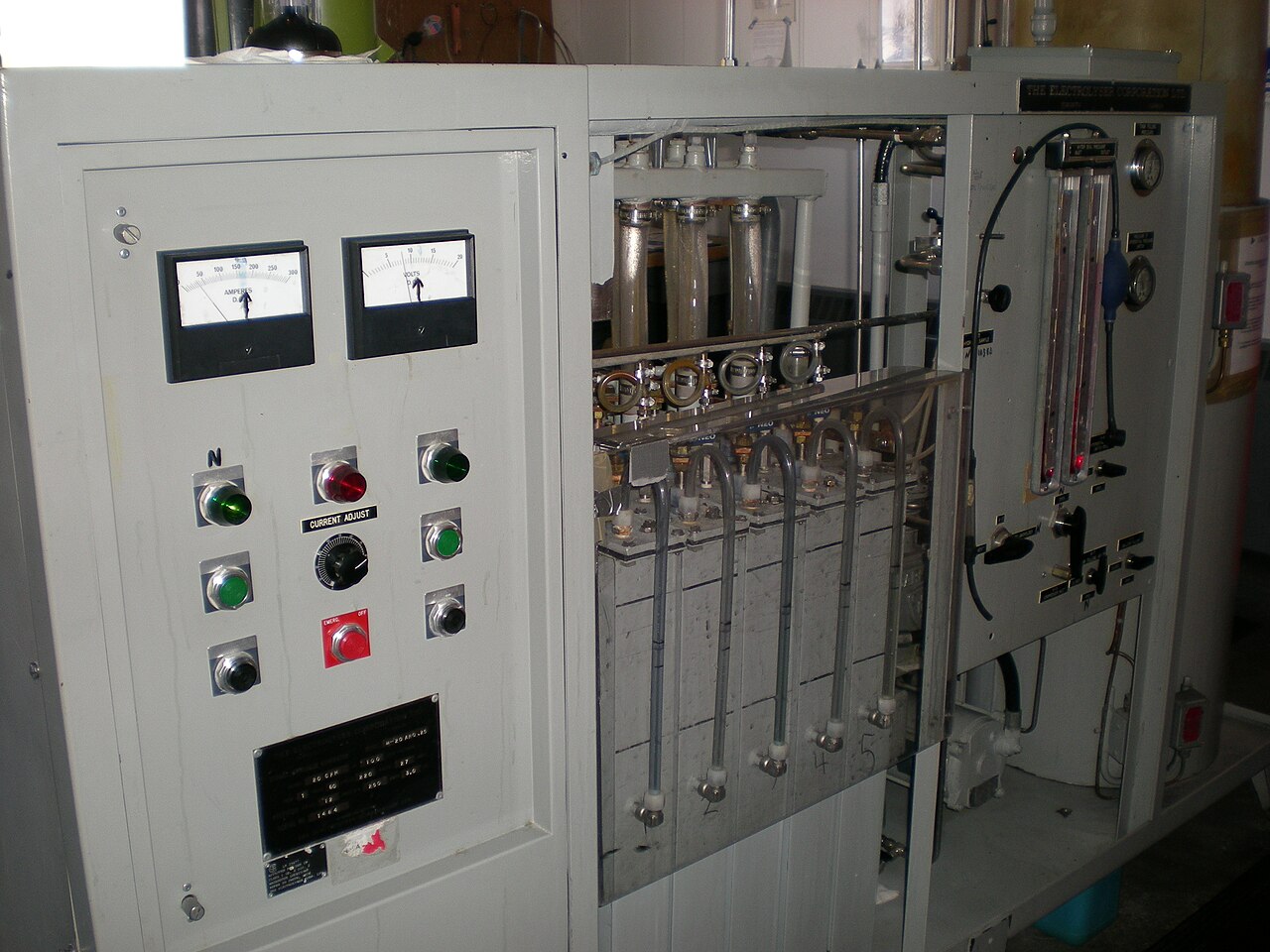
An electrolyser installation photographed in 2008 illustrates hydrogen-production hardware; the steel-plant integration and operating interruptions are discussed separately in the article.
CambridgeBayWeather / Wikimedia Commons · Image source · CC BY-SA 4.0

Replacing carbon with hydrogen in ironmaking sounds like a chemical substitution. At plant scale it becomes a coordination problem between an electricity system, gas-production equipment, a reduction reactor and a steelmaking shop. Their preferred operating rhythms do not naturally match. HYBRIT's February 2025 storage results, followed by a February 2026 decision extending the Swedish pilot's permitted operation, provide unusually concrete evidence about one interface between them. The interesting question is not simply whether hydrogen can remove oxygen from iron ore. It is how a complete facility continues producing the intended iron and steel when energy prices, equipment availability and production requirements move in different directions.
Separate iron reduction from steel melting
HYBRIT's technical description explains that direct reduction removes oxygen from iron-ore pellets below iron's melting point, leaving porous metallic sponge iron. Hydrogen performs the reduction and forms water. A subsequent electric arc furnace melts the material for steelmaking. These are distinct process stages. The reduction reactor does not deliver a finished steel product, and the arc furnace does not remove the need for suitable iron feedstock.
This separation creates both an opportunity and a constraint. Intermediate material can potentially decouple stages, but its temperature, handling and quality have consequences for the next operation. A plant designed only around the reduction reaction could overlook the furnace's required charge, the transfer equipment or the quality-control laboratory. The useful system boundary extends from ore preparation through the final steel grade. The discussion here concerns that integrated chain, rather than a claim that all commercial-scale details have already been demonstrated.
A stoichiometric floor is not a plant specification
A simple independent calculation shows the scale of the gas requirement. For pure hematite, the idealised reaction is Fe2O3 plus three H2 producing two Fe and three H2O. Using rounded molar masses, six grams of hydrogen can remove oxygen associated with about 112 grams of iron. The theoretical requirement is therefore roughly 54 kilograms of hydrogen per tonne of iron. That is a reaction floor for ideal material, not a quoted operating figure for HYBRIT.
Real equipment must also manage reaction rates, heat transfer, gas circulation, water removal and material that is not pure iron oxide. Excess circulating hydrogen is different from hydrogen chemically consumed, so those flows should not be confused. An electrolyser sized from the chemical minimum alone might leave no room for losses, maintenance or reserve. Conversely, sizing every component for an extreme case can create expensive idle capacity. The design task is to connect material balances to a realistic operating schedule.
Keep demonstrated savings separate from simulations
On 27 February 2025, HYBRIT reported results from a 100-cubic-metre steel-lined rock-cavern storage pilot. Real-time operation against electricity markets demonstrated savings of 26–31% in the variable operating cost of hydrogen production. Simulated future-market scenarios indicated approximately 25–40%. Those percentages describe different kinds of evidence and a specific cost component. They should not be presented as measured reductions in the total cost of steel or guaranteed savings at every future plant.
The distinction is especially useful for comparing studies. Variable operating costs can change with electricity prices and operating strategy, while capital recovery and maintenance may behave differently. A storage facility can reduce the price paid for electricity without reducing the quantity of hydrogen required by chemistry. Its benefit comes from changing when electricity is converted into gas. Any economic comparison must include the cost of the storage and the additional production capacity needed to refill it.
The 2026 extension is continued testing
HYBRIT announced on 24 February 2026 that the pilot storage's temporary building permit had been extended until 2031. The update reported approximately 5,700 hours of combined hydrogen production and storage operation through 2025, with 96% availability, accumulated during intermittent campaigns. This is stronger operating evidence than a single successful filling. It remains pilot evidence, rather than proof of uninterrupted commercial steel production or the operating availability of a complete future industrial complex.
Availability figures need a denominator and a boundary. An assessment of a storage subsystem over selected campaigns does not automatically describe an entire calendar year, nor the simultaneous availability of electrolysers, compressors, the reduction shaft and the melt shop. A plant can lose production when any critical subsystem is unavailable. The sensible inference is that the pilot reduces uncertainty about a particular interface while leaving integrated reliability and commercial scaling as further engineering work.
A buffer buys time rather than energy
Consider an illustrative reduction plant consuming one tonne of hydrogen per hour. An eight-tonne usable gas buffer can bridge eight hours at that consumption rate, ignoring minimum-pressure and reserve constraints. It cannot bridge an indefinite electricity shortage. If the electrolyser can produce only exactly one tonne per hour when operating, it also cannot refill the buffer while maintaining the same reactor demand. Some excess production capacity or a reduced-demand interval is necessary.
This arithmetic exposes why storage volume, electrolyser size and the acceptable production schedule must be chosen together. Pressure limits determine usable rather than geometric capacity. Compressor availability and refill rates constrain how quickly a reserve can be restored. A control policy that saves money during normal price fluctuations may leave too little reserve before a forecast interruption. A good plant model therefore distinguishes commercial optimisation from the minimum inventory needed to sustain safe, stable operation.
The furnace still has a demanding job
HYBRIT's melting documentation describes trials with direct reduced iron, or DRI, and hot briquetted iron, or HBI. The latter presses sponge-iron pellets into larger pieces. The change from a liquid blast-furnace stream to a solid reduced-iron feed changes the interface into steelmaking. The electric furnace needs an appropriate charge and an operating practice that can deliver the required chemistry and temperature before downstream processing.
An independent heat-balance thought experiment shows why transfer conditions matter. Suppose a solid feed arrives colder than expected. Even if its composition is unchanged, additional furnace energy is needed to raise its temperature and melt it. A comparison that credits a process for hot charging must actually preserve and deliver that heat. Material storage may improve scheduling flexibility while sacrificing some thermal integration. Neither choice is universally best; the preferred design depends on electricity, equipment and production constraints.
A tonne of iron is not a steel specification
A plant must supply material that can become a particular steel product, not merely remove most oxygen from an ore sample. Ore composition, incomplete reduction and handling can influence the charge entering the furnace. The final grade then requires composition control, cleanliness and downstream processing. These requirements mean a successful ironmaking campaign and a successful product-qualification programme are related but distinct demonstrations.
For a meaningful evaluation, reports should identify the material tested, its variability and the resulting product requirements. They should also distinguish the reduction step's direct emissions from upstream electricity and the rest of steelmaking. An ore-based process can substantially change one major emissions source without making every downstream operation emission-free. This is a proposed reporting standard for comparing integrated projects. It follows the physical boundary of production rather than treating a technology name as a complete lifecycle result.
The next milestone is coordinated operation
The most informative next demonstration would publish a joined record of electricity use, hydrogen production, buffer inventory, reduction output and furnace performance over representative disturbances. It would show planned maintenance, demand changes and low-inventory conditions as well as favourable operating periods. Such a record could establish whether the control strategy protects production quality while making useful use of energy flexibility. It would also make economic assumptions easier to audit.
The 2025 storage results and 2026 extension matter because they turn part of that integration problem into an experimentally informed design question. They do not remove the need for plant-wide engineering. Hydrogen ironmaking becomes industrially persuasive when the whole facility can transform variable inputs into a predictable product, with the remaining uncertainty explicitly bounded. The essential advance is a coordinated production system that can tolerate the real interruptions surrounding its chemistry.
Sources & further reading
Primary papers, project documentation, and research releases used in this article. Publication dates below refer to the sources themselves.
- Decision on extended operation of HYBRIT’s pilot facility for fossil-free hydrogen storage in LuleåHybrit DevelopmentPublished Checked
- HYBRIT: Large-scale storage of fossil-free hydrogen gas successfully provenHybrit DevelopmentPublished Checked
- Pilot scale direct reduction with hydrogenHybrit DevelopmentChecked
- Smelting sponge iron in electric arc furnaceHybrit DevelopmentChecked
FOLLOW THE QUESTION
Explore engineering