ENGINEERING
District heating from waste heat: the temperature lift determines the system
Helsinki’s 2026 wastewater heat-pump plant and a new data-center agreement reveal the practical temperature, timing, and network questions behind recovered heat.
Research checked
Newest cited publication
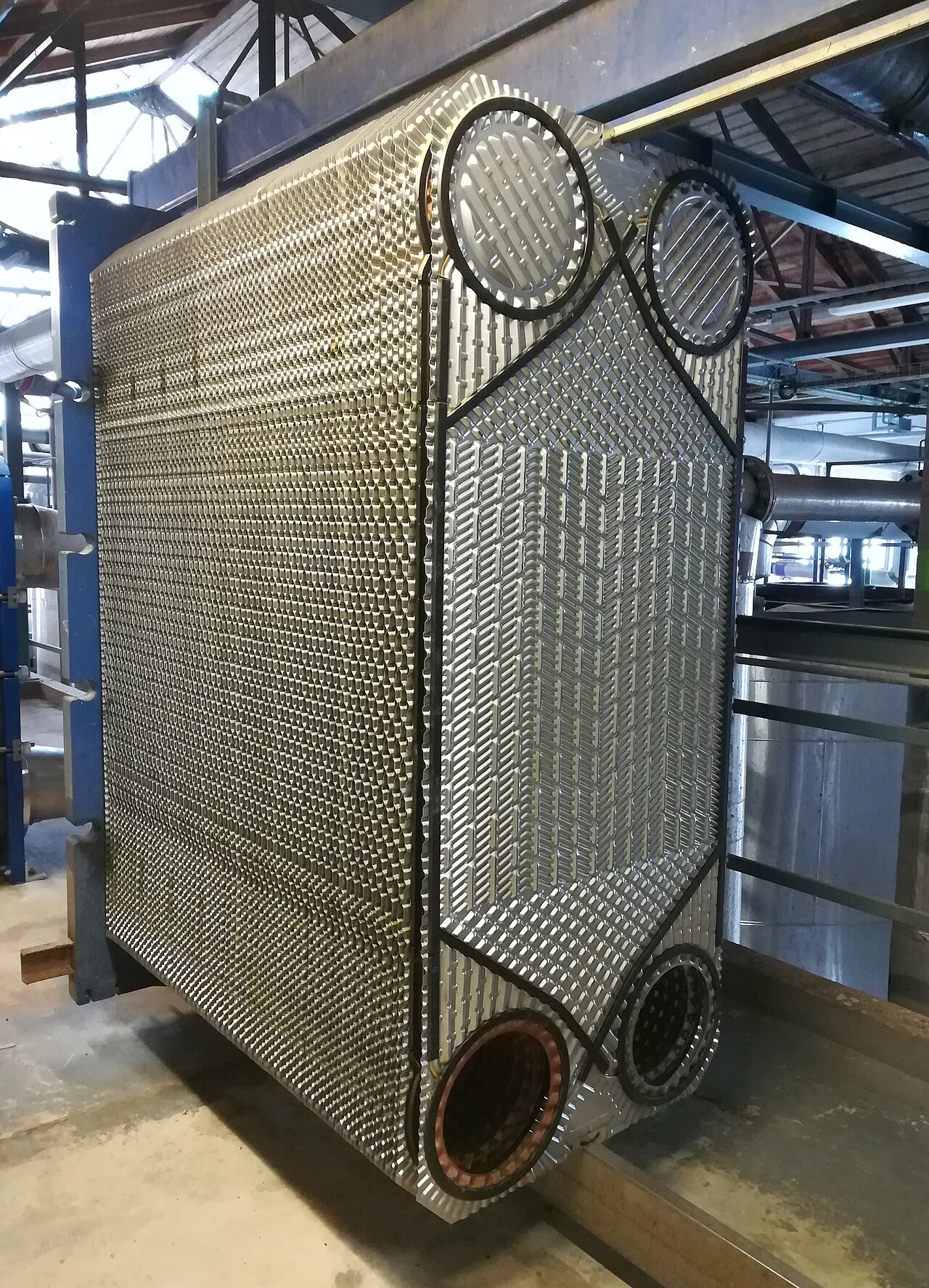
A dismantled plate heat exchanger shows a common interface between heat circuits, providing context for waste-heat recovery and district-heating networks.
RomanM82 / Wikimedia Commons · Image source · CC BY-SA 4.0

A factory, wastewater stream, or data center can reject a great deal of heat without being able to warm a nearby building directly. Heat has a temperature as well as an energy quantity, and a district heating network needs both delivered under controlled conditions. That makes waste-heat recovery a problem of matching sources to customers across space and time. Helsinki offers a current example with two different stages of evidence: a wastewater heat-pump plant completed in August 2026 and an August agreement for a data-center connection planned to begin supplying recovered heat in 2027. Distinguishing the operating asset from the future project is the first step toward understanding what each demonstrates.
Two 2026 developments at different stages
Helen's Eiranranta project page states that its wastewater heat-pump plant was completed in August 2026. The operator lists approximately ninety megawatts of district heating capacity, sixty megawatts of district cooling capacity, and around three hundred gigawatt-hours of annual heat production. The annual quantity should be read as a project specification or expected output, rather than an already completed twelve-month operating measurement at the October cutoff. The source is treated wastewater whose thermal energy has already been partly recovered upstream.
On August 31, 2026, Helen separately announced an agreement with OnZero Finland for a new data center. Heat recovery is scheduled to start in 2027, with potential annual supply above five hundred thousand megawatt-hours once fully operational. That figure is a projection for a planned facility. It does not demonstrate that the data center was already delivering that heat in 2026, nor establish its eventual operating profile. The agreement is nevertheless concrete evidence of heat recovery being included in the design of a major new load.
Temperature is the first screen
A heat exchanger transfers energy from a hotter stream to a colder one. If a waste stream is cooler than the temperature required by the network, a heat exchanger alone cannot raise it to the delivery temperature. A heat pump supplies the missing temperature lift by consuming work. A source can therefore contain substantial recoverable energy while still requiring significant electrical infrastructure to make that energy useful. Calling it waste heat does not imply that collection and delivery are free.
As an idealized reference, the maximum heating coefficient of performance for a reversible heat pump is the hot-side absolute temperature divided by the difference between hot and cold absolute temperatures. With an illustrative hot side at eighty degrees Celsius and a source at twenty degrees, that ratio is about 353 divided by sixty, or 5.9. Real equipment performs below that bound and needs additional exchanger temperature differences. Lowering the delivery requirement to sixty degrees would improve the ideal ratio to about 8.3 for the same source. These examples explain the value of temperature compatibility; they are not predictions for Helen's machines.
Recovering the same stream in sequence
Helen's current description says Eiranranta uses wastewater already processed thermally at Katri Vala and returned to a tunnel at temperatures as low as roughly five degrees Celsius. Recovering additional heat from that cooler stream is different from repeatedly counting the same useful output. Each stage removes another portion of the stream's available thermal energy, while a heat pump adds electrical work to produce a higher-temperature delivery stream. The remaining recoverable amount depends on permitted outlet conditions, flow, and exchanger performance.
The older Katri Vala expansion provides background. In September 2023, Helen reported completion of a seventh heat pump and listed total heating capacity of 160 megawatts and cooling capacity of one hundred megawatts. That announcement also projected an earlier completion date for Eiranranta. The current project page now states August 2026, illustrating why a recent status page should take precedence over an old construction forecast. Capacity figures from the two sites should not be combined into annual output without checking how the plants share the same wastewater resource and network demand.
A yearly total does not match an hour
District heat demand changes strongly with weather. A data center may reject heat through summer when residential heating demand is low, while a factory may shut down for maintenance during a cold week. An annual source total and annual customer total can therefore look compatible even when their hourly profiles do not align. A useful feasibility study overlays time series and identifies what happens to both systems when the other cannot accept or provide heat.
Thermal storage can bridge some mismatches, but its scale must be stated. An illustrative town needing ten megawatts through a twenty-four-hour source outage would require 240 megawatt-hours of delivered heat from storage or another plant. A modest hot-water buffer that smooths a few minutes of demand cannot cover that day. Conversely, an industrial source with reliable output during winter could reduce fuel use even if summer recovery is limited. Measuring the useful fraction of available waste heat is more informative than assuming every annual megawatt-hour will find a customer.
The pipes and return temperature belong in the calculation
Transporting heat requires water flow, insulated pipes, pumps, and a temperature drop across connected buildings. For a fixed delivered heat rate, a larger supply-to-return temperature difference reduces the required mass flow. Using water's approximate specific heat of 4.18 kilojoules per kilogram-kelvin, ten megawatts with a thirty-kelvin network difference needs about eighty kilograms per second. If that difference falls to fifteen kelvin, the required flow roughly doubles. These are transparent design examples, rather than specifications for the Helsinki network.
A high return temperature can therefore undermine a recovery project even when the source equipment operates well. Building exchangers, controls, and domestic hot-water systems influence how much heat the network can deliver per unit of circulating water. The distance to the customer matters as well: a long connection introduces cost, pressure loss, and standing heat loss. A data center next to a suitable network can be a very different proposition from an equally efficient facility far from heat users. Location is part of thermal design, not merely a real-estate choice.
A useful heat-supply agreement needs operational physics
The network operator needs dependable heat, while the source operator may primarily need reliable cooling or uninterrupted manufacturing. A sensible technical agreement defines delivery temperatures, available power, planned outages, metering, contamination barriers, and who supplies backup when a component fails. A heat exchanger commonly separates process or wastewater circuits from network water. That separation protects water quality but introduces an additional temperature difference and must be included in performance calculations.
The environmental comparison also needs a declared alternative. Recovered heat displacing a combustion boiler has a different consequence from recovered heat displacing an efficient heat pump already using low-emission electricity. Electrical consumption, rejected heat that cannot be used, and backup production should all appear in the boundary. The strongest next evidence from the 2026 Helsinki developments will be a measured operating year: heat actually supplied, electricity consumed, temperatures maintained, and unavailable hours. Those observations will show how much useful service the source, heat pump, and network provide together, beyond the promise contained in a large annual energy number.
Sources & further reading
Primary papers, project documentation, and research releases used in this article. Publication dates below refer to the sources themselves.
- Eiranranta heat pump plantHelenChecked
- Helen to Use Waste Heat from New Data Centre in Helsinki’s District Heating NetworkHelenPublished Checked
- Waste heat plays a significant role in a sustainable energy system – the Katri Vala heat pump plant can provide heating for an entire medium-sized cityHelenPublished Checked
FOLLOW THE QUESTION
Explore engineering