ENGINEERING
Methanol ships: the engine is only one part of the system
Methanol-capable ships are entering service, but verified climate progress depends on fuel production, storage, safety and the fuel actually burned at sea.
Research checked
Newest cited publication
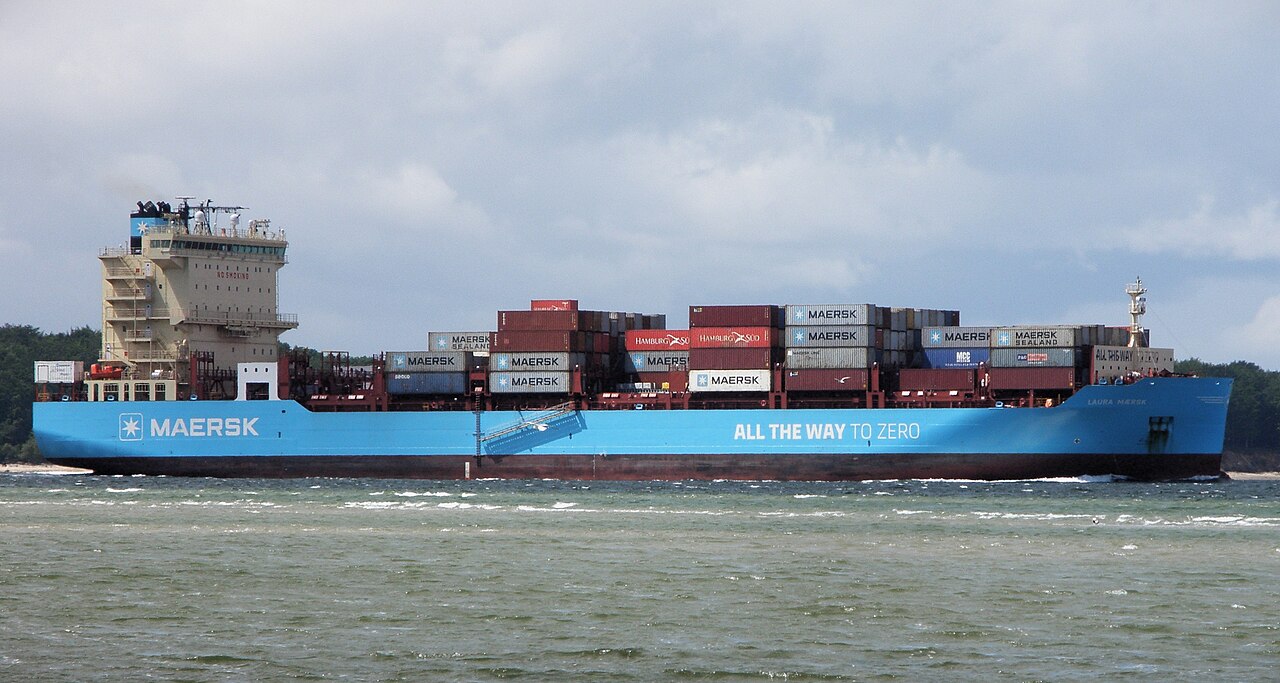
Laura Maersk, photographed in Kiel Fjord in June 2024, supplies a real container-shipping example. An exterior photograph cannot identify the fuel being burned at that moment.
Siegbert Brey / Wikimedia Commons · Image source · CC BY-SA 4.0

A ship can possess an advanced methanol engine and still spend much of its working life consuming a different fuel. That gap between capability and operation is the central engineering question in the latest wave of methanol shipping. In May 2025, MAN Energy Solutions announced an exceptionally powerful methanol-capable engine for large container vessels. European Energy brought its Kassø e-methanol project through production milestones during the same year. Maersk's 2025 Green Finance Report, approved in February 2026, then supplied a sobering operational detail: limited availability and cost meant a significant share of methanol operations used fossil-derived methanol. The useful story connects all three parts.
A large engine proves a bounded capability
MAN's 20 May 2025 announcement described a two-stroke methanol engine rated at 82,440 kilowatts and 80 revolutions per minute, with delivery planned for June. It was intended for the first of twelve 24,000-container-capacity vessels then under construction. The company also reported substantial accumulated methanol operating experience across its engine family. This supports a claim about industrial engine maturity. The announcement by itself does not establish delivery of every vessel, its annual fuel mix or its lifecycle emissions.
At a basic mechanical level, the low rotational speed and very large power indicate why the propulsion system cannot be evaluated like a small road engine. Torque equals power divided by angular speed. Using the announced rating gives approximately 9.84 million newton-metres, an independently calculated value. That figure is a scale illustration, not a measured shaft-load history. Bearings, torsional behaviour, shafting and propeller matching all belong to the system delivering useful thrust over a voyage.
Liquid fuel still occupies valuable space
Methanol's attraction includes handling it as a liquid under ordinary storage conditions, but liquid storage alone does not make tank integration trivial. The ship needs sufficient usable energy for the intended route, along with reserve, protected tank locations, piping, ventilation and access for maintenance. Changing the fuel can therefore affect cargo space, structural arrangements and the ship's mass distribution. A naval architect must work from the actual voyage requirement rather than a nominal engine rating.
An independent comparison makes the logic visible without assuming a specific vessel. Suppose a candidate fuel supplies half the usable energy per cubic metre of the existing fuel, while engine efficiency remains unchanged. Matching voyage energy would require about twice the usable tank volume. If efficiency changes, the volume ratio changes with it. Tank geometry and permitted fill level matter too. This is why a fuel conversion can become a ship-layout project even when the underlying engine family is familiar.
A shutdown must leave the ship manageable
The International Maritime Organization's December 2020 interim guidelines for ships using methyl or ethyl alcohol remain an important technical background document. They address containment, ventilation, leak detection, monitoring and protective actions. They also require designers to consider whether safety actions could create an unacceptable loss of power. That combination is important: preventing a fuel incident and preserving the ship's ability to respond are coupled requirements, rather than independent boxes on a checklist.
Consider a conceptual leak alarm during a harbour manoeuvre. Simply closing every fuel valve might remove the immediate fuel source but also deprive the ship of propulsion when control is most important. A real design needs analysed transitions, redundancy and procedures appropriate to its architecture. This example is explanatory, not an operating instruction. The engineering challenge is to define safe states that remain safe in the surrounding maritime situation, including the behaviour of auxiliary electrical generation and essential services.
A fuel plant has several firsts
European Energy reported its first industry-grade e-methanol batch at Kassø on 3 April 2025, following earlier raw-methanol production. The reported purity exceeded 99.85%. The project's own chronology records its official opening on 13 May 2025. These are meaningful production and commissioning milestones. Neither the first batch nor an opening ceremony is, by itself, evidence of sustained annual output at nameplate capacity or reliable deliveries across an entire shipping network.
The distinction resembles the difference between starting an engine and completing a long endurance programme. A synthesis plant has to coordinate hydrogen supply, carbon-dioxide quality, reaction conditions, separation and product storage. Material that leaves a reactor is not necessarily finished marine fuel. Water and other constituents must be controlled to a specification, and sampling must continue when feedstocks or operating loads vary. A repeatable process is more valuable to a ship operator than an isolated high-quality sample.
The 2026 report exposes the fuel constraint
Maersk's report for 2025, approved on 5 February 2026, described nineteen dual-fuel methanol vessels in operation after ten deliveries during the reporting year. It also stated that a significant share of 2025 operation relied on grey methanol because bio-methanol and e-methanol were expensive and scarce. The report explained that fossil-derived grey methanol can have higher lifecycle greenhouse-gas emissions than conventional bunker fuel and adjusted its impact accounting accordingly. Capability clearly did not guarantee a low-emission fuel supply.
That disclosure changes what a useful fleet metric looks like. Counting methanol-capable ships measures installed flexibility. Counting tonnes of verified low-emission fuel consumed measures how much that flexibility has been used for decarbonisation. Both numbers are useful, but they answer different questions. A ship's engine can be an enabling asset while the bottleneck sits ashore. The engineering response is to connect procurement contracts, bunker logistics, fuel records and actual engine operation into one auditable operational picture.
Follow the carbon through the whole chain
E-methanol combines hydrogen and a carbon source, so its environmental performance depends on more than the final molecule. Producing hydrogen requires energy; collecting and preparing carbon dioxide also uses equipment and energy. Transport and storage add further steps. Once burned, the fuel releases its carbon. The relevant comparison therefore follows the full pathway from resource production to useful propulsion, often called a well-to-wake assessment.
Imagine two identical ships each consuming the same quantity of chemically equivalent methanol. If one supply chain uses carbon-intensive electricity and the other uses additional low-emission electricity, their engines cannot reveal that difference from the molecule alone. Conversely, a favourable certificate cannot compensate for poor engine efficiency or unrecorded fossil-fuel use. This example explains why physical fuel quality and sustainability traceability must travel together. Neither should be inferred from the vessel's paint scheme or its dual-fuel designation.
The route is part of the fuel system
A reliable methanol route needs more than a single production plant and a single capable ship. It needs compatible bunkering arrangements, sufficient delivery frequency, buffers against delays and a plan for ports where the preferred fuel is unavailable. Dual-fuel machinery can protect commercial continuity, but continuity may come at the cost of a different emissions outcome. That tradeoff should appear in scenario planning rather than only in an annual explanation after the fuel mix has changed.
For an illustrative scheduling exercise, assume a service requires one delivery every seven days and the supply chain can occasionally slip by four days. A storage buffer that covers only two days leaves an operational gap even if average annual production is sufficient. Increasing nominal plant output does not automatically close that gap. Delivery variability, maintenance outages and berth availability all shape usable supply. Such calculations are ordinary logistics engineering, but they determine whether a new propulsion technology achieves its intended purpose.
What would demonstrate system-level progress
The strongest next reports would combine vessel fuel consumption by pathway, verified supply-chain emissions, operational availability and the cost of delivering the fuel to the ship. Engine performance should be reported over representative loads, while production facilities should distinguish nameplate capacity from delivered, specification-compliant tonnes. Safety experience also deserves structured reporting, including equipment faults and the performance of protective systems. These are proposed evaluation criteria, not claims that every operator already publishes them.
Methanol shipping has moved far enough that purely hypothetical descriptions are inadequate. Large engines, commissioned production equipment and operating vessels are real industrial developments. The outstanding question is how consistently those pieces work together with genuinely lower-emission fuel. Evaluating that connection avoids dismissing useful engineering progress while also avoiding the assumption that a fuel-ready vessel is automatically a climate result. The decisive unit is a reliably completed voyage with a documented energy and emissions history.
Sources & further reading
Primary papers, project documentation, and research releases used in this article. Publication dates below refer to the sources themselves.
- World’s Most Powerful Methanol Engine AnnouncedMAN Energy SolutionsPublished Checked
- A.P. Moller - Maersk 2025 Green Finance ReportA.P. Moller - MaerskPublished Checked
- Kassø e-methanol facility produces industry-grade e-methanol for the first timeEuropean EnergyPublished Checked
- Kassø E-methanol FacilityEuropean EnergyChecked
- Interim guidelines for the safety of ships using methyl/ethyl alcohol as fuel (MSC.1/Circ.1621)International Maritime OrganizationPublished Checked
FOLLOW THE QUESTION
Explore engineering