ENGINEERING
Cold-climate heat pumps: what field performance actually measures
New 2026 field studies connect cold-weather heat-pump performance to defrost, auxiliary heaters, and installation details that a headline rating cannot capture.
Research checked
Newest cited publication
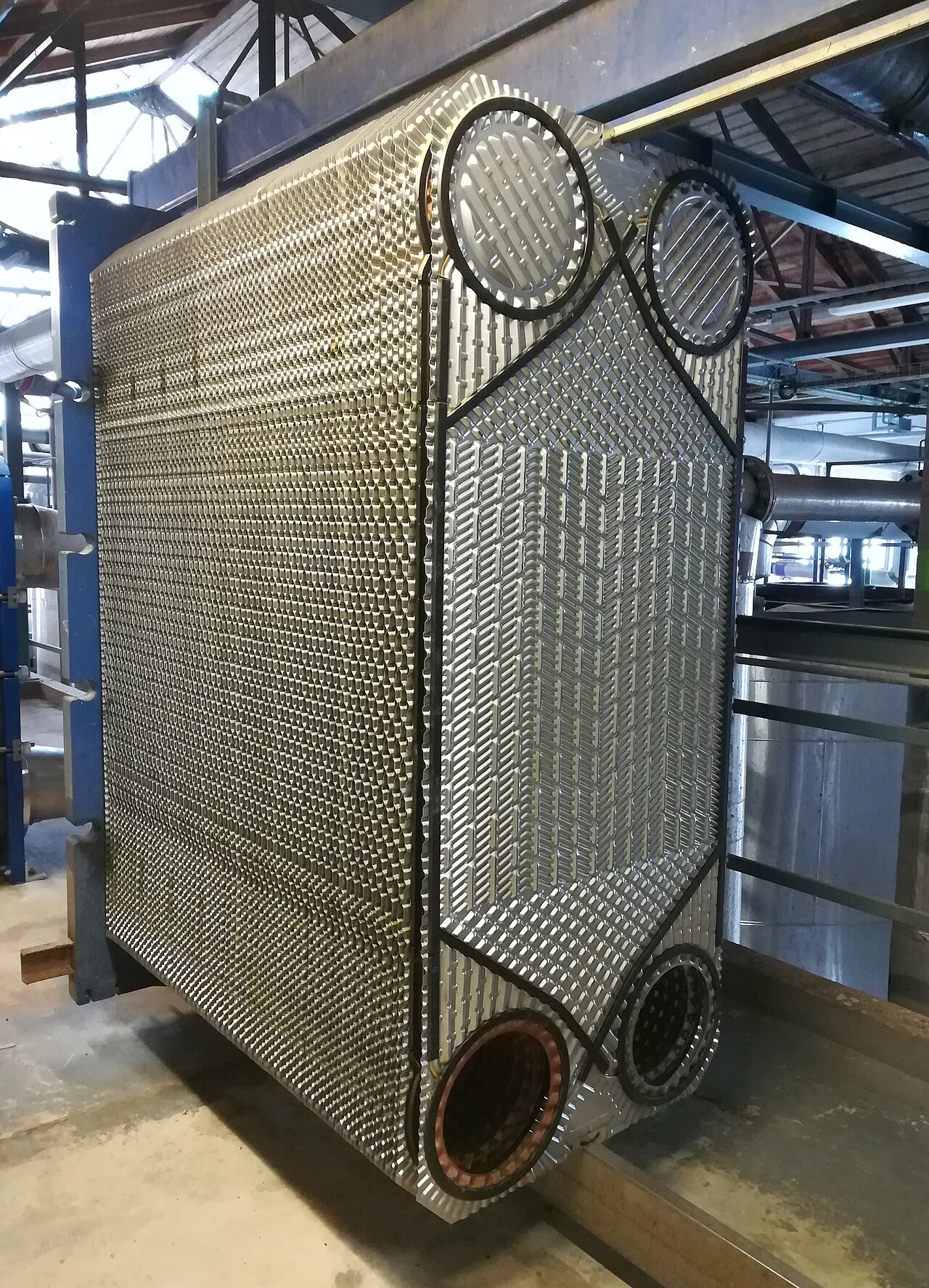
A plate heat exchanger provides background for engineered heat transfer; the heat-pump field measurements discussed here involve complete refrigeration systems.
RomanM82 / Wikimedia Commons · Image source · CC BY-SA 4.0

A heat pump does not stop finding heat merely because outdoor air feels cold to a person. The real engineering problem is how much heat it can deliver, how much electricity it needs, and what happens during interruptions such as defrosting. Those questions are increasingly being answered in occupied buildings rather than only in controlled laboratory chambers. Two 2026 publications sharpen the picture: a Canadian comparison follows complete operating modes, while an American study examines defrost behavior at twenty-two residential sites. Together they make a useful case for reading field performance as a sequence of operating states, not as one flattering efficiency number.
What the new field results actually establish
A conference paper published on May 26, 2026 by Jeremy Sager and Amr Daouk reports CanmetENERGY's evaluation of three Cold Climate Heat Pump Challenge systems. The climate-bin analysis found seasonal heating coefficients of performance more than twenty percent higher than two previously monitored commercial comparison systems. Two challenge systems achieved a coefficient of performance of 1.8 at minus 26 degrees Celsius when all operating modes were included. This is evidence from those systems and the stated analysis, not a guarantee for every home or product sold under a cold-climate label.
A separate March 23, 2026 paper by Kevin Keene and colleagues studies defrost at twenty-two homes using pre-commercial challenge units. Defrost was more prevalent at higher humidity and between roughly minus twelve and minus one degrees Celsius. Median changes in average room temperature stayed below about six-tenths of a degree Celsius across the strategies examined, yet supply-air temperatures could become low when the indoor fan ran without substantial auxiliary heat. Comfort at a vent and average room temperature are therefore different observations.
Capacity and efficiency answer different questions
Heating capacity is a rate: how many kilowatts of heat reach the home. Coefficient of performance, usually shortened to COP, is a ratio: useful heating output divided by electrical input over a declared interval. A system can have an attractive COP while delivering insufficient heat for the building's coldest hour. Conversely, resistance heaters can deliver plenty of heat while pulling the combined system's COP toward one. A fair assessment needs both quantities at relevant outdoor conditions.
Consider an illustrative building needing nine kilowatts during a particular cold hour. A heat pump providing six kilowatts at a COP of two draws three kilowatts of electricity. If resistance heat supplies the missing three kilowatts, total output is nine and electrical input is six, giving a combined COP of 1.5. Reporting only the compressor's COP would conceal the additional demand. These are simple example values rather than figures from the field papers. They show why the boundary around a performance calculation matters as much as its decimal precision.
Why frost turns efficiency into a control problem
In heating mode, an outdoor coil must be colder than the air from which it collects heat. Under suitable moisture conditions, frost accumulates on that surface and makes heat exchange harder. Reverse-cycle defrost temporarily redirects heat toward the coil. Defrosting too late allows the obstruction to worsen; defrosting too early wastes time and energy on a surface that may not need clearing. The 2026 American paper observed apparently unnecessary cycles in some units, while explicitly noting that the researchers did not have access to manufacturers' proprietary control algorithms.
An engineering controller faces imperfect evidence. Outdoor temperature does not directly measure ice thickness, and humidity alone does not establish whether a coil has become restrictive. A temperature difference, pressure change, or trend in output might add useful information, but each sensor introduces cost and failure modes. The appropriate next step is a controlled comparison showing that a proposed trigger reduces total energy while clearing the coil reliably. A more elaborate algorithm is valuable only when it improves that practical outcome across wet, dry, windy, and transitional conditions.
The building and installation set the boundary
A January 2025 Pacific Northwest National Laboratory report documents the broader challenge field validation conducted during 2022–2024. This older program context helps explain what the later analyses are examining: prototype technologies tested in real homes, after laboratory qualification. A prototype's field record should not be silently treated as a ranked shopping list for current equipment, because manufacturers may revise hardware or controls before commercial release.
The heat delivered indoors also depends on airflow, duct resistance, leakage, and the location of sensors and equipment. For example, an undersized return path can increase fan work and alter the heat exchanger's operating conditions. A house with several poorly connected rooms can experience uncomfortable differences even if a central thermostat is satisfied. Building heat loss changes with outdoor temperature, wind, and occupancy. These effects make installation quality a physical part of the system rather than a cosmetic detail added after choosing the machine.
Read the meter before accepting the average
An annual efficiency should be calculated from total useful heating divided by total electrical energy, not by averaging a collection of instantaneous COP readings. Imagine one period delivering ten kilowatt-hours of heat using two kilowatt-hours of electricity and another delivering ten using five. Their COP values are five and two, whose simple average is 3.5. The correct combined ratio is twenty divided by seven, about 2.86. An unweighted average overstates performance because it ignores the different energy inputs.
Field instrumentation needs similar care. The sensible heat delivered by an air stream depends on mass flow, specific heat, and the supply-to-return temperature difference. If airflow is estimated rather than measured continuously, uncertainty in that estimate propagates into heating output. A brief fan transition can complicate comparisons made immediately before and after defrost. The most helpful reports state their sampling interval, calibration approach, missing-data rules, auxiliary loads, and uncertainty. This information allows readers to distinguish a well-characterized difference from one that could be explained by measurement choices.
What the next round of evidence should resolve
The coldest temperature recorded during a winter is not necessarily the temperature at which a study has enough operating hours to make a robust comparison. A useful next field program would deliberately recruit diverse humidity regimes and building types, preserve data through extreme events, and report comfort alongside electrical peaks. It would also track maintenance and control updates, because the same model name can conceal meaningful changes in real behavior. Several winters would provide a better reliability picture than one successful cold spell.
For the engineering reader, the current message is encouraging and specific. The Canadian evaluation demonstrates improved performance for its tested challenge systems, while the American work identifies defrost decisions as a continuing opportunity. Neither removes the need to match capacity to a building or to count auxiliary consumption honestly. Progress becomes clearer when heat pumps are evaluated as complete installed systems with changing operating modes. That perspective connects laboratory innovation to the things residents actually experience: rooms remaining comfortable, predictable electrical demand, and equipment returning smoothly to heating after a frosty interval.
Sources & further reading
Primary papers, project documentation, and research releases used in this article. Publication dates below refer to the sources themselves.
- Cold climate field evaluation of high performance air to air heat pump systems developed through the cold climate heat pump challenge programIEA Heat Pumping Technologies TCPPublished Checked
- Evaluating the impacts of defrost mode in cold climate residential heat pumpsEnergy EfficiencyPublished Checked
- Performance Results from DOE Cold Climate Heat Pump Challenge Field ValidationPacific Northwest National LaboratoryPublished Checked
FOLLOW THE QUESTION
Explore engineering