ENGINEERING
Desalination design beyond a better membrane: energy, fouling, and operating conditions
Rice’s 2026 membrane research agenda and industry collaboration connect molecular transport with the practical demands of desalination, brine management, and reuse.
Research checked
Newest cited publication
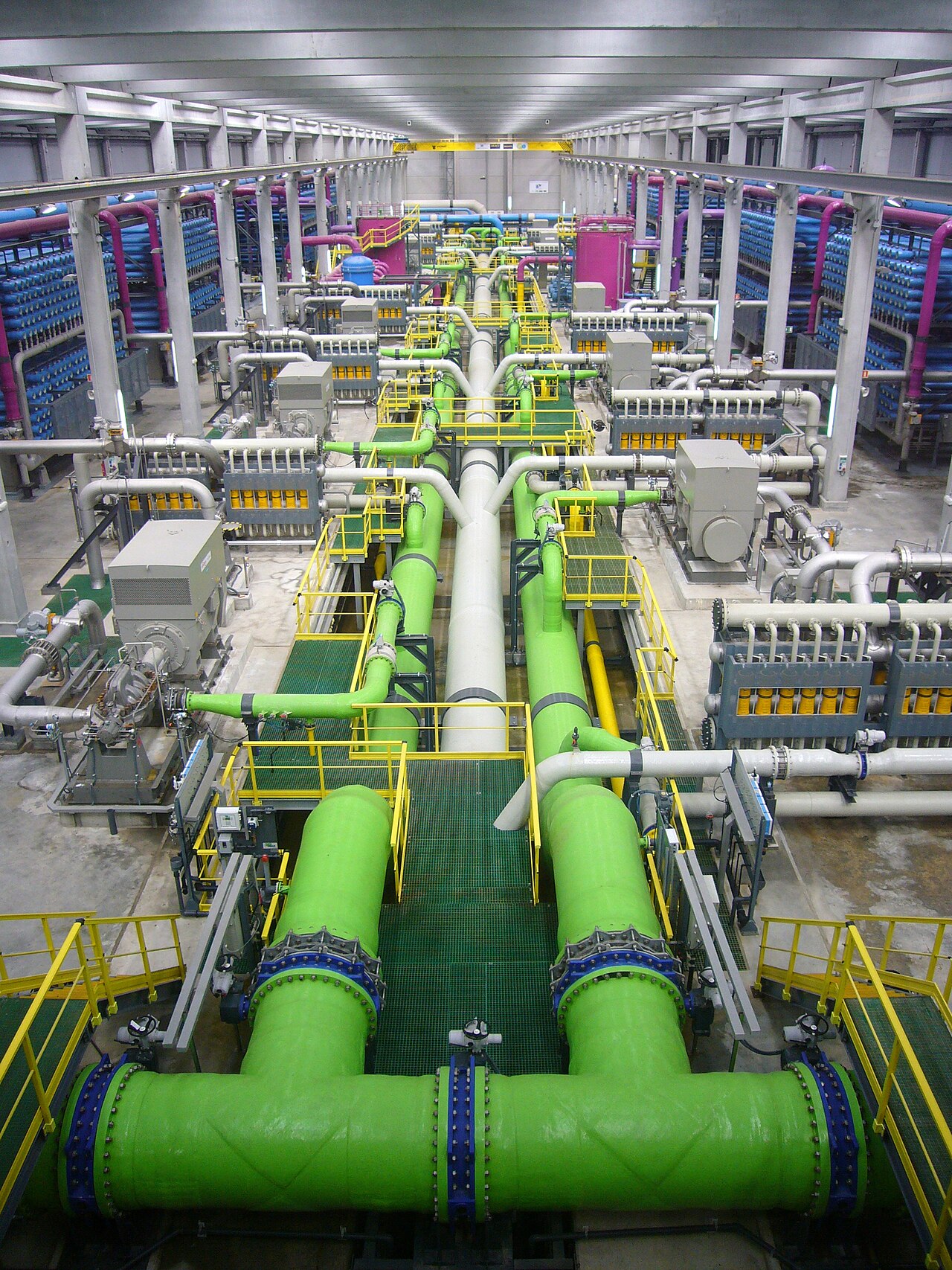
Membrane pressure vessels at the El Prat desalination plant show the system surrounding a reverse-osmosis membrane, including the hardware that must operate reliably at scale.
James Grellier / Wikimedia Commons · Image source · CC BY-SA 3.0

A desalination membrane is a remarkably thin component inside a much larger machine. Its chemistry determines what passes through, but pumps, pretreatment, cleaning, energy recovery, and brine handling determine whether the entire process works well. Two Rice University developments in 2026 make that connection timely: a February research perspective on membrane transport and a March collaboration with water-treatment company IDE Technologies. Neither announcement is a claim that a new universal membrane has entered every plant. They describe a scientific agenda and a route for testing practical systems. Understanding why they matter requires following water from the molecular scale to the operating plant, while keeping permeability, selectivity, energy, and reliability as separate engineering quantities.
A 2026 agenda for connecting scales
Rice’s February 18, 2026 account describes an invited Nature Water perspective that brings together molecular simulation, experiments in well-defined nanoscale channels, and advanced measurements of membrane structure. The proposed strategy moves from simple channels to model membranes and then toward more complex commercial materials. That is a research roadmap, not a newly reported full-scale desalination efficiency record. Its value is the attempt to explain observed performance using structures and transport mechanisms rather than treating the membrane as a mysterious fitted coefficient.
A well-defined channel offers a controlled experiment: change its width or surface chemistry and observe what happens. A manufactured sheet contains a distribution of pathways, defects, and local environments, so the same explanation must eventually survive that complexity. Scale-bridging research asks which microscopic features remain important after averaging over the real material. The most useful model is not necessarily the most detailed one. It is the model that predicts an independent change in operating conditions, with a stated range of validity and uncertainty.
Pressure is useful only after paying the osmotic cost
Reverse osmosis pushes water through a selective membrane against the tendency for a concentrated solution to draw in water. Engineers therefore distinguish the applied pressure from the effective driving force available for transport. As salt concentration rises, the osmotic contribution becomes more important. A membrane with higher water permeability can reduce some pressure losses or permit less membrane area, but it does not eliminate the thermodynamic work associated with separating water from salt.
A simplified dimensional example helps. A membrane with a permeability of two liters per square meter per hour per bar, operated at an effective driving pressure of ten bar, would ideally pass twenty liters per square meter per hour under that linear description. Doubling the effective pressure would double that modeled flux, but only if other effects stayed unchanged. A real plant must also account for concentration changes, flow distribution, fouling, and mechanical limits. The calculation explains one coefficient; it is not a prediction of total plant electricity consumption.
Why the transport mechanism still matters
Yale’s April 2023 account of experiments and molecular simulations argues for a pressure-driven picture of water movement through connected membrane pores, contrasting it with assumptions in the conventional solution-diffusion explanation. The researchers describe clustered water movement and comparisons involving viscosity and molecular size. This is older foundational work relevant to the 2026 agenda. It should not be presented as a new 2026 discovery, nor does a theoretical disagreement mean engineers suddenly stopped being able to operate existing plants.
The practical issue is how a model guides material changes. If a manufacturer alters polymer chemistry, the sheet may change its water pathways, swelling, mechanical response, and ion interactions together. A fitting equation can describe the old sheet accurately yet mispredict the new one if it hides those coupled changes. Direct measurements and molecular calculations can help identify which explanation remains consistent. A useful engineering model earns trust by predicting changes that were not used to tune its parameters.
Cleaning compatibility is part of selectivity
A Yale and Nanjing research announcement from April 2024 describes a polyester reverse-osmosis membrane designed to resist chlorine, fouling, and scaling while maintaining useful water and salt separation. The work responds to a practical tension: disinfectants can help control biological growth, while familiar polyamide membrane chemistry can be vulnerable to chlorine exposure. The report describes experimental materials and a potentially adaptable fabrication route, rather than documenting years of operation in a commercial seawater plant.
This is why the best membrane is not simply the one with the largest clean-water flux on its first day. A sheet that tolerates the necessary cleaning regime may spend more time producing water and less time being replaced. Conversely, an initially selective film can become unattractive if its performance deteriorates rapidly. A good comparison should track rejection and permeability after realistic exposure sequences, with changes in chemical conditions, mechanical pressure, and cleaning frequency. Those trajectories matter more to an operator than a single pristine-sample measurement.
A plant sees a different feed from a laboratory vial
As water crosses a membrane and rejected salt remains on the feed side, the liquid immediately beside the surface can become more concentrated than the bulk stream. This concentration polarization changes the local driving conditions and can increase the likelihood of mineral deposition. Good module design therefore couples material properties with flow channels, spacers, and crossflow. A membrane cannot be evaluated independently of how the surrounding liquid is delivered and removed.
An illustrative operating decision shows the trade-off. Increasing crossflow may reduce the concentration buildup near the surface, but circulating more liquid also requires pumping. Raising water recovery produces more useful water from a given feed volume, but leaves a more concentrated residual stream. These are optimization problems rather than instructions to maximize every desirable metric simultaneously. A fair test reports feed composition, temperature, recovery, pretreatment, and the energy boundary, making clear whether the number covers only a membrane stage or the complete process.
A route from specimens to operating constraints
The March 24, 2026 Rice–IDE announcement identifies joint work on desalination, brine management, resource recovery, and other treatment problems. It describes a planned test-bed system, technical exchange, and work spanning laboratory analysis and techno-economic assessment. The initial focus includes existing IDE treatment approaches and research into further processes. The announcement establishes the collaboration’s intended scope; it does not itself report a completed test bed or independently verified gains from a newly commissioned system.
Such a partnership can be valuable because academic and operating questions are often different. A laboratory team may ask which polymer arrangement improves ion rejection. An operator may ask whether a treatment train can recover after a feed upset, whether a replacement part is available, or how much a cleaning interruption costs. Bringing these questions together early can prevent a technically elegant component from solving the wrong bottleneck. It also creates an opportunity to publish well-characterized failures, which are essential for understanding the operating envelope.
Measure useful water over time
My proposed comparison is straightforward: evaluate the delivered water quality and quantity over a representative operating period, then include all required energy, chemicals, consumables, and residual handling. Record the downtime and recovery after disturbances. For a high-recovery process, include what happens to the increasingly concentrated brine. For a chlorine-resistant material, include repeated cleaning cycles. This makes the claimed advantage correspond to a service the plant actually provides, while leaving room to distinguish scientific promise from demonstrated operation.
The 2026 developments are encouraging because they connect levels of the same problem. Molecular studies can reveal why a particular pathway admits water or rejects ions. Material experiments can test chemical resilience. A treatment test bed can expose feed variability and operational constraints. None makes the others unnecessary. Better desalination will come from selecting improvements that remain valuable after those levels are joined, and from publishing enough operating context that another engineer can tell where the improvement should work next.
Sources & further reading
Primary papers, project documentation, and research releases used in this article. Publication dates below refer to the sources themselves.
- New Rice-led perspective charts path to next-generation water and energy membranesRice UniversityPublished Checked
- Rice WaTER Institute and IDE Technologies collaborate to advance water treatment solutionsRice UniversityPublished Checked
- Greater access to clean water, thanks to a better membraneYale UniversityPublished Checked
- Upending a decades-long theory of reverse osmosis water desalinationYale UniversityPublished Checked
FOLLOW THE QUESTION
Explore engineering