ENGINEERING
The engineering tradeoffs inside rare-earth-free electric motors
Renault’s 2025 production examples and 2026 motor roadmap show how wound rotors trade magnet dependence for excitation, cooling and manufacturing complexity.
Research checked
Newest cited publication
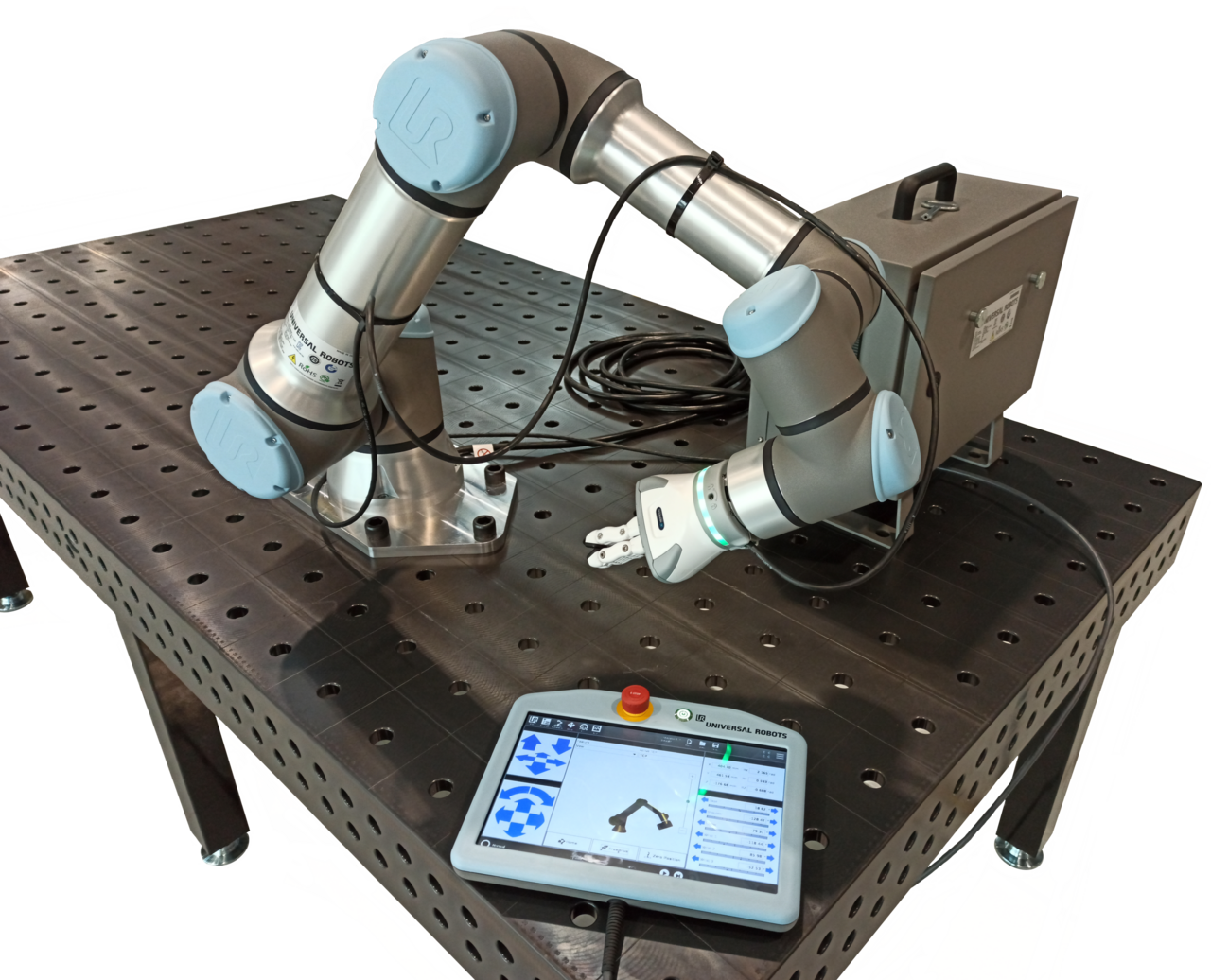
An industrial manipulator provides electromechanical context for controlled motion; the electric-vehicle motor designs discussed here have different duty cycles and architectures.
Auledas · Image source · CC BY-SA 4.0

Removing rare-earth magnets from an electric vehicle motor does not remove magnetism. It changes how the machine creates and controls its magnetic field. That distinction sits at the centre of Renault's continuing work on electrically excited synchronous motors. The company documented production examples in October 2025 and described another generation in its 2026 technology roadmap. Its July 2026 manufacturing discussion reaffirmed the wound-rotor approach. These are useful industrial primary sources, although future performance figures remain company targets rather than independently measured production results. The engineering question is what has to replace the permanent magnet, and whether the complete drive system benefits over the vehicle's actual working life.
The rotor still needs a magnetic field
A motor's stationary part, the stator, creates a changing magnetic field. In a synchronous machine, the rotor's magnetic pattern follows that rotating field at the corresponding speed. Permanent-magnet machines obtain rotor excitation from magnets. Electrically excited synchronous machines instead create the rotor field using current in windings. Renault's technical explanations describe this approach as an alternative already used in its vehicles. The absence of rare-earth magnets is therefore a production design choice, not a purely speculative laboratory idea.
The important physical change is controllability. A wound rotor can adjust its excitation, while a permanent magnet supplies a field without needing rotor-winding current. Neither arrangement eliminates losses elsewhere in the machine. Both still require carefully designed steel, conductors, insulation, bearings and power electronics. Calling the alternative magnet-free can be useful shorthand, but the precise claim concerns permanent magnets in the traction motor. It should not be expanded into an unsupported claim that every component in the vehicle contains no rare earths.
Current hardware and future targets are different evidence
Renault's 16 October 2025 account identified the Renault 5 and Renault 4 as users of a 110-kilowatt electrically excited motor. Its 2026 technology roadmap describes development of a third-generation wound-rotor motor, targeting 275 horsepower, 93% efficiency at highway operating conditions and an integrated 800-volt electronics architecture. These numbers refer to a development roadmap. They do not establish that every future vehicle will achieve the same efficiency, or that the whole vehicle converts 93% of battery energy into road motion.
This distinction also prevents comparisons between incompatible measurements. A peak motor efficiency, an efficiency at one highway operating point and a whole-drive efficiency over a driving cycle are three different quantities. A careful comparison states where electrical input and mechanical output were measured and includes the operating speed, torque and temperature. Without those boundaries, a small difference in a headline percentage can conceal a much larger difference in what was actually included.
Controllable flux comes with an energy bill
Wound excitation introduces rotor copper loss. The elementary relationship is current squared multiplied by resistance: doubling current, with resistance unchanged, produces four times the resistive heating. A motor designer therefore does not simply maximise rotor current. The controller must select an excitation level that helps produce the requested torque while limiting losses and respecting temperature. This physical explanation is general motor analysis, rather than a claim about Renault's undisclosed control maps.
An independent example illustrates the accounting. Suppose two hypothetical motors deliver 40 kilowatts mechanically. At 94% efficiency, electrical input is about 42.55 kilowatts and loss is 2.55 kilowatts. At 92%, input is about 43.48 kilowatts and loss is 3.48 kilowatts. The difference is around 0.93 kilowatts at that point. These assumed efficiencies are not product specifications. They show why even a modest percentage change affects cooling, battery consumption and the interpretation of a motor comparison.
One efficient point cannot describe a journey
An electric vehicle accelerates, climbs, cruises, coasts and recovers energy through regenerative braking. Its motor consequently visits many combinations of speed and torque. The useful measure is an efficiency map combined with the time spent at each point. A machine optimised for sustained high-speed operation may make a different compromise from one intended mainly for urban driving. The roadmap's emphasis on highway efficiency should be read in that operating context.
Controllable excitation can help tailor flux as speed changes, but the benefit must be assessed alongside the current used to create it. During weak-load operation, fixed losses become relatively important. At high output, current limits and thermal constraints can dominate. A fair evaluation integrates the map over representative journeys and includes the inverter, transmission and auxiliary demands where relevant. It should also report whether a quoted result was obtained cold, after thermal stabilisation or during a short burst.
The hard part rotates at speed
Putting windings on the rotor creates mechanical and thermal design obligations. Conductors and insulation must remain secure under centrifugal loads and repeated thermal expansion. Heat has to leave a rotating assembly while clearances and bearing conditions remain acceptable. Supplying excitation to a rotating part also requires an engineered transfer arrangement. Different manufacturers can choose different solutions, so none should be assumed from the phrase electrically excited alone.
These interfaces explain why component-level simplicity can be misleading. Removing one material dependency may introduce manufacturing steps, joining operations and new inspection requirements. A compact layout that performs well in a prototype must also tolerate production variation. Designers need margins for winding placement, electrical insulation, balance and cooling passages. The decisive question is whether those margins can be maintained over many units and many kilometres, rather than whether an isolated motor can briefly deliver its rated power.
A motor strategy is also a factory strategy
In its 15 July 2026 discussion of the electric-vehicle transition, Renault highlighted its long-running rare-earth-free wound-rotor expertise and the role of French development and manufacturing sites. This is the manufacturer's account of its industrial strategy, not an independent audit of every claimed cost or environmental advantage. It nevertheless identifies an important point: choosing a motor architecture commits a company to skills, tooling, inspection and supplier relationships as well as electromagnetic performance.
A production engineer evaluates winding repeatability, impregnation or insulation processes, joining quality, assembly time and end-of-line testing. Yield matters. A design that uses inexpensive materials can still be costly if it produces many rejected assemblies or needs slow inspection. Equally, a more complex process can become competitive when accumulated experience makes it repeatable. The practical tradeoff is architecture plus manufacturing capability, rather than a comparison of raw-material prices in isolation.
What a convincing comparison would publish
A useful public test would compare machines intended for the same vehicle duty, with the same cooling boundary and an explicitly defined drive cycle. It would publish continuous output as well as peak output, because thermal endurance determines how long useful performance lasts. The data should include excitation power, inverter losses, temperature rise and uncertainty in torque and electrical measurements. A supply-chain claim would additionally state exactly which materials and components are included.
Durability deserves similar care. A short dynamometer run establishes that a motor functions under its tested conditions. A validation programme needs repeated temperature changes, vibration, moisture exposure and representative electrical stresses. The appropriate sequence depends on the design. These are proposed comparison criteria, not assertions that the cited roadmap supplies such a dataset. Their purpose is to make a future claim assessable by someone who does not have access to the manufacturer's internal development programme.
A useful alternative does not need to win every metric
Rare-earth-free motors can broaden the choices available to vehicle designers and reduce reliance on a particular class of permanent magnets. Their value need not depend on being smallest, cheapest and most efficient at every operating point simultaneously. A manufacturer may accept one compromise to gain control of materials, maintain a familiar factory process or optimise a particular vehicle segment. Those priorities should be stated openly so that the resulting design can be judged against its actual purpose.
The 2025 production examples show that wound-rotor traction is established hardware. The 2026 roadmap shows that development continues, while leaving future performance to be demonstrated in the intended vehicles. The substantive engineering story is the replacement of a passive magnetic component with a controlled electrical and thermal subsystem. Whether that exchange is attractive depends on the complete motor, its manufacturing process and the journeys it must perform.
Sources & further reading
Primary papers, project documentation, and research releases used in this article. Publication dates below refer to the sources themselves.
- All about electric motors with no rare earthsRenault GroupPublished Checked
- Tech-ready: accelerating innovationRenault GroupChecked
- Powering innovation through the EV transitionRenault GroupPublished Checked
- How does an electric car motor work?Renault GroupPublished Checked
FOLLOW THE QUESTION
Explore engineering