ENGINEERING
Elastocaloric cooling: the engineering between a clever alloy and a refrigerator
New 2026 elastocaloric prototypes widen the design space, but useful refrigeration still depends on heat exchange, mechanical work, fatigue, and temperature lift.
Research checked
Newest cited publication
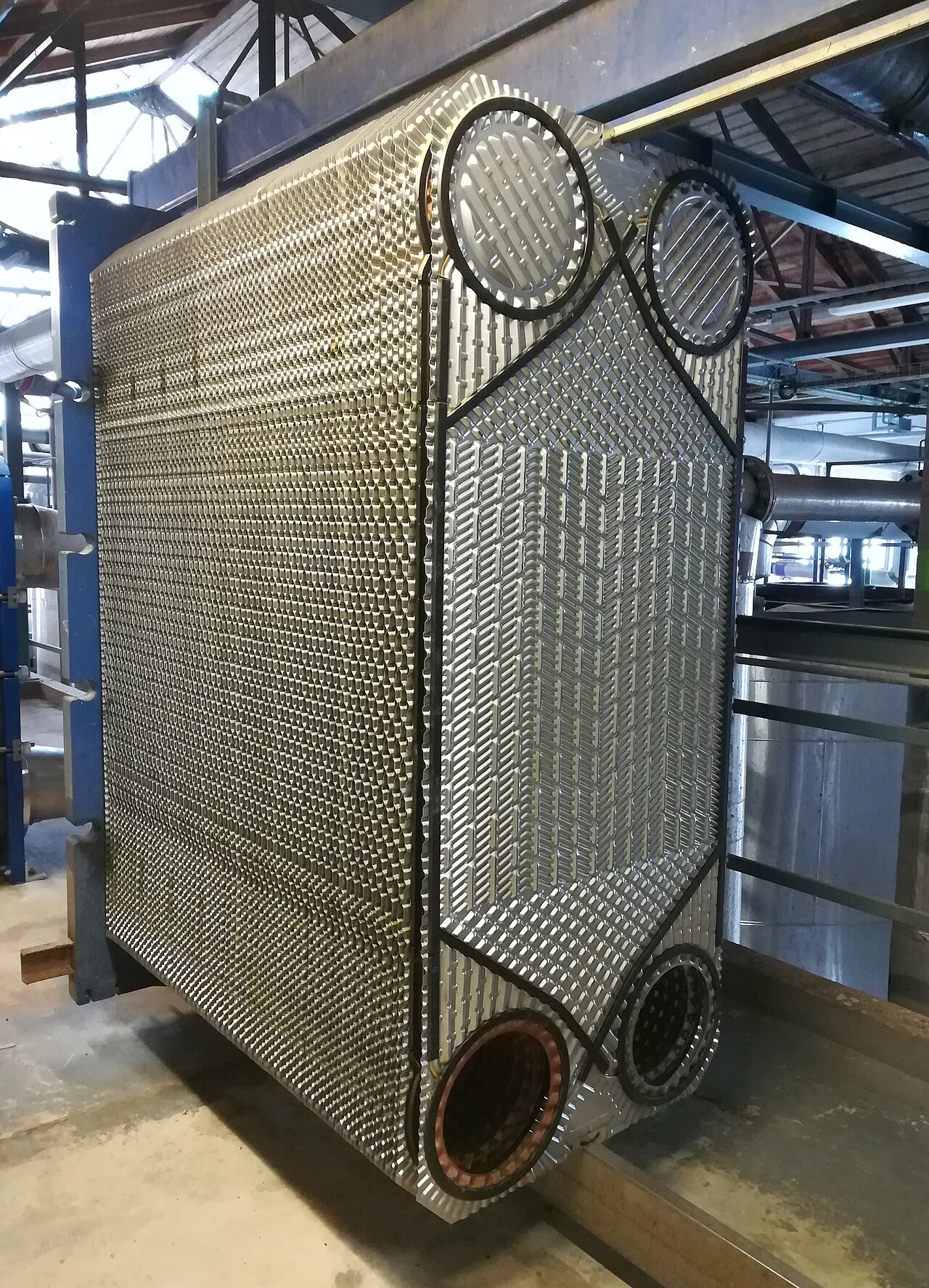
A plate heat exchanger illustrates why useful cooling requires a path for moving heat. Elastocaloric regenerators add the cycling material and flow sequence examined in the text.
RomanM82 / Wikimedia Commons · Image source · CC BY-SA 4.0

A shape-memory alloy can warm when mechanical stress changes its crystal structure and cool when that stress is released. It is an intriguing route to refrigeration because the active material is a solid rather than a circulating volatile refrigerant. Yet watching a sample cool is only the first step toward a machine that keeps something else cold. The engineering challenge is to transfer heat in the correct direction, repeat the transformation efficiently, and maintain useful output over a temperature difference. Research from 2025 and 2026 shows progress at several different scales, making careful comparisons more valuable than a single claim that conventional refrigerators are about to disappear.
A 2026 prototype uses heat to create the motion
A Nature Energy paper published on August 28, 2026 by Yi-Ting Hsiau and colleagues describes a heat-driven elastocaloric system made with shape-memory films. One thermally activated element provides mechanical actuation for another cooling element. Under electrically supplied heating of the actuator, the researchers report a film-level temperature span of 12.9 kelvin and a device-level span of 4.0 kelvin. With an external heat source, the reported device span is 2.2 kelvin. Those are prototype results under different drive conditions; they should not be merged into one best-case specification.
The approach is interesting because actuation is part of the machine, not an invisible laboratory accessory. Replacing a bulky electrical actuator with a thermally driven element changes the energy pathway and packaging problem. It does not make the refrigerator energy-free: heat enters, mechanical work occurs, and heat must still leave at the warm side. Whether the concept is useful will depend on the available heat source, the required cooling temperature, and how much cooling is delivered continuously relative to the complete input.
A material result opens a window rather than defining a machine
Another 2026 paper, published in Nature Communications on April 27, investigates a titanium–aluminium–chromium alloy with an unusually broad elastocaloric operating range. It reports a directly measured room-temperature temperature change near ten kelvin and a material coefficient of performance of 4.6. The authors distinguish their integrated material metric across temperature from the actual refrigeration capacity of a single-stage device. Its title refers to exceeding a conventional Clausius–Clapeyron-based prediction, not to escaping conservation of energy or the second law of thermodynamics.
A broad material window can help a designer choose operating temperatures or construct stages that cooperate. But a single sample's temperature excursion does not specify how quickly a food container will cool. That requires a rate of heat removal, an exchanger, a drive mechanism, a temperature lift, and insulation. Material-level performance can identify a promising ingredient while leaving system losses unresolved. This difference is familiar elsewhere in engineering: a high-efficiency solar cell is valuable, but it is not an installed power plant with wiring, maintenance, and weather exposure included.
Cooling power and temperature lift need a map
A February 26, 2025 Nature paper by Guoan Zhou and colleagues reported a multi-cell nickel–titanium device producing 1,284 watts on the fluid side at zero temperature lift during the initial five hundred thousand cycles. The architecture puts mechanical cells in series while keeping fluid paths parallel. This demonstrates substantial cooling power under the stated condition. Zero lift means that the headline power should not be read as the heat-removal rate available across any desired temperature difference.
An illustrative refrigerator might remove one hundred watts while keeping its cold side twenty kelvin below its warm side. Another might remove three hundred watts only when both sides are nearly at the same temperature. Neither number alone establishes the better product. Plotting cooling power against lift at several input powers produces a more useful operating map. A clear comparison also identifies whether the drive, pumps, fans, controls, and heat leaks are included. A small material sample and a complete household appliance have profoundly different measurement boundaries.
Regeneration makes the timing matter
A regenerative device can use a temperature gradient within the machine to extend its useful lift. During one part of a cycle, the active material exchanges heat with fluid moving in one direction; during another, the motion and material state change. If the timing is wrong, heat can return toward the side that should remain cold. Faster cycling can increase potential output, but it leaves less time for heat transfer and can increase pressure losses and mechanical demands.
Imagine an alloy element capable of exchanging ten joules per cycle under ideal conditions. At two cycles per second, that suggests twenty watts before losses. If only half the available heat is exchanged before the next transformation, the delivered rate falls to ten watts. Doubling frequency would not necessarily restore twenty watts because the exchanged fraction might fall further. These are invented values for explaining the trade-off. They show why geometry, surface area, channel size, and phase timing can matter as much as the temperature change measured in a fast material test.
Fatigue is a property of the assembled machine
An April 28, 2025 Nature Sustainability paper explores an all-solid cooler using a non-reciprocal heat-transfer arrangement. Its prototype reported 174.8 milliwatts of cooling and more than two million operating cycles without failure under compressive loading designed to resist buckling. This emphasizes a different design goal from the kilowatt device: controlling heat-transfer direction and demonstrating repeated device operation. Milliwatts, watts, and cycle counts should remain visible when discussing the result.
Cycle count also needs a time conversion. Two million cycles at one cycle per second would represent about twenty-three days of continuous cycling; the same count at a different frequency represents a different duration. That example is not a reconstruction of the paper's operating schedule. It explains why an appliance lifetime requires both cyclic and calendar evidence. A machine has joints, load paths, thermal contacts, bearings, and seals in addition to an alloy. A material that survives repeated transformation can still be part of a device whose actuator or exchanger needs frequent service.
What convincing commercial proof would add
The next decisive experiments would demonstrate a declared cooling duty over realistic ambient conditions with every required energy input measured. They would report startup, part-load behavior, acoustic output, maintenance, and the ability to recover after power interruption. Where a heat source drives the machine, its temperature and availability should be recorded alongside electrical consumption. Where a liquid loop transfers heat, its pump power should be counted rather than assigned to an unspecified laboratory support system.
The recent results expand the space of possible machines: heat-driven films address actuation, the titanium alloy explores operating range, multi-cell architecture increases useful material mass, and directional heat transfer tackles cycle losses. These are complementary research directions rather than a ranking based on one spectacular metric. A practical elastocaloric refrigerator will combine several such advances while meeting an ordinary user's cooling requirement reliably. The most interesting transition will be from impressive pieces of the cycle to a complete machine whose performance can be reproduced on a bench, in a room, and over years of service.
Sources & further reading
Primary papers, project documentation, and research releases used in this article. Publication dates below refer to the sources themselves.
- Heat-driven elastocaloric cooling with shape memory filmsNature EnergyPublished Checked
- Enhanced elastocaloric cooling beyond Clausius–Clapeyron limitsNature CommunicationsPublished Checked
- Achieving kilowatt-scale elastocaloric cooling by a multi-cell architectureNaturePublished Checked
- Sustainable all-solid elastocaloric cooler enabled by non-reciprocal heat transferNature SustainabilityPublished Checked
FOLLOW THE QUESTION
Explore engineering