ENGINEERING
How fast railway measurements become maintenance decisions
Rail monitoring combines vibration, optical inspection and temperature data. Recent projects show why an accurate sensor still needs an actionable maintenance process.
Research checked
Newest cited publication
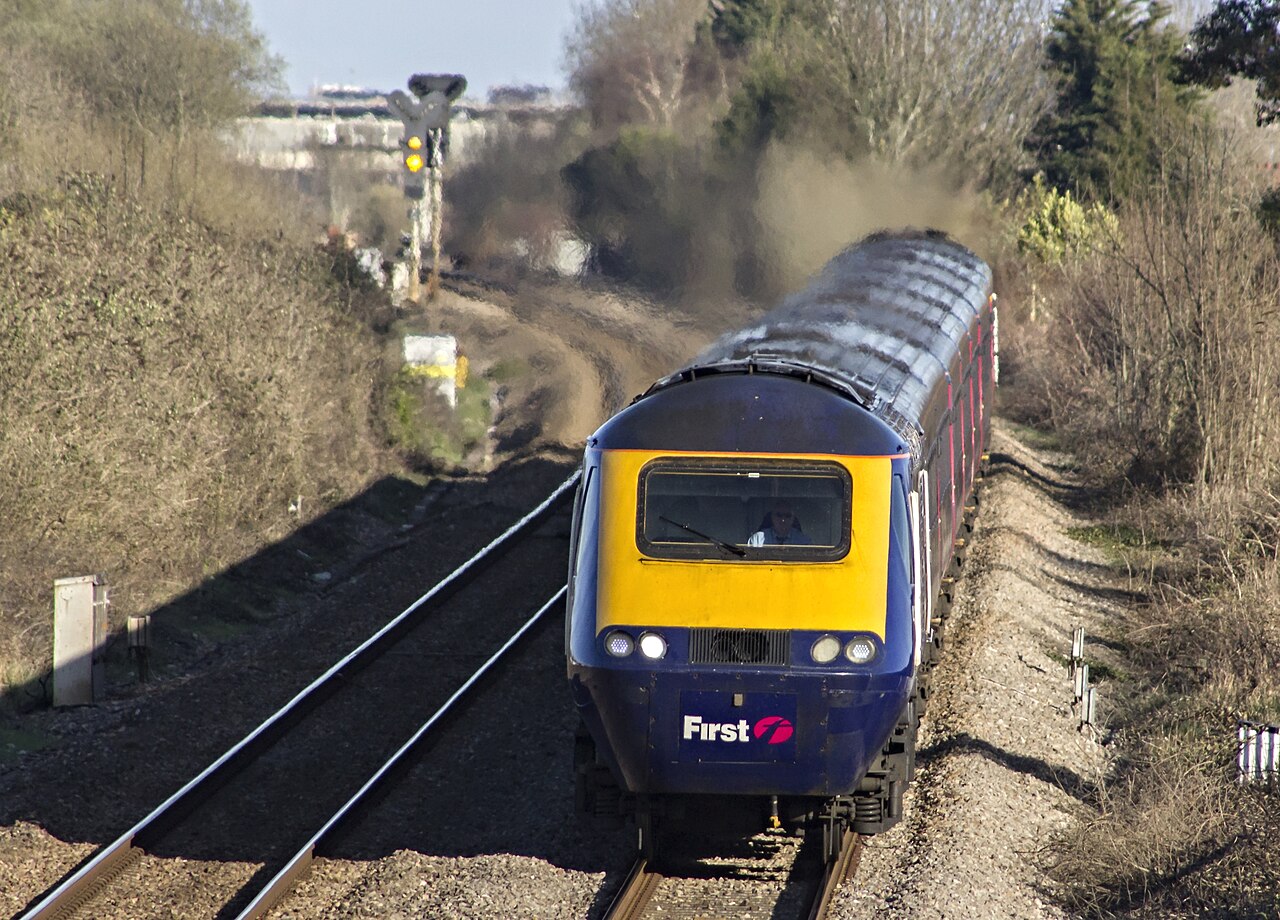
A British High Speed Train photographed in Cardiff in 2016 illustrates railway hardware. The monitoring methods examined here infer condition from the measurements identified in the text.
Jeremy Segrott / Wikimedia Commons · Image source · CC BY 2.0

At 300 kilometres per hour, a train covers more than 83 metres each second. A short irregularity in the track can therefore produce a brief, information-rich event that a human observer cannot examine as it passes. High-speed railway maintenance depends on converting such measurements into a trustworthy account of where a problem is, how it is changing and when somebody must act. Recent developments include Network Rail's June 2025 account of remote rail-temperature sensing and a June 2026 research agreement between SNCF and the French Alternative Energies and Atomic Energy Commission, CEA. The technologies differ, but their common challenge is making evidence useful before a defect becomes disruptive.
A research agreement is not a deployed safety system
CEA announced on 29 June 2026 that it and SNCF had signed a five-year technology-cooperation agreement earlier that month. The stated research areas include sensor-fusion localisation, robotics, trustworthy artificial intelligence and railway-asset maintenance. This establishes an active research direction. It does not establish that a newly validated autonomous maintenance system has entered service across France's high-speed network. The distinction protects an interesting programme from a much stronger claim than its announcement supports.
Existing monitoring systems provide a useful operational reference. Network Rail describes measurement trains, track imagery and remote condition monitoring as inputs to its insight decision-support tool. These examples concern the British network, with its own infrastructure and operating conditions. They should not be treated as interchangeable with French high-speed operation. Comparing them is useful for understanding the measurement-to-action chain, while the performance of any particular system still needs evidence from its intended railway.
Speed turns spatial detail into a sampling problem
Network Rail's New Measurement Train records track condition at speeds up to 125 miles per hour, approximately 201 kilometres per hour. Its documented equipment includes optical rail-profile measurements and accelerometers that observe vehicle motion. It is an established inspection platform, rather than a new 2026 invention. The practical advantage is obtaining measurements while moving through the network, with follow-up inspections and repairs handled through the maintenance process.
An independent sampling example shows the design pressure at higher speeds. At 300 kilometres per hour, resolving samples every 0.1 metre requires about 833 samples per second per channel. That sampling interval does not guarantee detection of every 0.1-metre defect: sensor bandwidth, filtering and the shape of the signal also matter. The arithmetic simply converts distance into time. A specification written only in samples per second can be misleading unless it also states train speed and the spatial features the system must resolve.
An accelerometer measures a response
A vibration sensor mounted on a train does not directly report the rail's geometric shape. It measures the response of the vehicle and its mounting location to wheel-rail forces. That response depends on speed, suspension, wheel condition and load as well as track condition. A repeated vibration peak might indicate a track feature, but it could also travel with a particular vehicle. Separating those possibilities requires context, repeated passes or complementary measurements.
This is why optical geometry measurements and mechanical measurements can be valuable together. One characterises visible shape; the other captures how the moving system responds. Agreement strengthens an interpretation, while disagreement can reveal an instrument problem or an overlooked mechanism. The same principle applies to an algorithm trained on one fleet: different suspension dynamics may change its input distribution even when the track defect is similar. Transfer to a different railway needs validation, not merely a compatible file format.
The defect must return to the same place in the data
Condition monitoring becomes predictive only when successive observations can be compared. That requires reliable position alignment. If two runs place the same feature several metres apart in the database, a deterioration model may mistake one defect for two or average it away. Speed estimates, odometry, track references and other localisation signals can help, but each has uncertainty. CEA's stated interest in sensor-fusion localisation is relevant to this wider engineering problem, although the announcement supplies no completed deployment benchmark.
For an illustrative case, imagine a defect extending over two metres and a positional uncertainty of plus or minus three metres. Comparing raw traces at nominal coordinates could make the feature appear to change dramatically between runs. Alignment should occur before a trend is interpreted as deterioration. Data processing also needs to preserve the original observation and the correction applied, so that an engineer can distinguish a change in the track from a change in the mapping software.
Some important faults need a different sensor
Network Rail's 13 June 2025 report describes rail-mounted temperature sensors taking readings every fifteen minutes and transmitting them remotely, with threshold alerts. The purpose is more targeted heat-related restrictions and reduced need for staff to take repeated manual readings. The report described use in some regions and an intention to expand coverage. It should not be read as evidence that every section of the network had continuous remote temperature monitoring.
Temperature sensing illustrates why condition monitoring is not synonymous with vibration analysis. Thermal expansion changes the forces in constrained rail, and the relevant risk also depends on the track's condition and restraint. A hot spot may develop without the same signature as a local geometric defect. Conversely, a safe reading at one site does not establish the temperature several kilometres away under different shading or exposure. Sensor placement is therefore a sampling problem across space as well as time.
A useful alarm has a maintenance horizon
Network Rail describes insight as a decision-support system combining multiple data streams to anticipate faults and help teams plan work. That is an operational claim by the infrastructure manager, rather than an independently reproduced benchmark of every prediction. To judge a predictive-maintenance model, one needs more than the fraction of correctly labelled examples. The timing of the warning, the severity of missed defects and the work created by false alarms all matter.
Suppose a hypothetical model detects ninety out of one hundred developing faults but produces ten thousand unnecessary inspections. Another detects slightly fewer while providing more usable lead time and far fewer false alerts. Neither can be judged from detection rate alone. The appropriate decision depends on consequence, inspection capacity and permitted response time. Railway maintenance also includes rare, high-consequence conditions for which historical data may be sparse. Human review and established inspection rules remain important parts of the decision process.
The maintenance organisation closes the loop
An alert does not tighten a fastener, restore ballast support or inspect a rail. It must identify a location and asset, communicate urgency and reach a team with the right access and equipment. The work may require a possession of the line, a temporary restriction or coordination with other planned tasks. A technically accurate prediction that arrives after the next feasible maintenance window may have much less value than an earlier, less precise indication.
Closing the loop also creates better evidence. After an inspection or repair, the system should record what the team actually found and what changed. That result can confirm a prediction, expose an error or reveal a new failure mode. Without this feedback, a database of algorithmic alerts can gradually be mistaken for a database of verified defects. The distinction is especially important when later models are trained on the accumulated records. Measurement, interpretation and ground truth should remain distinguishable.
Judge monitoring by the decisions it improves
The most persuasive next evaluation would follow a defined population of assets over time, publish the warning lead times and compare alerts with actual inspections. It would report missed events, false alarms, unavailable sensors and changes in traffic or weather. For high-speed applications, it would also document the intended speed range and vehicle types. These are suggested evaluation requirements, not results supplied by the 2026 cooperation agreement.
The latest projects point toward more connected sensing and analysis, but the enduring engineering task is disciplined decision-making. Optical images, vibration signals, temperature measurements and maintenance records each contain a different piece of the problem. Combining them is useful when the system can explain what was observed, where uncertainty remains and what action follows. A railway gains most from monitoring when a valid measurement becomes timely, verified maintenance that improves the condition of the real track.
Sources & further reading
Primary papers, project documentation, and research releases used in this article. Publication dates below refer to the sources themselves.
- Le groupe SNCF et le CEA signent un accord-cadre de coopération technologique pour accélérer l’innovation ferroviaireCEAPublished Checked
- Smart sensors, fewer delays: tackling heat on the tracksNetwork RailPublished Checked
- New Measurement Train (NMT)Network RailChecked
- insight – using AI to run a reliable railwayNetwork RailChecked
FOLLOW THE QUESTION
Explore engineering