ENGINEERING
Why sustainable aviation fuel is an aircraft integration problem
New fuel research connects aircraft compatibility, combustion chemistry and contrails. What recent flight tests establish, and what certification still needs to prove.
Research checked
Newest cited publication
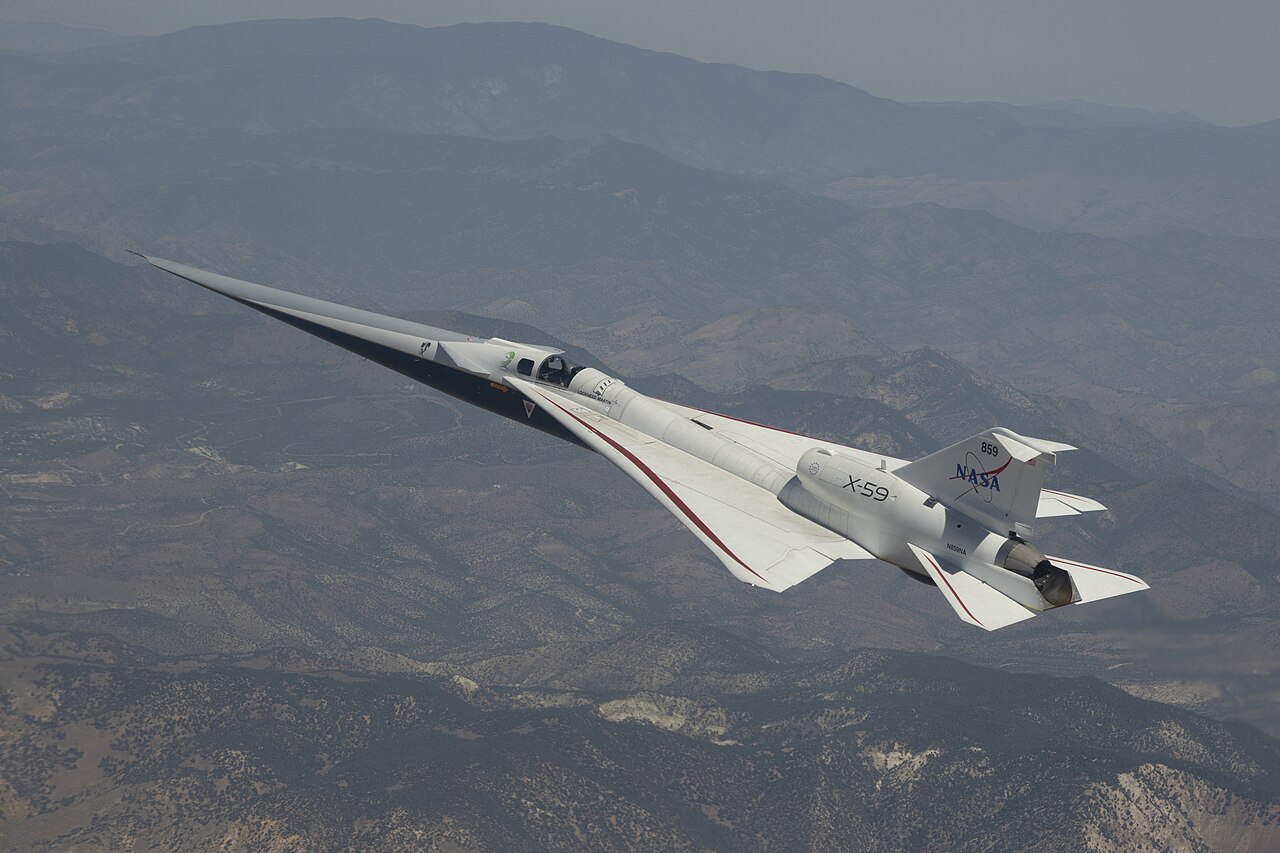
NASA’s X-59 research aircraft provides aviation context; the photograph does not establish which fuel it used or demonstrate sustainable-fuel performance.
NASA / Jim Ross · Image source · Public domain (US government / NASA)

An aircraft does not experience the sustainability label on a fuel delivery. It experiences density, viscosity, temperature, chemical composition and the reliability of every component between the tank and the flame. That is why sustainable aviation fuel, usually shortened to SAF, remains an engineering integration problem even when its molecules resemble conventional kerosene. Airbus reported an expansion of SAF use at its Canadian assembly site in March 2025. More recently, an April 2026 German Aerospace Center report complicated the relationship between cleaner combustion and contrails. Together, these developments make a useful starting point for asking what a different fuel must actually demonstrate.
A delivery milestone has a specific meaning
On 20 March 2025, Airbus announced that SAF deliveries to its Mirabel A220 site completed the introduction of SAF into internal operations across its commercial aircraft assembly sites. The release described blending and auditable mass-balance accounting at the site's fuel farm. It also stated that the A220 could operate with blends containing up to 50% SAF, while operation with up to 100% remained a company objective for 2030. The headline's reference to worldwide delivery-centre capacity must therefore be read alongside the actual blending limits.
These are distinct accomplishments. A fuel-farm operation demonstrates that procurement, handling, sampling and records can function within existing operations. An aircraft approval establishes a permitted envelope for particular equipment and fuel specifications. A research flight explores an envelope that may require special permissions and instrumentation. Treating all three as interchangeable would hide the very work needed to move from an interesting experiment to routine service. A credible progress report should say which of these boundaries has moved.
The fuel system is a chain of tolerances
Consider an independent design exercise in which two candidate fuels have equal energy per kilogram but one has 3% less mass per litre. A tank filled to the same volume then carries roughly 3% less chemical energy, before accounting for temperature or unusable fuel. That does not automatically make the fuel unsuitable. It changes the relationship between volume indication, dispatch planning and range. Conversely, a fuel with good volumetric energy might still pose a problem if its low-temperature behaviour moves outside a component's tested operating envelope.
A systems review follows the whole path: storage, transfer, pumping, filtration, metering, heat exchange and injection. Fuel can also act as a thermal sink, so thermal management belongs in that review. Interfaces are particularly important. A seal that behaves acceptably in a short test may need much longer exposure and repeated thermal cycles before its service behaviour is understood. This is an engineering checklist for evaluating candidates, rather than a claim that the Mirabel programme measured every item.
The 2026 finding changes a simple assumption
On 1 April 2026, DLR reported results from the NEOFUELS/VOLCAN campaign, whose measurement flights took place in spring 2023. Researchers sampled exhaust and contrails behind an A321neo with lean-burn engines. Under low-soot conditions, substantial ice-crystal numbers persisted. Volatile particles offered an additional formation pathway, and fuel sulphur, organic compounds and lubrication-oil vapours mattered. This was a flight-measurement result with supporting simulations, not a demonstration that a particular airline could eliminate contrail warming by changing fuel alone.
The distinction matters because a proxy can stop being predictive when a system enters a new regime. If one population of particles is suppressed, another can become relatively important. An instrument that counted only the first population might then make an intervention appear more effective than the atmosphere actually experiences. The wider lesson for engineering is to measure the downstream outcome as well as the mechanism being modified. A successful component improvement can expose a previously secondary process.
Test the fuel and the combustor together
The PACIFIC project, documented by DLR with a running period from January 2025 to June 2028, studies how fuel composition and engine-cycle conditions influence particulate emissions and climate effects. Its controlled combustor tests compare fuel variants while holding boundary conditions constant. This is an active research programme. Its existence does not establish that all fuel-composition questions have been resolved or that one formulation will perform identically in every engine.
A useful experimental matrix changes one variable at a time before exploring interactions. Fuel composition, inlet pressure, inlet temperature and operating point may each alter the result. Repeating only a favourable cruise condition leaves takeoff, descent and transients unresolved. Conversely, a ground rig is valuable precisely because it can repeat conditions more cleanly than a flight campaign. The two approaches answer complementary questions: controlled testing identifies mechanisms, while flight measurements check whether those mechanisms remain decisive in the real plume.
Lifecycle savings need their own evidence
Fuel compatibility and greenhouse-gas accounting answer different questions. The first asks whether equipment can use a fuel safely within a defined envelope. The second follows resources, processing energy and transport through a supply chain. Burning a carbon-containing alternative still releases carbon dioxide at the aircraft. Any lifecycle advantage depends on where that carbon came from and what happened while the fuel was produced. A label on an invoice cannot substitute for that chain of evidence.
For example, suppose an illustrative supply chain emits 20 units before combustion and another emits 60, with identical use-stage emissions. A calculation that stops at the airport would miss the entire difference. Equally, a favourable upstream calculation does not establish low contrail warming on a particular route. The time scales and physical mechanisms differ. A strong aircraft-integration programme therefore keeps compatibility, lifecycle carbon and non-carbon climate effects visible as separate measurements, even when an eventual decision combines them.
Scale brings a quality-assurance problem
EASA's first ReFuelEU Aviation Annual Technical Report, released on 22 October 2025, established a reporting baseline using 2024 data. Suppliers reported SAF as 0.6% of aviation fuel supplied at Union airports. The agency also described concentrated supply and incomplete first-year reporting. Those observations are historical measurements of a young supply system; they are not measurements of the October 2026 market. They show why production capacity, delivered fuel and verified consumption should be reported separately.
The engineering inference is that scale requires repeatable quality across batches and locations. A laboratory can thoroughly characterise a small sample. An operating network needs procedures that continue to work when deliveries are frequent, tanks contain mixtures and equipment changes hands. Sampling frequency, traceability and contamination controls become as consequential as a single impressive engine test. If bookkeeping allocates sustainability attributes by mass balance, the physical fuel-quality checks still need to protect every aircraft receiving the blend.
What a persuasive next demonstration would contain
A useful next-stage report would publish an explicit test envelope, the fuel properties sampled, the equipment configuration and any departures from routine operation. It would distinguish a pass at the tested point from a justified claim over a wider envelope. Engineers would also want uncertainty estimates and unsuccessful or limiting conditions. Otherwise, a result can be technically correct while leaving operators unable to tell whether it applies to their own fleet or climate.
The same discipline applies to environmental measurements. A contrail study benefits from simultaneous weather observations, a clearly identified engine operating mode and instruments that can distinguish particle populations. A fuel-handling study benefits from batch records and repeat sampling. Neither needs to pretend to settle the entire aviation transition. Narrow, reproducible answers accumulate into a much stronger basis for deployment than a single headline that compresses safety, emissions, cost and supply into one percentage.
An integration problem can still be tractable
The practical appeal of kerosene-like alternatives is that much existing aircraft infrastructure can remain useful. That is a considerable advantage, but it makes precise qualification more valuable, not less. A programme can preserve a familiar architecture while changing the allowed chemistry, sourcing and climate response. The work then shifts toward understanding variation, proving margins and maintaining evidence across a long supply chain.
The current research points toward a careful sequence: establish fuel quality, validate equipment compatibility, measure combustion and atmospheric behaviour, then confirm that delivery and reporting systems work repeatedly. This sequence is an analytical recommendation, not an announced certification schedule. It makes room for genuine progress without erasing unresolved questions. The most useful measure of success is an aircraft-and-fuel combination whose performance is understood across its intended operation and whose environmental claims can be traced to measurements.
Sources & further reading
Primary papers, project documentation, and research releases used in this article. Publication dates below refer to the sources themselves.
- Airbus Canada rolls out sustainable aviation fuel, unlocking 100% SAF capacity across all delivery centres worldwideAirbusPublished Checked
- EASA publishes report on Sustainable Aviation Fuel scale-up, progress and pressure pointsEuropean Union Aviation Safety AgencyPublished Checked
- Contrails – beyond sootGerman Aerospace CenterPublished Checked
- Climate Impact of Sustainable Aviation Fuel VariantsGerman Aerospace CenterChecked
FOLLOW THE QUESTION
Explore engineering