ENGINEERING
Why Bigger Offshore Turbines Need Better Reliability Evidence
Recent blade tests and a new turbine prototype reveal why offshore wind needs evidence about fatigue, access and maintenance as machines grow larger.
Research checked
Newest cited publication
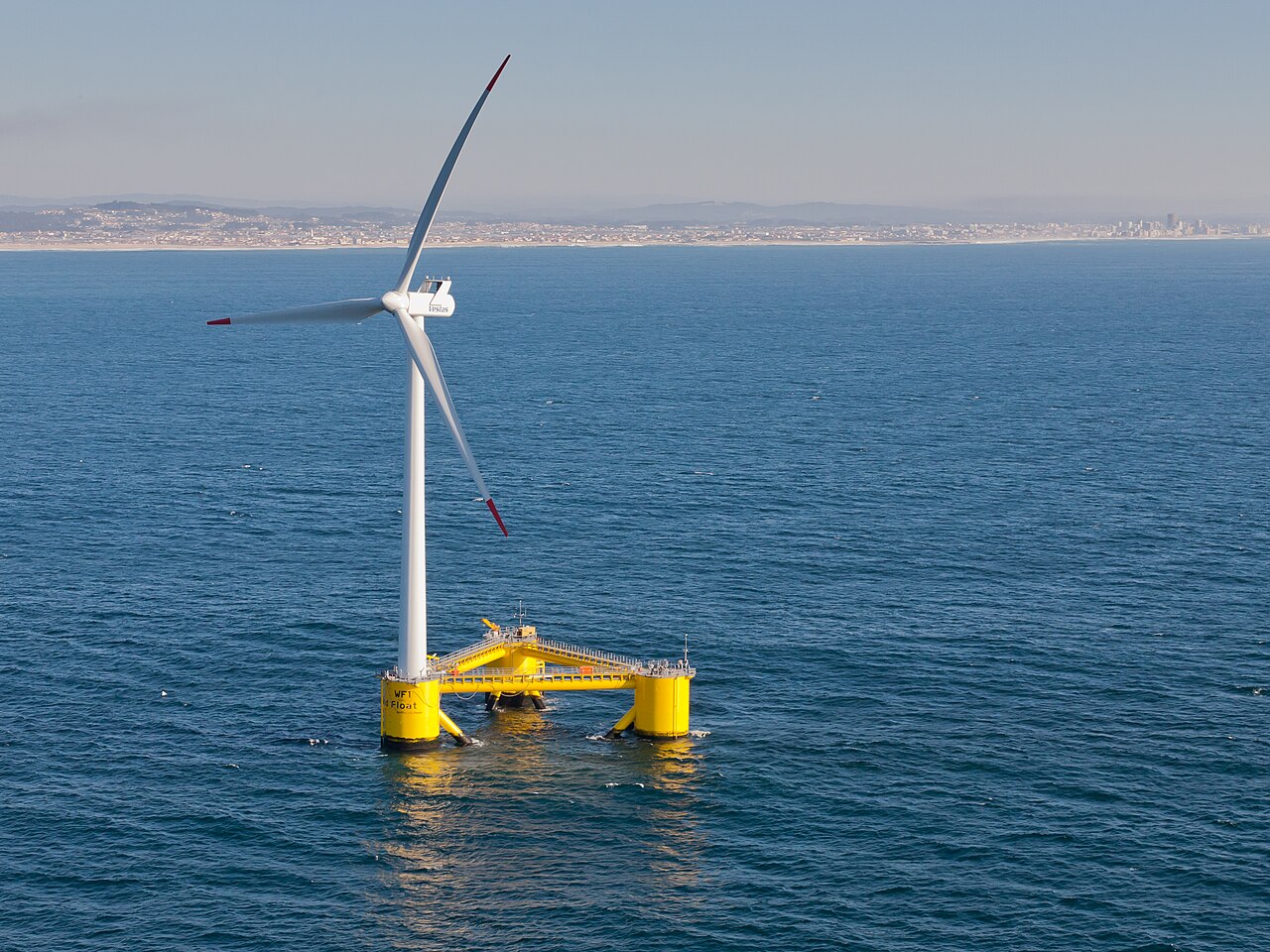
The 2 MW WindFloat prototype photographed in 2012 illustrates offshore foundations and turbine access. Today’s much larger machines impose different reliability and service demands.
Untrakdrover / Wikimedia Commons · Image source · CC BY-SA 3.0

The most interesting question about a larger offshore wind turbine is often what happens after its first electricity reaches the grid. A prototype can establish that a machine works; a fleet must establish how consistently it works, what fails and how quickly repairs can happen at sea. Recent developments illuminate different parts of that gap. ORE Catapult and RWE reported blade life-extension testing in September 2025, while Siemens Gamesa’s HIPPOW project describes a new offshore turbine prototype intended to validate technology before series production. Read together, these sources point toward an engineering priority: growth in machine size needs a corresponding growth in the quality of reliability evidence.
Larger rotors change more than rated power
The first scaling argument is straightforward. A rotor’s swept area grows with the square of its radius, so increasing radius by ten percent increases area by twenty-one percent. That is a geometric calculation, not a prediction of annual energy: actual production also depends on the wind, power controls and operating limits. Structure does not receive a free benefit from extra area. Aerodynamic forces act across longer lever arms, blades deflect farther, and changes in stiffness can move natural vibration frequencies toward or away from repeated excitation.
This coupling explains why a larger turbine is rarely a simple enlargement of an older one. Keeping every dimension proportional would change mass, stiffness and loading in different ways. Material placement, internal reinforcement and control settings have to evolve together. A control action that reduces one peak load might increase the number of smaller load cycles elsewhere. Evaluating the full load history matters because fatigue responds to repetition and amplitude, whereas an ultimate-strength calculation asks whether an exceptional event exceeds a limit. Both questions are necessary, and neither can stand in for the other.
What a prototype project can and cannot establish
Siemens Gamesa describes HIPPOW as a project for installing, operating and testing a new offshore turbine prototype at Østerild in Denmark. Its public page lists July 1, 2025 as the entry-into-operation date and identifies innovations in bearings, the electrical system, cooling, installation and maintenance. The page presents validation and certification as steps before full-scale production. This is evidence about a development programme and its intended validation scope. It is not a public fleet failure-rate dataset, and a listed project date alone should not be treated as proof of completed long-duration qualification.
A prototype offers unusually rich instrumentation and close access to specialists. Those are strengths for diagnosis, but they can make its operating circumstances different from routine commercial service. A fleet adds manufacturing variation, different installation histories and technicians working within ordinary service constraints. The transition therefore requires traceability: which design revision was tested, what changed before manufacture, and whether the evidence remains applicable afterward. A redesign of a bearing interface or cooling path can alter the failure mechanisms that an earlier test appeared to retire. Configuration control is part of reliability engineering, not paperwork added after it.
A blade test has to reproduce the right damage
ORE Catapult lists full-scale static, fatigue and dual-axis testing, alongside stiffness, natural-frequency and rain-erosion capabilities. Its standard blade test methods follow IEC 61400-23. These capabilities illustrate why a single bend-to-failure demonstration is insufficient. A blade experiences different directions of bending and twisting, and the interactions can matter around joints, adhesive bonds and internal structural transitions. A test that applies a convenient load repeatedly may be precisely repeatable while exercising the wrong damage mechanism. The connection between the test fixture and the intended service load must be demonstrated.
Acceleration creates another tradeoff. Raising load amplitude can shorten a test, but excessive loading can produce a failure mode unlike the one expected during years of service. Engineers must decide which regions of a blade need representative damage, which loads can be combined and how to avoid unrealistic local stress concentrations from the test equipment. Instrumentation then checks the assumptions: measured strains and deflections should match the intended distribution. A successful test is stronger evidence when it validates a predictive model that can explain nearby conditions, rather than becoming an isolated pass certificate with no disclosed context.
Life extension needs an individual asset history
The September 16, 2025 ORE Catapult–RWE announcement reported testing that suggests some blades could operate substantially beyond their originally expected lifespan, in some cases by up to half as much again. The careful word is could. The public release does not establish that every blade design, every installation or every operating history qualifies for the same extension. Its significance is that remaining life can be investigated using evidence instead of assuming a calendar age is a complete diagnosis of structural condition.
Two outwardly similar blades may have experienced different winds, repairs, lightning events and manufacturing defects. Their accumulated damage need not be equal. An extension decision should connect the tested design with inspection findings and the actual load history, then identify what ongoing monitoring would detect a change in condition. Monitoring also has limits: a sensor can only report the quantities and locations it observes. Missing or drifting measurements must not silently become evidence of good health. The practical objective is a defensible estimate of remaining capability, with a plan for how uncertainty will be reduced during continued operation.
Simulating fatigue is useful when assumptions remain visible
A February 2025 preprint by Ding and colleagues studied fatigue reliability for a simulated five-megawatt floating turbine using wind and wave information from a South China Sea site. The authors compared their probability method with Monte Carlo calculations. This is a methodological result for a specified numerical model; it does not supply operating statistics for today’s largest offshore machines. It is nevertheless a useful example of why environmental combinations, including wind–wave direction, belong inside a reliability analysis rather than being replaced by one average weather condition.
Agreement between two computational methods answers a narrow but important question: are they estimating the same modeled quantity consistently? It does not independently establish that the underlying model represents every field mechanism. For that, measured loads and observed damage are needed. A useful validation campaign therefore keeps numerical error, parameter uncertainty and model discrepancy separate. More simulation runs can reduce sampling noise without fixing a missing physical effect. Reporting all three sources of uncertainty helps operators understand which prediction is already trustworthy and which additional measurement would most improve a maintenance decision.
Offshore availability includes the time needed to repair
Reliability measures how often failures occur; availability also depends on how long a machine remains unavailable afterward. An illustrative comparison makes the distinction clear. One hypothetical component fails once in ten years and takes two months to replace; another fails twice in ten years but each repair takes a day. The first component has fewer failures but causes more lost operating time. These invented numbers are not turbine statistics. They show why access, spare parts, lifting requirements and weather windows belong in a design review alongside material strength.
For larger offshore machines, the most persuasive next evidence would connect these layers: representative component tests, controlled prototype measurements, traceable manufacturing and transparent fleet outcomes. The existing public sources reveal active work on several of them, but they do not justify one universal reliability verdict on larger turbines. Progress will be visible when manufacturers and operators can explain failure mechanisms, demonstrate the applicability of tests and shorten restoration time. The engineering achievement is not simply a larger machine that turns. It is a larger machine whose behavior and maintenance needs become more predictable with accumulating evidence.
Sources & further reading
Primary papers, project documentation, and research releases used in this article. Publication dates below refer to the sources themselves.
- Pioneering testing suggests route to significant life extension for turbine bladesORE CatapultPublished Checked
- Turbine Blades | Testing & Validation ServicesORE CatapultChecked
- HIPPOW: Highly Innovative Prototype of the most Powerful Offshore Wind turbine generatorSiemens GamesaChecked
- Fatigue reliability analysis of offshore wind turbines under combined wind-wave excitation via DPIMarXivPublished Checked
FOLLOW THE QUESTION
Explore engineering