ENGINEERING
Co-Packaged Optics Has Become a Packaging and Serviceability Problem
Recent optical-network platforms show why shorter electrical links must be evaluated together with cooling, external lasers, assembly yield, and repair.
Research checked
Newest cited publication
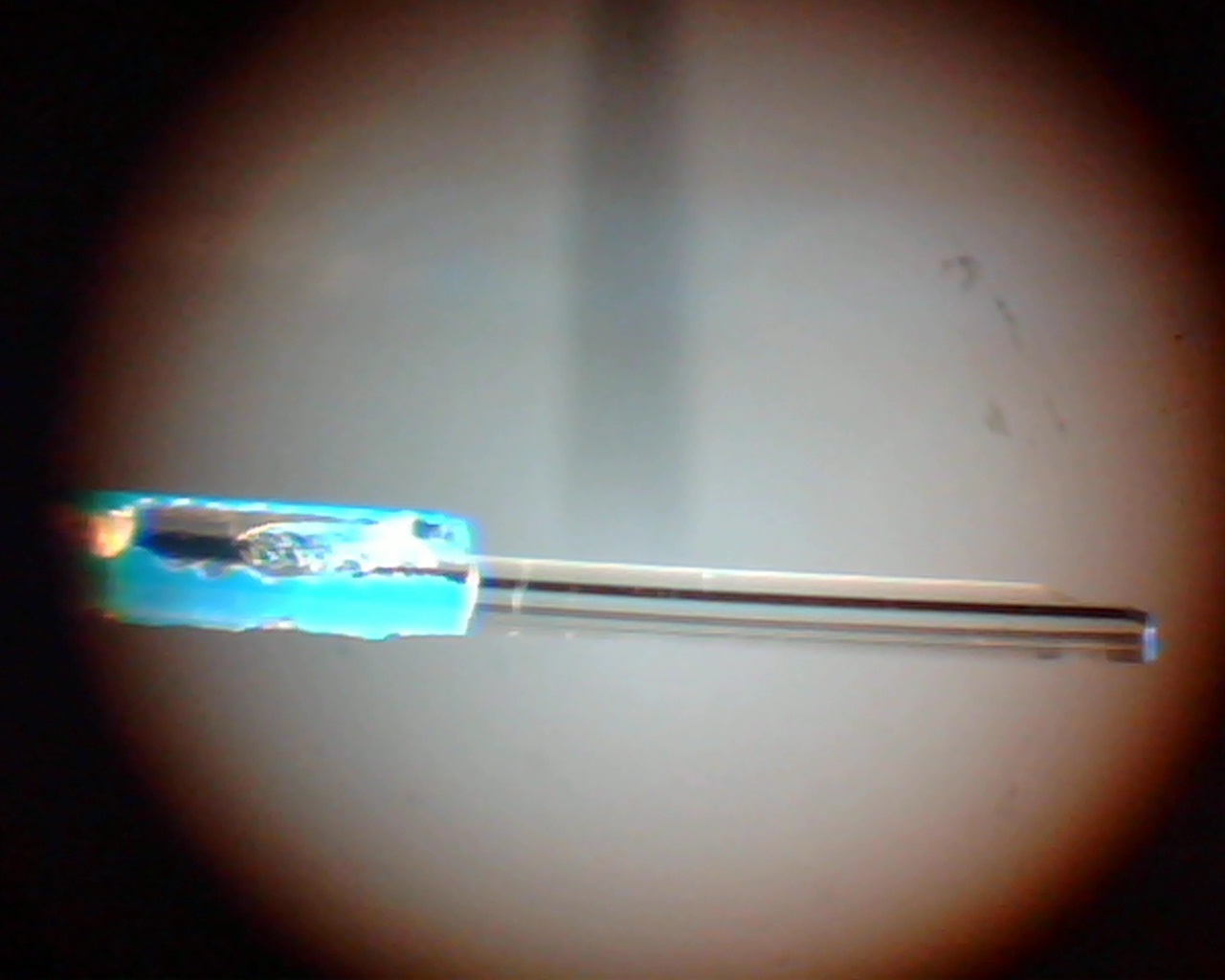
A microscope view of a single-mode optical fiber illustrates the physical medium of optical interconnection; the pictured broken end is not a co-packaged optics prototype.
Stalinets / Wikimedia Commons · Image source · CC BY-SA 4.0

Moving an optical transmitter closer to a switch chip sounds like a straightforward way to shorten a troublesome electrical connection. In a complete system, that move changes the cooling arrangement, assembly sequence, fiber access, test strategy, and repair procedure. Co-packaged optics therefore deserves an engineering discussion wider than energy per bit. NVIDIA’s August 2025 technical descriptions provide a concrete architecture; its March 2026 agreement with Coherent shows continuing investment in the manufacturing ecosystem. Neither a product announcement nor a supply commitment proves every advertised system benefit in every deployment. Together, they identify the practical questions a network designer now has to ask.
The saved electrical path creates the opportunity
A conventional pluggable optical module sits at the face of a networking chassis, connected electrically to the switch silicon through a circuit board and connectors. At high data rates, the electrical channel distorts the transmitted waveform. Equalization tries to reconstruct information that the channel has attenuated or spread between neighboring symbols. Its circuits cost power and add heat. Bringing the optical conversion into the switch package can reduce that electrical distance, although the optical link still needs lasers, modulators, receivers, and control.
In its August 18, 2025 technical account, NVIDIA compares a long electrical path with a co-packaged alternative and reports approximately 22 versus 4 decibels of electrical loss in its illustrated 200-gigabit-per-second channel example. Those are vendor-specific architecture figures, not a universal measurement for every cable or switch. They establish the motivation for shortening the path. A fair system comparison must still include laser electricity, tuning, cooling, management, and the actual useful traffic carried by the links.
Energy per bit must have a clearly drawn boundary
Suppose an illustrative optical subsystem consumes 12 watts while delivering one terabit per second. Dividing power by bit rate gives 12 picojoules per bit. If the same subsystem delivers only half that useful traffic while keeping its power unchanged, the figure becomes 24 picojoules per useful bit. Neither number is inherently dishonest; they answer different questions. Engineers should specify whether the denominator is the nominal lane rate, encoded traffic, useful payload, or application-level data delivered after retransmission.
A similarly careful boundary is needed for the numerator. Counting only the modulator driver can hide an external laser’s electrical consumption. Counting only the networking chassis can omit a laser enclosure elsewhere in the rack. A comprehensive comparison might report active and idle power for each enclosure, the utilization profile, and any incremental cooling load. This accounting is especially important when integration relocates components rather than eliminating them. Physical consolidation can be beneficial while still requiring an honest inventory of the equipment that remains.
An external laser changes what a technician can replace
NVIDIA’s August 26, 2025 description places light generation in field-replaceable external laser-source modules with a separate thermal environment. It also describes socketed optical subassemblies for one platform and detachable optical connectors for another. These are concrete choices about system boundaries. A laser, fiber interface, electronic driver, and photonic circuit do not have to share the same repair unit merely because they participate in one communication link.
Consider two otherwise identical failures. In one architecture, a technician replaces a small light-source module. In another, the same light-source failure requires draining coolant, disturbing neighboring fibers, and replacing a much more valuable switch assembly. The failure rate of the original component might be identical, while repair time and collateral risk differ dramatically. The reverse tradeoff is possible too: adding detachable interfaces can create additional contamination or alignment risks. Serviceability must therefore be measured as a procedure with tools, access clearances, and recovery verification, rather than inferred from a component count.
Shared resources change failure accounting. Combining several light sources or cooling connections may reduce the number of components, yet a failure of one shared resource can affect more links. Reliability engineering therefore distinguishes component failure probability from the size of the resulting outage. Independent redundancy helps only when its power, cooling, control, and routing do not share the same vulnerable path. A useful fault-injection exercise would disconnect one resource at a time, observe the affected ports, and verify whether operators can restore service without disturbing healthy neighbors.
Cooling a switch is also controlling an optical device
Optical resonators and semiconductor lasers respond to temperature. An optical channel can therefore be affected both by its own dissipation and by a nearby compute or switch die. Thermal control loops need to maintain the intended operating point without consuming so much power that the electrical savings disappear. Heat spreaders and cold plates also occupy space near fiber exits and connectors. A mechanically attractive layout can become awkward once coolant fittings, insulation, strain relief, and a technician’s hand must fit around it.
A March 22, 2026 arXiv perspective by Yasha Yi and Danny Wilkerson argues that packaging, temperature management, and serviceability become dominant concerns as optics move closer to electronics. It is an architectural analysis, not a new qualification test or a fleet reliability study. Its useful challenge is to evaluate the coupled system. An engineer might vary switch load and coolant temperature while monitoring optical power, error counts, tuning power, and link recovery. Correlated measurements reveal interactions that isolated component tests can miss.
A manufacturing agreement answers a different question from a benchmark
On March 2, 2026, NVIDIA and Coherent announced a multiyear, nonexclusive optics agreement, a purchase commitment, and a two-billion-dollar NVIDIA investment in Coherent. The stated purposes include research, future capacity, and US manufacturing. This is evidence of an industrial commitment and planned expansion. It is not a measurement of installed capacity, final product yield, or availability to every customer. Keeping those categories separate prevents a financial announcement from becoming an invented deployment milestone.
Manufacturing yield has its own arithmetic. In a simplified assembly requiring ten independently successful steps, a 99% success probability at each step produces about 90.4% overall yield. Real defects are often correlated, so this is not a prediction for a particular optical package. It illustrates why adding a delicate alignment operation can matter economically even when the operation is usually successful. Conversely, testing components before expensive assembly can prevent avoidable downstream loss. The optimum process depends on inspection quality, reworkability, throughput, and the cost already embedded at each stage.
What convincing deployment evidence would include
The next useful public evidence would state the actual operating population and observation time. A reliability claim should distinguish failed lasers, dirty connectors, electrical faults, software recovery events, and cooling-related interruptions. Repair statistics should identify whether operators restored one port, one engine, or an entire switch. Throughput should be measured under realistic load variation, because a stable laboratory transfer can miss problems associated with idle transitions, thermal transients, and simultaneous activity on many adjacent channels.
My engineering conclusion is that co-packaged optics can be valuable precisely because electrical communication has become so difficult at the package boundary. Its assessment should nevertheless follow the whole chain from electrical input to useful received data and eventual field repair. Shorter electrical reach creates room for improvement; a complete implementation decides how much survives. The most persuasive platform will combine credible energy measurements with repeatable assembly, thermal margins, and a service procedure that a data-center team can execute reliably at scale.
The transition also affects inventory. A service organization might need several spare optical engines, external lasers, connector-cleaning tools, and complete switch assemblies. Keeping only the most expensive replacement unit can shorten diagnosis but raise replacement cost; keeping many smaller units requires better fault isolation. These are engineering consequences of the physical partition, rather than peripheral operational details. Before deployment, the manufacturer and operator should agree on what a diagnostic code identifies and which parts a trained technician is allowed to replace in the field.
Sources & further reading
Primary papers, project documentation, and research releases used in this article. Publication dates below refer to the sources themselves.
- Scaling AI Factories with Co-Packaged Optics for Better Power EfficiencyNVIDIAPublished Checked
- How Industry Collaboration Fosters NVIDIA Co-Packaged OpticsNVIDIAPublished Checked
- NVIDIA and Coherent Announce Strategic Partnership to Develop Optics Technology to Scale Next-Generation Data Center ArchitectureNVIDIAPublished Checked
- 3D optoelectronics and co-packaged optics: when solving the wrong problems stalls deploymentarXivPublished Checked
FOLLOW THE QUESTION
Explore engineering