ENGINEERING
Liquid cooling AI data centers: the thermal budget beyond the cold plate
A 2026 Frontier cooling study shows why flow, temperature, control limits, and heat rejection matter as much as the cold plates attached to powerful chips.
Research checked
Newest cited publication
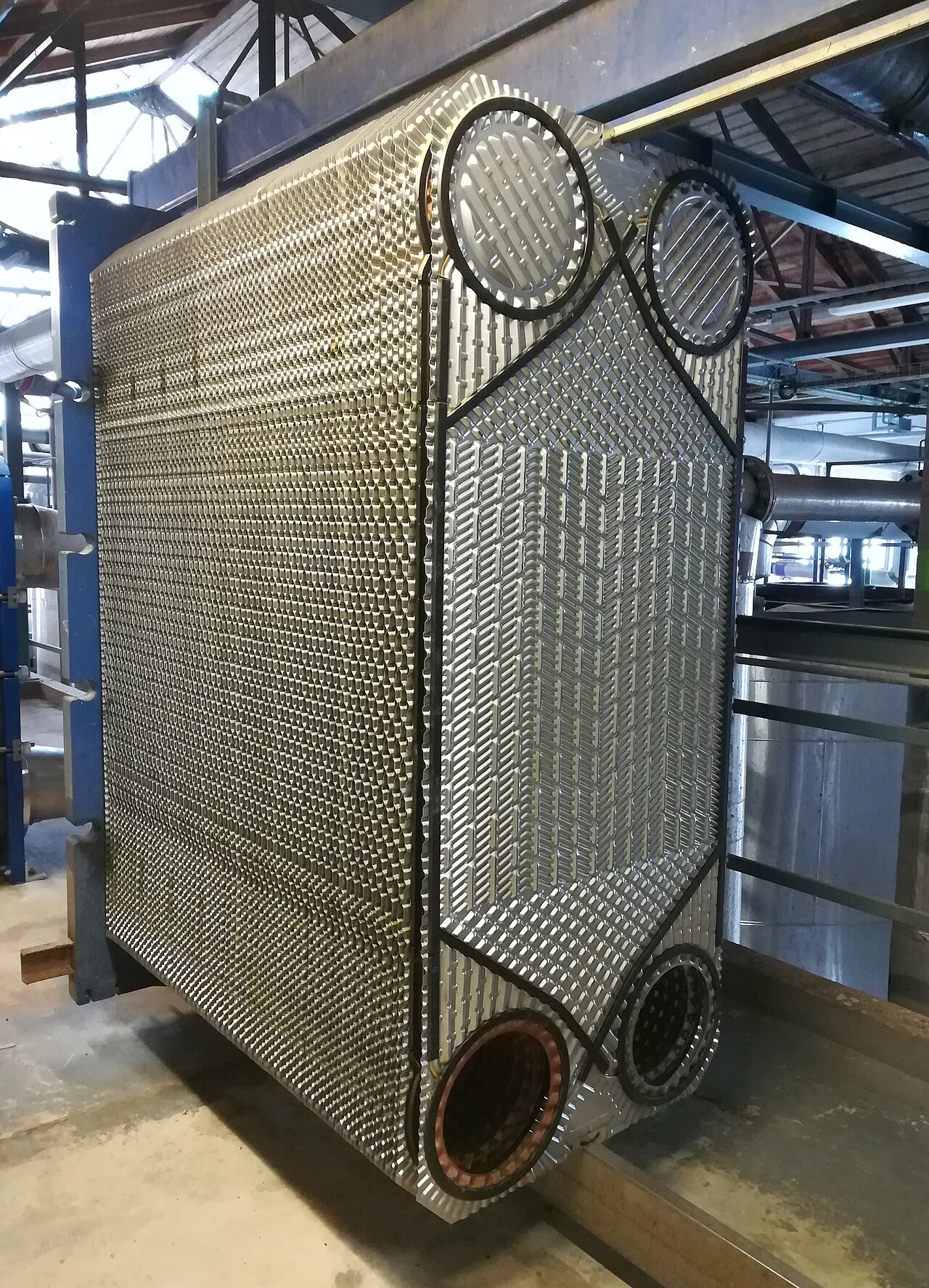
A dismantled plate heat exchanger illustrates the hardware that can transfer heat between fluid circuits; the data-center system requires the complete thermal budget described in the text.
RomanM82 / Wikimedia Commons · Image source · CC BY-SA 4.0

A cold plate makes the physical problem of an artificial intelligence data center look deceptively local. Bolt a metal heat exchanger onto a powerful processor, circulate coolant through narrow passages, and remove the heat before silicon becomes too hot. But the processor is only the beginning of a thermal network. The rack, distribution unit, building loop, outdoor equipment, and control system must all deliver compatible temperatures and pressures. Recent research makes this coordination especially interesting: the useful question is increasingly how to operate a liquid-cooled facility across changing workloads, rather than whether a laboratory cold plate can remove heat at all.
A current model grounded in an operating supercomputer
A preprint by Shrenik Jadhav and Zheng Liu, first submitted in March 2026 and revised on August 8, studies Frontier's liquid-cooling infrastructure through a digital twin. The model was checked against a year of operating measurements sampled every ten minutes. Its constrained optimization scenario reports 27.8 percent cooling-energy savings while respecting actuator ramp limits. That is a result computed with a validated model, not a claim that operators changed the live facility and measured that reduction. The distinction matters because an accurate description of yesterday's operation does not automatically establish safe performance under every possible new control policy.
The interesting engineering idea is to change flow and supply temperature together. Reducing pump speed may save electricity, but it also allows coolant to warm more as it passes through equipment. Raising supply temperature can make outdoor heat rejection easier, while shrinking the temperature margin available at the chip. These actions interact. An optimizer that treats either one as fixed may miss a better operating point, whereas an optimizer with no practical limits can recommend a setting that real valves and pumps cannot reach quickly enough.
Follow the temperature ladder
ASHRAE's data-center handbook distinguishes facility water from the technology cooling system serving computing equipment and emphasizes the heat exchanger between them. Its liquid-cooling classes describe allowable facility supply temperatures. Those labels are equipment requirements, rather than a promise that any server can operate at any warm-water setting. This is useful background for interpreting current proposals: the relevant inlet temperature belongs to a particular point in the system, and it cannot be exchanged casually for another point's temperature.
Consider an illustrative chip dissipating 800 watts through an overall junction-to-coolant thermal resistance of 0.04 kelvin per watt. Its junction would sit about 32 kelvin above the local coolant under that simplified steady-state model. If the coolant enters at 40 degrees Celsius, that gives roughly 72 degrees Celsius before accounting for additional local warming and uncertainty. These are invented design values, not measurements from Frontier. The calculation shows why a seemingly small resistance change can consume several degrees of operating margin at high power. Improving the interface can therefore help the whole facility accept warmer water.
Water flow is a design variable with a price
The heat carried by a water stream is approximately its mass flow multiplied by its specific heat and temperature rise. For a hypothetical 100-kilowatt heat load and a ten-kelvin rise, using a water specific heat of 4.18 kilojoules per kilogram-kelvin gives about 2.39 kilograms per second. Halving the permitted rise approximately doubles the required flow. This elementary balance is a powerful check on a proposal before detailed computational fluid dynamics is attempted.
The extra flow has consequences. Smaller pipes and narrow passages create pressure loss, and a pump must supply hydraulic power approximately equal to volume flow times pressure difference. Dividing by pump efficiency gives the electrical requirement. Pressure difference itself usually changes with flow, so doubling flow can cost much more than twice the electricity. Real networks also split unevenly: the easiest branch can take coolant that a more restrictive branch needs. Balancing valves, filters, quick disconnects, and fouling must therefore appear in the hydraulic model, rather than being treated as incidental plumbing.
The outdoor end still decides water and energy use
Liquid cooling does not specify where the heat ultimately goes. A dry cooler transfers it to outdoor air, an evaporative system uses water to assist rejection, and a chiller moves it across a larger temperature difference using compressor work. ASHRAE's integrated-design framework connects warmer liquid loops with opportunities for chiller-free operation, while emphasizing coordination between information technology and facility design. Such opportunities depend on the weather, equipment limits, and the heat exchanger temperature differences actually achieved.
Another design possibility is to shift cooling demand in time using thermal storage. Consider this as a system-design option rather than a claim about the cited Frontier installation. A stored cold resource can help cover difficult hours without requiring every piece of equipment to be sized around the same instantaneous peak. But a useful assessment must count pumping, the storage vessel or ground resource, regeneration of the store, and local conditions. Storage changes the time of heat rejection; it does not make the annual heat balance disappear. Its value depends on how frequently the difficult hours occur and whether sufficient inexpensive cooling capacity is available to recharge it.
Controls must survive failures and service
A data center cannot spend its thermal margin as though every sensor, pump, and connection were perfect. Suppose a temperature sensor reads two degrees too low just when several racks increase load. A control policy tuned to operate very near a limit may respond too late. Sensor disagreement, communications loss, and delayed actuator motion consequently need explicit fallback behavior. A conservative fixed setting can serve as that fallback even when the normal policy is adaptive.
Maintenance introduces another set of states. A technician can remove a server, isolate a branch, or replace a filter while the remaining racks stay online. The resulting hydraulic network differs from its commissioned configuration. A credible control trial should include these changes, as well as workload ramps, pump outages, and hot-weather operation. The need follows from the system's structure, rather than from any reported failure in the cited work. It also explains why a simulated percentage saving should be accompanied by an operating envelope and a plan for staged commissioning.
What a convincing next trial would measure
A strong next experiment would compare control policies on a declared boundary, measuring cooling electricity separately from computing electricity. It would preserve comparable workload and weather conditions, report all protective overrides, and identify the hottest equipment rather than only the average return temperature. An average can improve even while an unlucky rack loses margin. Publishing distributions and extreme events makes the result easier to assess than a single seasonal number.
For readers following AI infrastructure, this changes the meaning of progress. A better cold plate remains valuable, but useful deployment also depends on compatible water chemistry, serviceable connections, stable controls, and an outdoor system matched to the site. The 2026 Frontier analysis contributes evidence about the opportunity inside existing operational choices. Its next test is whether a practical controller can realize those modeled benefits repeatedly while preserving availability. Liquid cooling becomes convincing at the scale of the complete thermal path, where every watt removed from silicon must eventually arrive somewhere else.
Sources & further reading
Primary papers, project documentation, and research releases used in this article. Publication dates below refer to the sources themselves.
- Digital Twin-Based Cooling System Optimization for Data CenterarXivPublished Checked
- CHAPTER 20. DATA CENTERS AND TELECOMMUNICATION FACILITIESASHRAEChecked
- Integrated Design Principles | AI Data Center Energy Performance FrameworkASHRAEChecked
FOLLOW THE QUESTION
Explore engineering