ENGINEERING
A hip exoskeleton cuts stroke walking cost, but portability is only the first test
A 2026 hip exoskeleton study lowers walking energy cost after stroke. The next engineering tests concern daily transitions, comfort, control and endurance.
Research checked
Newest cited publication
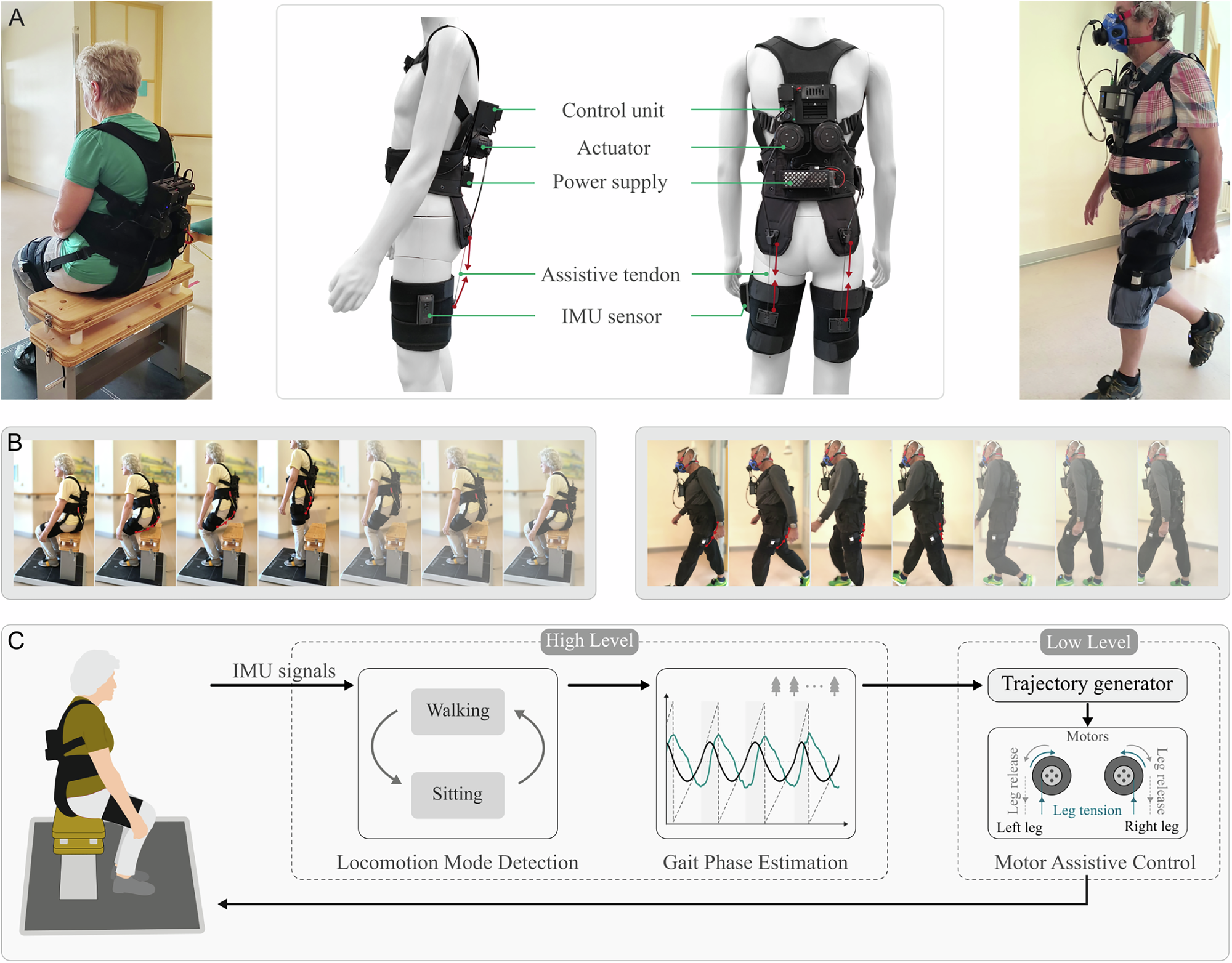
A figure from a separate 2026 older-adult exosuit study illustrates wearable assistance and its measurement setup. The stroke-walking device and participants discussed in this article belong to a different study.
Zhang et al., Nature Communications 17, 6540 (2026), Figure 1, CC BY 4.0 · Image source · CC BY 4.0
A wearable robot must earn the energy required to carry it. An impressive motor specification is irrelevant if the straps, batteries and moving hardware make walking harder overall. That makes a 2026 result from Kai Pruyn and colleagues particularly interesting: a portable hip exoskeleton reduced the net metabolic cost of treadmill walking in seven people with chronic post-stroke weakness. The paper appeared online on 14 February, with its version of record dated 25 March. It is an experimental result about assisted walking, rather than evidence that a commercial device already restores everyday independence. Reading it alongside newer soft-suit work and rehabilitation trials reveals the engineering questions hidden behind the headline percentage.
What the portable system actually demonstrated
The bilateral device weighed 2.63 kilograms. Researchers tuned assistance separately for each participant and side, using feedback and experimenter judgment. During six-minute treadmill bouts, assistance reduced net metabolic cost by 18 ± 2 percent, where the uncertainty is the standard error. Positive biological hip work fell by 29 ± 6 percent. These measurements support the claim that the system offloaded part of the walking task under the tested conditions.
The distinction between biological and robotic work deserves attention. Joint motion can remain broadly similar while responsibility for producing that motion changes. A person and a motor can both contribute torque around the same moving joint. Mechanical power is torque multiplied by angular velocity; integrating positive power over time gives positive work. Supplying useful motor work at the right moment can therefore reduce the human contribution without requiring an entirely different-looking step.
That does not make the robot an energy multiplier. Battery energy enters through the actuator, while muscles consume chemical energy with their own efficiencies and coordination demands. Comparing mechanical joules with metabolic joules requires keeping those energy pathways separate. The interesting achievement is a lower measured physiological burden after adding the complete wearable system, rather than a claim that motor output and metabolic savings should be numerically identical.
Why an energy saving is not an endurance guarantee
A simple hypothetical calculation shows both the promise and the limitation. Suppose a task requires 100 units of net energy over a fixed distance. Reducing that requirement by 18 percent leaves 82 units. If the person had a strictly fixed energy budget and every other constraint stayed unchanged, the reachable distance would scale by 100 divided by 82, or about 1.22. The corresponding idealized increase is approximately 22 percent, rather than 18 percent. This is arithmetic illustrating a possible relationship, not an outcome reported for the participants.
Human endurance does not obey that single-budget model. Balance confidence, local muscle fatigue, pain, attention and opportunities to rest can matter independently of average energy expenditure. The walking environment can also change the task: a turn, a curb or an unexpected stop interrupts the repeated pattern available on a treadmill. A shorter journey may still feel worthwhile even when it does not increase a maximum-distance score.
An engineering interpretation should therefore keep the measured variable close to its measurement conditions. Lower net metabolic cost is evidence for improved walking economy in that experiment. Establishing longer independent journeys needs a study that actually measures journeys. Establishing useful battery endurance needs electrical measurements across realistic activities. Neither result follows automatically from the other, because the user and the battery have different limits.
Assistance and rehabilitation answer different questions
A separate randomized study published in BMC Neurology on 29 September 2025 enrolled 40 people with subacute stroke. It compared robot-assisted gait training with therapist-assisted gait training alongside conventional rehabilitation, over four weeks. The robot group showed stronger post-intervention results on several gait and functional measures. The device combined posture, plantar-pressure and joint-angle sensing with motion prediction; a therapist remained alongside participants during training.
That trial addresses a different timescale from immediate energy assistance. A robot can help someone accomplish a movement while it is worn, and repeated practice might also change later performance. Those are separate hypotheses. A useful evaluation protocol should state whether its endpoint is measured with assistance active, after assistance is removed, or after an extended period without training. Mixing those endpoints can make an assistive effect sound like permanent recovery.
Control timing also matters independently of peak torque. Consider pushing a playground swing: a modest push synchronized with motion adds energy, while an equally large push at the wrong phase can oppose it. A walking controller faces the additional challenge that the user may stop intentionally. A prediction system should support intent without making every deviation from a periodic template look like an error to correct. For future studies, deliberately testing hesitation, interrupted steps and transitions would help reveal whether an apparently smooth controller remains cooperative when movement becomes irregular.
The July result broadens the task beyond walking
A newer Nature Communications paper, published on 17 July 2026, studied a tendon-driven soft hip exosuit in ten older adults. It paired walking assistance with help during chair transfers. Nine participants contributed to each principal performance analysis: assisted chair repetitions increased by 1.8 in a minute, and walking metabolic cost of transport decreased by 13.6 percent. Different participants were excluded from those analyses for documented reasons. Crucially, the principal comparison was assistance enabled versus disabled while wearing the suit, rather than a full-cohort comparison against wearing no device.
That comparator limits what the percentage means. Switching a worn device on can establish that its active assistance contributes a benefit, but it does not by itself establish the complete-system advantage over ordinary clothing. This is a general experimental-design issue, rather than an objection unique to soft robotics. A heavy system can improve greatly relative to its own disabled state while remaining unattractive relative to no system.
Chair transfers also expose a useful architectural trade-off. Walking repeats a cycle; standing up starts from rest and involves a brief change in support. A controller must recognize which task is happening before applying the relevant force pattern. Soft connections can accommodate movement, but they also transmit forces through clothing and contact surfaces. The next practical question is whether that interface remains consistent after the wearer changes posture, adjusts a belt or spends time seated. Those are proposed engineering checks, not additional results from the July study.
Usability belongs inside the system boundary
A 2025 PLOS One crossover trial makes the practical boundary visible. Ten participants with motor-complete spinal cord injury trained with the ABLE exoskeleton and conventional knee-ankle-foot orthoses. The study assessed safety, feasibility and usability in a rehabilitation hospital. It reported 17 adverse events with the robot and 31 with orthoses, together with a 43-second reduction in combined donning and doffing time. These are observations in that supervised trial, not estimates of every user’s home risk. The paper discloses manufacturer-related financial interests.
Putting on and removing equipment is productive time only if the wearer considers it worth the effort. A device that saves effort during ten minutes of walking might require an inconvenient setup before every short trip. Conversely, preparation may be acceptable before a longer planned session. The relevant comparison therefore includes the whole activity sequence: retrieving the device, fitting it, moving, sitting, removing it and arranging charging.
Comfort deserves the same treatment. A brief successful demonstration cannot reveal every effect of sweat, changing clothing, contact pressure or accumulated wear. An endurance test should record why a session ended: depleted battery, uncomfortable interface, excessive heat, user fatigue or a technical fault. Combining those endings into a single runtime number would obscure which subsystem needs improvement. Practical evidence becomes more useful when failures are classified clearly enough to guide the next design revision.
What would make the next result persuasive
Taken together, these papers suggest an evaluation sequence rather than a single winning architecture. First establish a benefit with the complete hardware under a controlled task. Then test whether the benefit survives task transitions and realistic setup. Finally, measure repeated use with outcomes meaningful to the intended population. This sequence is an engineering proposal drawn from the different questions the studies investigate; it does not imply that every device has already completed it.
For a portable hip system, a strong next report would pair energy expenditure with turning, stopping, chair transfers and everyday route completion. It would publish electrical consumption, assistance settings, fitting time, unsuccessful trials and the distribution of individual responses. Follow-up could then distinguish a device people can operate during a demonstration from one they continue choosing when help from the research team is less available. The 2026 walking-economy result clears an important experimental hurdle. Its broader value will depend on whether careful control, tolerable interfaces and reliable daily operation can preserve that benefit outside the repeated steps that first revealed it.
Sources & further reading
Primary papers, project documentation, and research releases used in this article. Publication dates below refer to the sources themselves.
- Portable hip exoskeleton improves walking economy for stroke survivorsNature CommunicationsPublished Checked
- Enhancing sit-to-stand transitions and walking efficiency in older adults with a soft robotic suitNature CommunicationsPublished Checked
- A novel real-time assistive hip-wearable exoskeleton robot based on motion prediction for lower extremity rehabilitation in subacute stroke: a single-blinded, randomized controlled trialBMC NeurologyPublished Checked
- Randomized, crossover clinical trial on the safety, feasibility, and usability of the ABLE exoskeleton: A comparative study with knee-ankle-foot orthosesPLOS OnePublished Checked
FOLLOW THE QUESTION
Explore engineering