ENGINEERING
Why the Web Became a System of Links
The original Web proposals solved an engineering information problem through links, servers and common interfaces, while leaving difficult tradeoffs visible.
Research checked
Newest cited publication
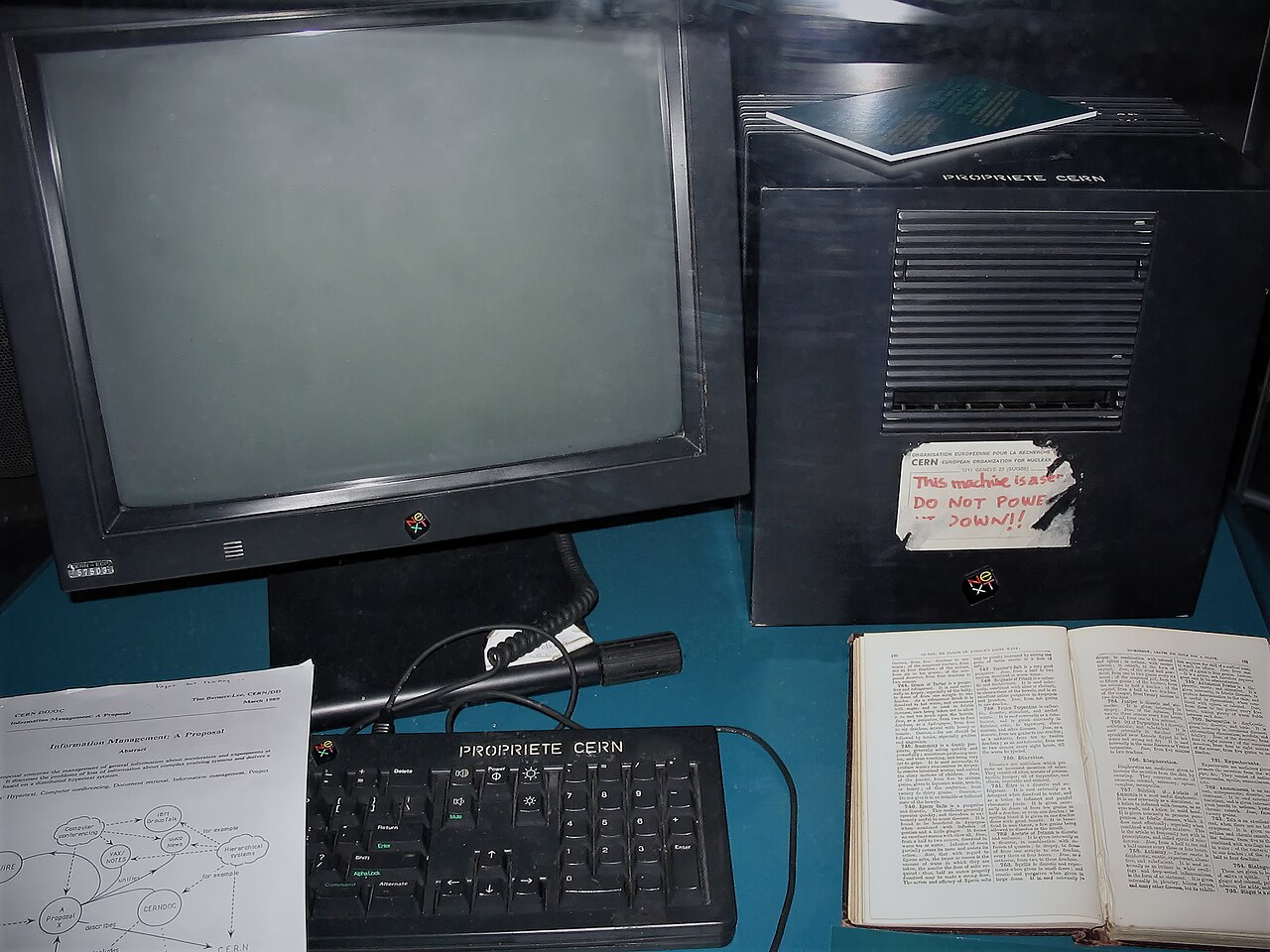
Tim Berners-Lee’s original NeXT workstation, which served the early World Wide Web, is displayed at CERN’s Microcosm in this 2005 photograph.
Coolcaesar at English Wikipedia · Image source · CC BY-SA 3.0

A laboratory can preserve a document and still lose the knowledge inside it. The file remains somewhere, but the person who knows its name has moved away, the project has changed, or its connection to another system was never recorded. Tim Berners-Lee's March 1989 proposal at CERN approached that practical failure through linked information. The Web that emerged from this work offered a way to connect independently maintained material across computers. Its engineering originality becomes clearer when we examine what links, addresses and servers accomplished, and which responsibilities they deliberately left to others.
An organization has more relationships than a filing tree
Information Management: A Proposal describes CERN as an evolving network of people, projects, software and equipment. It emphasizes information lost through staff turnover and the difficulty of keeping a single comprehensive account current. Berners-Lee proposes linked nodes that can represent different kinds of things and relationships. The requirements include access across different computers, connection to existing information and growth without a central coordinator. The task begins with finding relationships that an organizational hierarchy does not adequately capture.
Imagine a detector module with three useful descriptions: a maintenance guide, an installation record and a note about software that reads its output. A filing system can place each document under a project, but the relationships cross those folders. Copying every document into every relevant folder creates an update problem. Linking lets one maintained description participate in several contexts. This example also exposes a limitation: a link records a relationship only as well as its author chooses and describes it. Replacing duplicated documents with references reduces one kind of inconsistency while making meaningful naming and continued maintenance more important.
Clients and servers divided the work
The November 12, 1990 proposal by Berners-Lee and Robert Cailliau sets out a client-and-server architecture. Browser software displays information and follows links; servers answer requests for the information they provide. The proposal describes a link as a string from which a browser can determine how to contact the appropriate service. It also separates broad text readership from more ambitious authoring facilities, and discusses using existing systems rather than converting every document store immediately.
That division makes independent implementation possible. Suppose a laboratory changes the database behind a server while retaining the externally useful way of requesting a document. A browser should not need to understand the new storage tables just to follow the same reference. Conversely, a browser can improve its display without requiring the author to move every source document. The benefit depends on honoring the interface: if the meaning of an address changes unexpectedly, the separation fails from the reader's perspective. Interoperability is therefore an ongoing agreement about observable behavior, not merely the presence of networking code in two programs.
A 1991 message shows the system taking shape
In an August 6, 1991 message preserved by W3C, Berners-Lee describes an available prototype: a NeXT hypertext editor, a line-mode browser, and server code. The message explains that addresses include an access method and usually a host and path. Existing files and other information services could be exposed through the browsers; a server could also generate a hypertext document from other data. It explicitly presents the software as provisional. This is evidence of working tools and an invitation to collaborators, rather than a retrospective claim that the entire later Web already existed.
Three separate questions help explain the design. An address identifies what to request. A communication convention determines how the request and response travel between programs. A document representation determines how the received content can describe structure and references. Mixing those jobs into one opaque application would make replacement difficult: changing the display could force changes in storage or communication. Keeping the jobs distinguishable gives implementers room to evolve each part while preserving useful connections. The separation is conceptual; successful software still has to make all three cooperate for a reader who simply clicks a link.
Local freedom creates predictable failure cases
The original requirement for growth without central coordination has a practical consequence: maintaining a link can involve different owners. A page author controls the reference, while another group may control the destination. Consider a small example in which ten manuals each link to one instrument specification. Moving that specification without preserving its old address can break ten routes at once. Updating the destination's own menu repairs none of the references held by other people. The example follows from the separation of ownership; it does not require a historical count of broken links.
An engineer can reduce the risk by treating published addresses as interfaces. Keep them stable where possible, provide a useful response when content moves, and check important outgoing links. Those practices do not require one authority to approve every page, but they do require operational responsibility. The tradeoff is visible even in a tiny deployment. Requiring every author to register every relationship centrally might improve certain checks while delaying local publication. Permitting immediate publication lowers that barrier while accepting incomplete knowledge about the wider graph. The appropriate choice depends on how much coordination the intended community can actually sustain.
The early project page demonstrated its own idea
CERN's preserved World Wide Web project page is mostly an organized set of references: information about software, technical details, people, history and ways to obtain code. It is valuable as an artifact of navigation. A single entry point directs readers toward material that can be maintained elsewhere. The page's simple appearance also makes a useful conceptual separation visible. Its job is to help a reader reach information, while the destination pages supply the details. The historical page on display is an archived artifact; it should not be used to invent a precise date for every link it contains.
This suggests a small test for any knowledge portal. Give a new reader a concrete question, such as finding the maintainer of an unfamiliar component, and observe which links they choose. Count unsuccessful detours and ask whether the displayed terms matched their expectations. A technically valid hyperlink can still be a poor interface if its label fails to describe the destination. Good navigation therefore depends on the reader's task and vocabulary as well as correct addresses. The early project page is interesting precisely because it turns the Web's general idea into a usable starting place.
The original ambition had explicit limits
The proposals distinguish immediate objectives from later possibilities. The 1990 document concentrates on wide text access and existing information; advanced multimedia and sophisticated network authorization lie outside its immediate scope. Its phased authoring plans are proposals, not proof that every capability was delivered on the proposed schedule. The 1989 document's archival introduction also explains that Berners-Lee used the name Mesh at that stage, choosing World Wide Web while writing code in 1990. Preserving that sequence prevents a familiar later name from flattening the development process.
A useful lesson for current engineering is to inspect the cost of joining a system. Can a new participant publish a useful contribution without replacing every existing tool? Can another developer implement a compatible client? Can local information remain under local maintenance? These questions explain why modest interfaces can have large consequences, without claiming that openness alone guarantees good outcomes. The Web still leaves questions of accuracy, persistence and trust to people and institutions using it. The landmark is a workable connection between independently maintained information, accompanied by enough shared rules that following a reference becomes an ordinary action.
Sources & further reading
Primary papers, project documentation, and research releases used in this article. Publication dates below refer to the sources themselves.
- Information Management: A ProposalTim Berners-Lee / CERN, archived by W3CChecked
- WorldWideWeb: Proposal for a HyperText ProjectTim Berners-Lee and Robert Cailliau / CERN, archived by W3CPublished Checked
- Re: Qualifiers on Hypertext links…Tim Berners-Lee / alt.hypertext, archived by W3CPublished Checked
- The World Wide Web projectCERNChecked
FOLLOW THE QUESTION
Explore engineering