ARTIFICIAL INTELLIGENCE
Word2vec and the geometry of distributed meaning
The 2013 word2vec papers made useful word representations cheaper to learn. Their geometry revealed linguistic patterns while leaving context and meaning unresolved.
Research checked
Newest cited publication
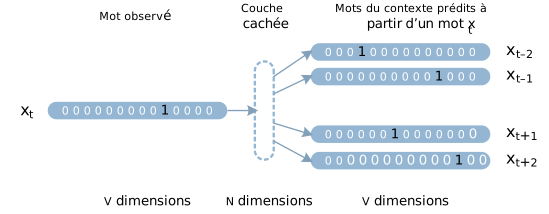
A skip-gram diagram maps a central word through an embedding layer to neighboring context targets. French headings identify the observed word, hidden layer, and predicted context words; the symbolic positions explain the learning task.
Jeran Renz / Wikimedia Commons. Unmodified original SVG. · Image source · CC BY-SA 4.0

A dictionary assigns separate entries to words. A numerical model needs an additional decision: should those entries remain unrelated identifiers, or should their representations share structure? Word2vec made the second approach practical at a scale that encouraged direct experimentation. Its landmark papers appeared in 2013, and their attraction was unusually concrete. A comparatively simple prediction task produced vectors that could be inspected, compared, and reused. Some relationships appeared as directions through that vector space. This historical account examines what the training procedure actually optimized, why efficient computation mattered, and how a striking analogy can become a misleading explanation. The achievement was useful statistical structure learned from text, rather than a complete account of what a word means in every sentence.
The contribution was efficiency as well as representation
Efficient Estimation of Word Representations in Vector Space was first submitted on 16 January 2013. Tomas Mikolov and colleagues proposed continuous bag-of-words, or CBOW, and continuous skip-gram architectures that removed an expensive nonlinear hidden layer from the representation-learning stage. CBOW predicts a central word from surrounding words; skip-gram predicts surrounding words from a central word. The paper compared training costs and performance on syntactic and semantic relationship tests. Distributed representations already had a history: these architectures were a contribution to learning them efficiently, not the invention of numerical representations for language.
For intuition, imagine a catalog whose item numbers reveal nothing about the items. Assigning consecutive numbers to a kettle and a comet does not make them related. A learned representation instead allocates several adjustable numbers to each item and trains them through a task. Reusing the same numbers across many examples allows evidence to accumulate. The coordinates need not correspond to named concepts such as temperature or astronomy. Their usefulness depends on what the training task encourages the resulting relationships to preserve.
Ordinary text supplies many small prediction problems
Consider a miniature corpus containing sentences about pouring tea, filling a cup, and washing a mug. With a local window, each occurrence provides nearby words as training evidence. A CBOW-style example combines neighboring representations to predict the missing center; a skip-gram-style example uses the center to predict individual neighbors. The simplified CBOW representation does not preserve the order of the surrounding words. These local objectives make text its own source of training targets, although the choice of corpus and window still determines what evidence is available.
The important distinction is between sharing contexts and being interchangeable. A cup and tea often occur together, but they are different kinds of thing. A cup and a mug can appear in similar sentence positions even when they do not occur beside each other. A useful representation can reflect several overlapping relationships without labeling them explicitly. When evaluating a neighbor list, the reader should therefore ask whether the intended task needs topical association, substitutability, morphology, or another relation. The label similar cannot specify all of them.
Negative sampling changes the computational problem
The second major paper, submitted on 16 October 2013, introduced extensions including negative sampling, frequent-word subsampling, and phrase learning. Negative sampling trains a classifier to distinguish observed word-context pairs from sampled noise pairs, using vector dot products as scores. Yoav Goldberg and Omer Levy's February 2014 derivation makes an important distinction explicit: this objective differs from the normalized conditional-probability objective of the original skip-gram formulation. It is not simply the same full-vocabulary calculation performed without cost.
Here is a deliberately invented two-dimensional scoring example. Let a word vector be (1, 0), an observed context vector be (0.5, 1), and a sampled context vector be (−0.5, 0). Their dot products with the word are 0.5 and −0.5. Applying the logistic function gives classifier outputs of approximately 0.622 and 0.378. Training can push those outputs toward their observed and noise labels. These numbers illustrate a calculation; they are not published embeddings, evidence that the contexts are genuinely incompatible, or probabilities that a sentence is true.
Sampling decisions shape what gets learned
Frequent-word subsampling reduces the dominance of very common tokens during training. Phrase detection addresses another issue: a multiword expression may have a meaning that is poorly captured by combining its individual words. The October paper builds representations for detected phrases as vocabulary items. Both changes show that the pipeline includes decisions about what counts as an example and what counts as a unit. A word vector is produced by that pipeline rather than extracted from text without assumptions.
Imagine a corpus about control equipment that repeatedly uses the phrase emergency stop. Treating the phrase as a unit might preserve an association that the separate words express less reliably. But an automatic phrase detector could miss an uncommon technical expression or join a frequent accidental pairing. An evaluation should inspect those choices before crediting every improvement to vector dimensionality. Changing preprocessing changes the observations supplied to the learner, much as changing a sensor's filter changes what reaches an estimator.
What an analogy calculation actually checks
Linguistic Regularities in Continuous Space Word Representations appeared at NAACL in June 2013. Mikolov, Wen-tau Yih, and Geoffrey Zweig investigated relation-specific offsets in representations learned by neural language models. Their paper evaluated syntactic analogies and semantic relations, rather than claiming a general symbolic reasoning system. This related work helps explain why linear geometry became central to the word-vector story, while remaining a separate experiment from the efficient CBOW and skip-gram architectures.
A constructed example makes the operation explicit. Assign lamp the vector (1, 1), lamps the vector (1, 3), and cup the vector (4, 0). The plural offset inferred from the first pair is (0, 2). Adding it to cup gives (4, 2). If cups has that vector, a nearest-neighbor search can recover it exactly. The construction guarantees success because the coordinates were chosen to do so. A real evaluation must test whether learned vectors exhibit the pattern on held-out pairs, among competing candidates, without designing the space around the answer.
A fixed representation has a clear boundary
A fixed word representation pools evidence across occurrences. That creates a straightforward limitation for an ambiguous spelling. For example, a corpus can use crane for a bird and for lifting equipment. One stored vector for that vocabulary item cannot independently select one meaning based on the current sentence. A downstream system may use surrounding text to disambiguate it, but that requires additional computation beyond looking up the same fixed vector. A fluent interpretation of a neighbor list should not conceal this representational constraint.
The same caution applies to social associations. A corpus can repeatedly connect an occupation with one demographic description. A representation useful for predicting that corpus may reproduce the association even when it is an inappropriate basis for a decision. This is an inference from the training setup, not a numerical bias measurement reported here. An application needs task-specific evaluation, attention to coverage and context, and a reason for using a similarity score. Statistical regularity is evidence about recorded usage; it does not provide a rule for how people should be treated.
The lasting lesson is an inspectable learning task
A careful reconstruction of the landmark would preserve corpus provenance, preprocessing, context-window rules, vocabulary thresholds, sampling settings, random seeds, and the exact evaluation candidates. It would compare useful downstream behavior alongside analogy accuracy. A high score can reflect a valuable regularity while leaving unrelated tasks unchanged. That combination of mechanism and bounded measurement gives the historical result its substance: simple objectives can produce reusable structure, and efficient training can make that structure available for systematic study.
My preferred small replication would use a corpus with two clearly separated domains, then evaluate ambiguous terms, rare words, and relational pairs in each. Inspecting mistakes would reveal which distinctions survive compression and which disappear. The experiment would not recreate the full 2013 result, but it would make its central trade-off tangible. Word2vec remains worth studying because the route from training examples to geometry is short enough to examine closely. That clarity helps explain both the power of a learned representation and the danger of reading more meaning into its coordinates than the evidence supports.
Sources & further reading
Primary papers, project documentation, and research releases used in this article. Publication dates below refer to the sources themselves.
- Efficient Estimation of Word Representations in Vector SpacearXivPublished Checked
- Distributed Representations of Words and Phrases and their CompositionalityarXivPublished Checked
- Linguistic Regularities in Continuous Space Word RepresentationsAssociation for Computational LinguisticsChecked
- word2vec Explained: deriving Mikolov et al.'s negative-sampling word-embedding methodarXivPublished Checked
FOLLOW THE QUESTION
Study engineering foundations