ARTIFICIAL INTELLIGENCE
Evo 2 and the Language of Genomes
Evo 2 reached Nature in March 2026. Its genomic language model links sequence statistics with biological experiments, while leaving important gaps between them.
Research checked
Newest cited publication
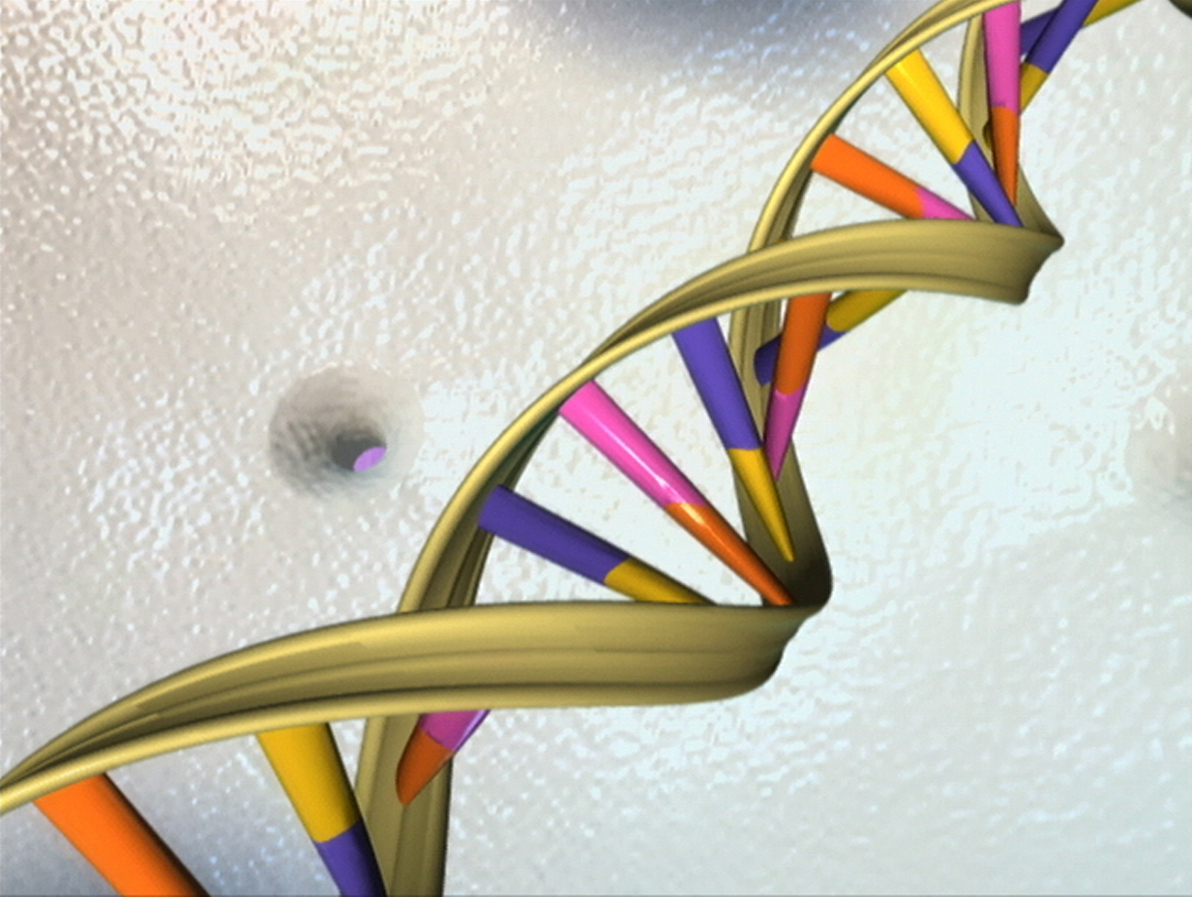
A DNA illustration supplies context for sequence modeling across genomes; the pictured molecule is a general illustration rather than a sequence generated by Evo 2.
National Human Genome Research Institute, NIH · Image source · Public domain

Predicting the next letter is a surprisingly indirect way to study life. A DNA model is not handed a complete rulebook for cells. It sees sequences shaped by evolution and learns which continuations fit their surroundings. Evo 2, initially released in February 2025 and published in Nature on March 4, 2026, makes that approach unusually ambitious: long genomic context, single-nucleotide resolution, and training data spanning widely different organisms. The interesting question is not whether DNA resembles a sentence. It is which biological constraints become learnable from sequences alone, and how to tell when a fluent-looking prediction has failed to capture the function that matters.
Prediction learns a distribution before it learns a task
Evo 2's public repository describes autoregressive training: the model predicts sequence elements using preceding context. Its StripedHyena 2 architecture combines convolutional operators and attention rather than relying on a conventional transformer alone. Models support contexts reaching one million bases. The repository provides sequence scoring, embeddings, and generation interfaces. These are related uses of a learned representation, not three independent demonstrations that the model understands every aspect of biology.
For an illustrative scoring example, imagine two candidate letters receiving probabilities of 0.6 and 0.2 in the same context. The ratio is three. A logarithmic comparison would summarize how much the model prefers one letter, but it would not transform that ratio into a threefold biological effect. The score concerns the model's sequence distribution. A functional interpretation requires an additional argument linking that distribution to the experimental question. This modest distinction prevents an attractive number from acquiring a meaning it was never trained to possess.
A trillion bases is also a curation problem
The Nature paper describes a curated dataset containing more than 8.8 trillion nucleotides and a 40-billion-parameter model trained on 9.3 trillion tokens. Those quantities are related but different: the size of a dataset need not equal the amount of data presented during training. A smaller model and staged context extension are also described. The published work evaluates functional prediction and generation, and reports learned representations associated with recognizable biological features.
The OpenGenome2 dataset card is therefore part of the scientific contribution, not merely a download link. It distinguishes raw sequence files from preprocessed training records, which can include added tags and tokens. Such details affect what information the model can exploit. If a species label strongly predicts a sequence property, a successful benchmark might partly reflect that label rather than a newly learned molecular rule. That is not inherently invalid, but it changes what the result demonstrates. Data provenance helps readers understand which relationships were available to be learned and which were genuinely withheld.
An independent analogy is a historical archive containing many copies of closely related documents. Counting every page gives an impressive total, but the diversity of ideas is a separate property. Genomic training sets similarly deserve scrutiny of redundancy and sampling, without assuming that the analogy captures their full biology. A useful evaluation asks what knowledge remains available after close relatives are excluded from the test comparison. This helps distinguish useful generalization from success on well-represented families.
Long context must earn its computational cost
The February 2025 institutional announcement emphasized the ability to process up to a million nucleotides and to include organisms beyond the single-cell emphasis of the predecessor model. Long context makes distant sequence relationships available to the network. Availability, however, is not the same as reliable use. A model can technically accept a large window while making a particular prediction mostly from nearby bases. The relevant experiment asks what performance changes when informative distant context is altered or removed.
Consider a harmless conceptual test using invented symbols rather than a real genomic design. Place an instruction near the beginning of a long string and an ambiguous marker near the end. If the correct interpretation depends on the early instruction, progressively moving the two apart tests whether the representation retains useful information. Real genomic relationships are far less tidy, but the logic carries over. Long-window claims become more persuasive when evaluated on controlled dependencies, matched distractors, and downstream biological tasks. Merely reporting the maximum accepted input length would answer a software capacity question while leaving the scientific context question open.
The 2026 update adds a different kind of evidence
Arc's March 4, 2026 update describes laboratory validation of generated chromatin-accessibility patterns, including experiments in mouse embryonic stem cells and two human cell lines. The reported designs used predictive models to guide generation. This detail matters: the result belongs to a combined prediction-and-search workflow, followed by a measurement. It is stronger evidence than visual agreement between two computer outputs, but it does not imply that unconstrained sequence generation routinely produces any desired biological behavior.
There are several sensible success questions. Did the measured signal follow the intended spatial pattern? Did the result generalize to a different biological setting? Did comparisons include alternatives that challenge the model? How often did designs fail? A study can provide a convincing answer to the first question while leaving the others unsettled. My interpretation is that the most useful progress report connects each claimed ability to the exact observation supporting it. A working element under one assay is an important result; calling it a complete solution to cell-specific control would erase the conditions that made the result interpretable.
Smaller models change who can check a claim
The official Evo 2 version 0.5.0 release introduces a 20-billion-parameter model, reporting performance near the 40-billion-parameter version on selected evaluations with a smaller hardware footprint. The release describes obtaining it through removal of selected layers rather than additional training. Its comparison includes variant-effect and generation benchmarks, and it documents hardware requirements. These are concrete engineering details that help another laboratory judge whether local evaluation is practical.
Accessibility has a scientific effect. If a group can run a model locally, it can examine failure cases, preserve an exact environment, and compare alternative data splits without depending on a changing hosted service. Yet an executable model is only one part of reproducibility. Tokenization, context construction, strand treatment, score normalization, checkpoint identity, numerical precision, and dataset version can all matter. A smaller checkpoint should be validated on the intended research task rather than assumed interchangeable because several headline benchmarks look similar. Better access makes scrutiny possible; it does not remove the need for scrutiny.
A biological language is not a universal dictionary
The most productive reading of Evo 2 is as a learned statistical instrument. Evolution leaves signals in sequence, and a sufficiently capable model can recover some of those signals without being trained separately for every assay. The Nature study supports that research direction. It does not establish a direct, universal translation from every sequence to every phenotype. Cellular state, environment, and experimental design remain relevant to deciding what a sequence does.
A convincing next evaluation would compare model scores with measurements chosen before inspecting the predictions, preserve challenging negative cases, and separate close relatives from distant test examples. It would also explain whether success comes from a general sequence representation or from extra task-specific guidance. These distinctions make the result more useful to both biologists and machine-learning researchers. The word language is a helpful invitation to study structure, dependency, and context. It becomes misleading when it suggests a complete vocabulary of function. Evo 2's 2026 publication is significant because it creates more ways to ask precise questions of genomic data, including questions whose experimental answers may expose what the model has not learned.
Sources & further reading
Primary papers, project documentation, and research releases used in this article. Publication dates below refer to the sources themselves.
- Genome modelling and design across all domains of life with Evo 2NaturePublished Checked
- AI can now model and design the genetic code for all domains of life with Evo 2Arc InstitutePublished Checked
- Evo 2: One Year LaterArc InstitutePublished Checked
- Evo 2: Genome modeling and design across all domains of lifeArc InstituteChecked
- OpenGenome2Arc InstituteChecked
- Evo 2 20B: strong performance with half the GPU footprintArc InstituteChecked
FOLLOW THE QUESTION
Study engineering foundations