ARTIFICIAL INTELLIGENCE
BitNet and the Difference Between Fewer Bits and Less Intelligence
What native ternary language models demonstrated in 2025, how 2026 embedding and speech work extends the idea, and where the efficiency claims stop.
Research checked
Newest cited publication
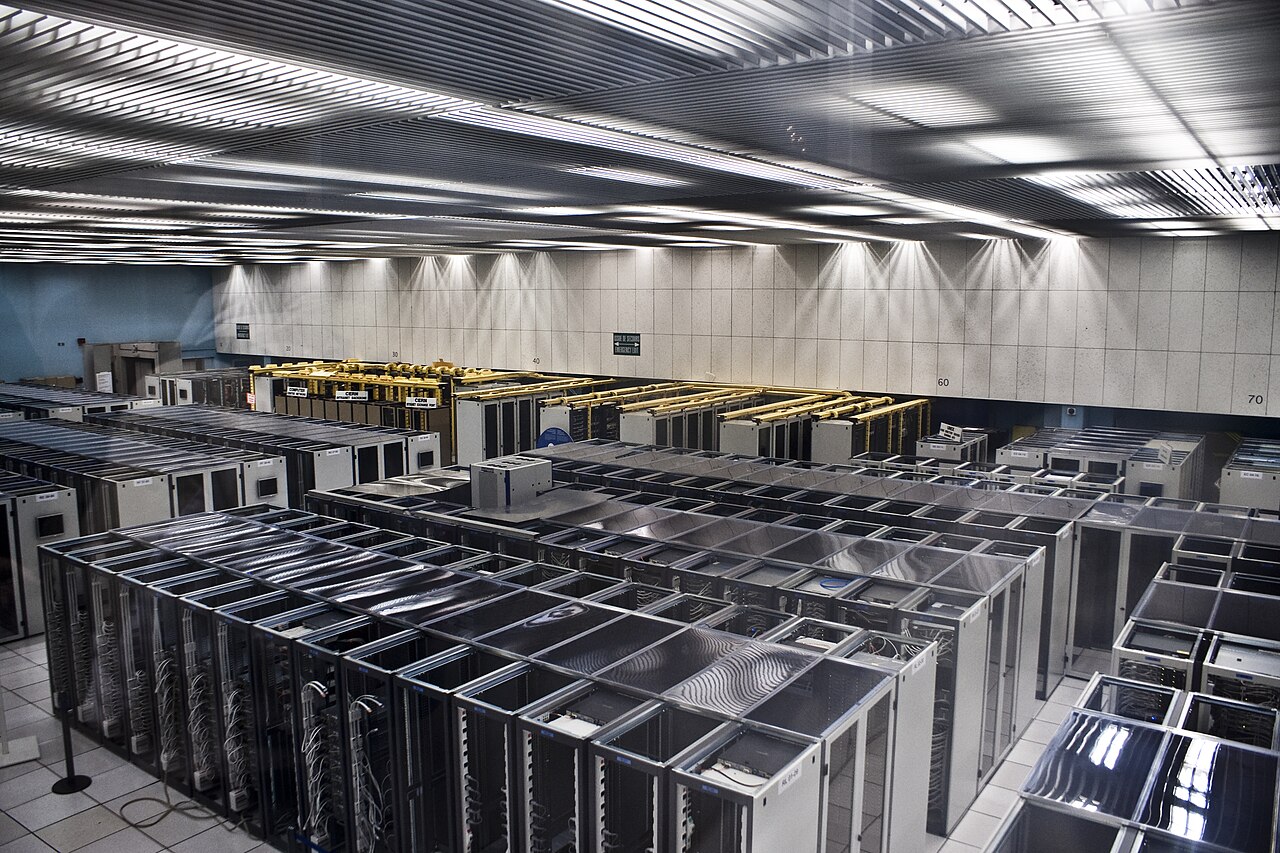
CERN’s server room in 2009 supplies historical computing-infrastructure context; the photograph does not show a BitNet training cluster or measure its cost.
Florian Hirzinger — www.fh-ap.com · Image source · CC BY-SA 3.0

A neural-network weight is usually described as a number, but storing that number requires a format. The format decides which values can be represented and how expensive they are to move. BitNet asks how much of a language model can work with a radically restricted weight alphabet. Its b1.58 variant uses three possibilities: negative, zero, and positive, together with scaling. A 2025 two-billion-parameter release made the idea concrete, and 2026 papers extended related techniques to text embeddings and speech recognition. None of this establishes that arbitrary large models can be squeezed into the same format without retraining. The interesting claim is more precise: when the learning procedure and the execution kernels are designed for a restricted representation, some useful capabilities may survive at substantially lower deployment cost.
Three choices are not a literal fraction of a transistor
The February 2024 paper introducing BitNet b1.58 uses ternary weights. The name reflects log base two of three, approximately 1.585, which measures the information needed to distinguish three equally likely symbols under ideal coding. Practical storage can use a different number of physical bits per weight, and not every tensor in a model must share that representation. Activations, scaling factors, and other state still occupy memory. The distinction between an information count and an executable layout is essential when estimating a downloadable model’s size.
For example, an imaginary inventory of two billion ternary symbols has an ideal fixed-information count of about 3.17 billion bits, or 396 million bytes. Storing each symbol in two bits instead would use 500 million bytes. Storing the same number of weights in a two-byte format would use four billion bytes. These figures exclude all metadata and uncompressed components and are not file-size measurements of a published checkpoint. They show both the potential saving and why an actual artifact can be larger than the number implied by its name.
Native training changes the question
BitNet b1.58 2B4T was described in an April 16, 2025 technical report. The authors trained a native low-bit model at roughly two billion parameters on four trillion tokens and evaluated language understanding, mathematical reasoning, code, and conversational tasks. They report competitive results against selected open-weight models of similar size. That is evidence for this trained artifact and comparison set. It does not show that a stronger full-precision model will preserve its abilities when its weights are simply rounded afterward.
Imagine learning to draw using only a small set of colored pencils. Training from the start allows the artist to organize shading around that palette. Converting a finished oil painting afterward can discard distinctions on which the original relied. The analogy captures the difference between adapting during learning and compressing a fixed solution, without implying that either approach always wins. A fair experiment would compare matched data, training tokens, model size, and downstream quality, then separately account for training expense and the eventual savings during repeated inference.
A small representation needs suitable kernels
Microsoft’s official bitnet.cpp repository provides specialized inference implementations and records further CPU optimizations in January 2026. Ternary weights make alternative arithmetic attractive, but hardware does not automatically turn the mathematical representation into a speedup. Implementations must pack values, access them efficiently, and arrange operations to fit available vector instructions. The repository’s reported speed and energy comparisons are tied to particular devices and baselines; they should not be transferred unchanged to a different laptop or workload.
A simple roofline-style thought experiment separates two cases. If decoding mainly waits for weight bytes to arrive from memory, cutting that traffic can help even when arithmetic units are not fully occupied. If a tiny batch instead spends much of its time on dispatch overhead, unpacking, or operations that remain high precision, the benefit can be smaller. Measuring tokens per second alone also misses responsiveness: initial prompt processing, first-token delay, and sustained power draw describe different aspects of the experience. The representation and the kernel are a joint experimental object.
Low-bit encoders meet low-bit search vectors
The June 24, 2026 BitNet Text Embeddings preprint, revised in July, addresses a different product from a chat model. Its BITEMBED framework adapts pretrained backbones into ternary-weight embedding encoders using contrastive learning and teacher guidance. It also trains output embeddings for several storage precisions. The reported tests use Qwen3-0.6B and Gemma3-270M backbones on an English embedding benchmark collection. These results support an efficiency-quality tradeoff for the tested retrieval representations, rather than a claim about general conversational reasoning.
There are two independent inventories here. The encoder’s weights determine the cost of turning new text into a vector. The stored vectors determine the size of the search index. For a hypothetical index containing ten million vectors with 768 components each, a four-byte representation occupies 30.72 billion bytes before index overhead. One byte per component would reduce that payload to 7.68 billion bytes. That calculation assumes the same dimension and ignores quality loss. It explains why compressing only the encoder can leave the larger storage bill untouched, especially when documents are embedded once but searched repeatedly.
A 2026 extension uses different precision in different stages
The July 23, 2026 VibeVoice-ASR-BitNet report studies speech recognition on edge CPUs. Its pipeline combines an eight-bit acoustic tokenizer with BitNet-style ternary weights in the autoregressive language-model stage, using progressive quantization-aware training. The authors report real-time recognition in their tested configurations and comparisons against another CPU inference system. This is a heterogeneous pipeline, not evidence that every operation or audio representation has become ternary.
Real-time factor has a concrete meaning: processing time divided by audio duration. A hypothetical system that transcribes 60 seconds of audio in 30 seconds has a factor of 0.5. That does not by itself establish low streaming delay, since the system could wait for the whole minute before starting. A useful evaluation must also report recognition error, language coverage, background noise, thread count, and delay to partial output. Those distinctions matter particularly for voice interfaces, where a fast final transcript can coexist with an awkward conversation.
Judge the retained behavior, not the label
My inference from these releases is that low-bit design is broadening from a storage trick into a collection of task-specific learning and systems choices. Chat generation, retrieval encoding, and speech transcription have different error tolerances and bottlenecks. A result in one setting supplies a reason to test another, rather than a guarantee. In particular, the existence of an efficient two-billion-parameter model does not settle performance at much larger scales or on rare knowledge and long sequences.
The next convincing comparison would publish matched-quality curves: memory, energy, and latency required to reach a declared task score. It should include difficult examples, repeated measurements, and the cost of converting or training the model. Engineers also need exact formats, supported kernels, and a reproducible artifact. Fewer bits are valuable when they allow useful computation on hardware that otherwise cannot support it. The important outcome is the behavior retained under a measured resource limit, with the remaining higher-precision components included in the accounting.
One useful boundary test would compare a device connected to power with the same device under sustained battery use and thermal limits. A short burst can hide throttling, and a model that fits in memory may still interrupt other applications. This proposed test is about the complete local experience: useful task completion, stable responsiveness, and energy drawn over a realistic session rather than a favorable isolated kernel.
Sources & further reading
Primary papers, project documentation, and research releases used in this article. Publication dates below refer to the sources themselves.
- The Era of 1-bit LLMs: All Large Language Models are in 1.58 BitsarXivPublished Checked
- BitNet b1.58 2B4T Technical ReportarXivPublished Checked
- BitNet: Official inference framework for 1-bit LLMsMicrosoftChecked
- BitNet Text EmbeddingsarXivPublished Checked
- VibeVoice-ASR-BitNet Technical ReportarXivPublished Checked
FOLLOW THE QUESTION
Study engineering foundations