ARTIFICIAL INTELLIGENCE
Qwen-VL and the Problem of Visual Grounding
Qwen3-VL-Seg turns language-guided boxes into pixel masks. Its May 2026 paper exposes the difference between describing a picture and grounding a request.
Research checked
Newest cited publication
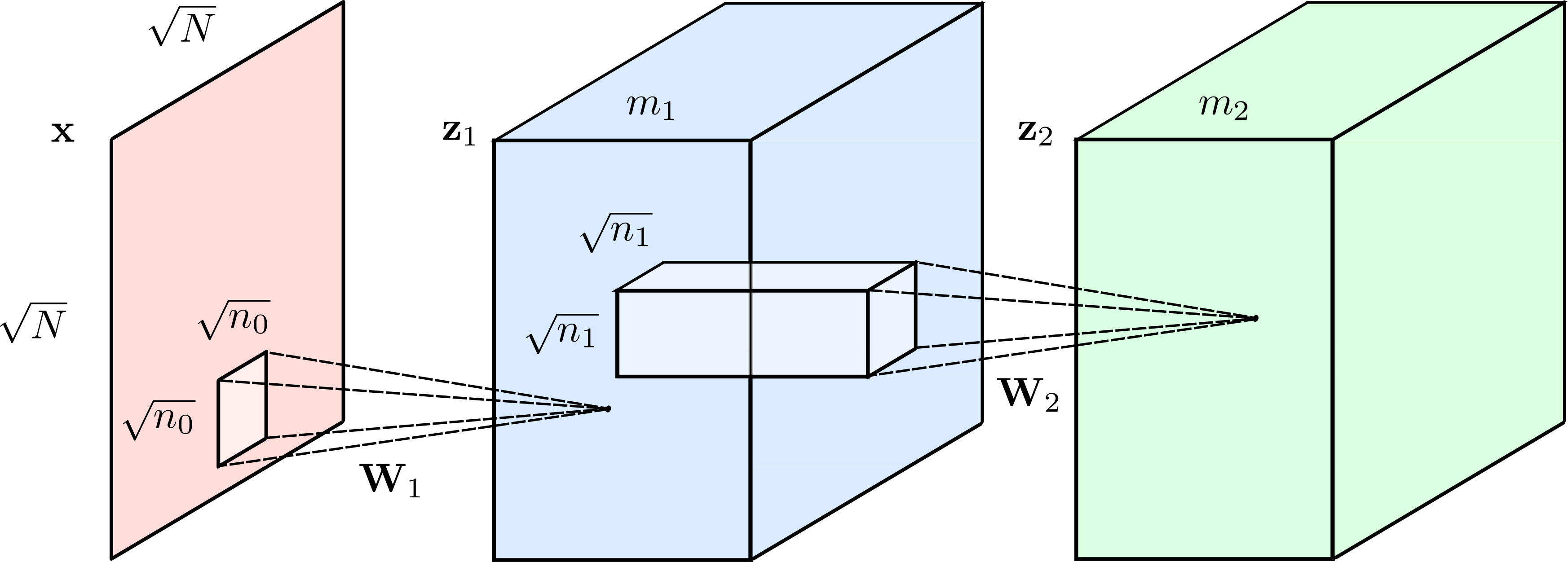
A convolutional-network diagram illustrates learned visual representations as background; the article distinguishes the architecture used by Qwen-VL.
Renanar2 · Image source · CC BY-SA 4.0

Ask a visual assistant to describe a desk, and it may produce a convincing paragraph. Ask it to select the cable connected to the smaller monitor, and correctness becomes more demanding: the words must refer to a particular object, and the output must identify the right region. This is visual grounding. Qwen3-VL's November 2025 technical report provides a broad multimodal foundation; the May 8, 2026 Qwen3-VL-Seg preprint investigates a narrower extension from boxes to pixel masks. That specialist paper is the current development examined here, not a claim that every later Qwen model has the same architecture. Its design makes the distinction between semantic understanding and spatial evidence unusually concrete.
A correct description can still point to the wrong thing
Qwen3-VL supports text, images and video within a multimodal context. Its report describes changes to spatial-temporal position handling, integration of visual features from multiple levels and explicit textual time alignment for video. Those mechanisms support broad image and video reasoning, but a broad benchmark score cannot answer every application-specific localization question. A request to identify an object has a different success condition from a request to write a plausible account of the scene.
Consider a hypothetical photograph containing two laptops and three charging leads. The instruction to select the lead attached to the closed laptop requires several steps: recognize both laptops, distinguish their states, trace the connection and choose the lead's visible extent. A model might name the correct laptop but highlight the neighboring cable. It might highlight the correct cable yet include most of the desk. These are different failures. Keeping them separate helps an evaluator determine whether the problem concerns language, relational reasoning, object identity or geometric precision. A single conversational answer often hides those distinctions.
The 2026 extension uses coarse location as a prior
Qwen3-VL-Seg treats a predicted bounding box as a spatial starting point for a mask decoder. The authors combine visual features at different scales, language-and-box-conditioned queries, high-resolution pixel information and a refinement pass. They report adding 17 million parameters, approximately 0.4 percent of the base model. The intended advantage is detailed referring segmentation without requiring a separate large segmentation model at inference. This is an architectural proposal supported by the paper's experiments, rather than a guarantee about every deployment configuration.
A rectangle is a useful compact summary of location, but it cannot express a cable's shape or the hole in a mug handle. A pixel mask can represent those boundaries, though it introduces many more decisions. An independent analogy is an editor first circling a paragraph and then marking the specific words that need changing. The circle narrows attention; it does not perform the detailed selection. Using a box as guidance can reduce ambiguity, but a wrong initial box can also steer attention toward the wrong region. The quality of the coarse anchor and the detailed decoder need to be tested together.
Coordinate handling is part of the experiment
The official Qwen3-VL repository provides preprocessing utilities and usage examples for images and video, including grounding-related interfaces. That surrounding code matters. A coordinate is meaningful only relative to a particular image size and coordinate convention. Resizing, cropping or rotating an image can alter the relationship between model output and the original photograph even when the language response remains unchanged. Reproducible visual grounding therefore includes the preprocessing path, not just the checkpoint name and prompt.
For an independent example, a hypothetical original image is 1,600 pixels wide. A preprocessing step crops away the first 400 pixels and resizes the remaining 1,200-pixel width to 600. A predicted horizontal coordinate of 200 in the resized crop corresponds to 400 in the unscaled crop and 800 in the original image. Simply drawing at 200 in the original would create a large error unrelated to whether the model recognized the target. This calculation is a general illustration, not a prescribed Qwen coordinate format. It shows why test images with known marked points are valuable before evaluating complex instructions.
Open vocabulary still needs an evaluation vocabulary
The segmentation paper introduces SA1B-ORS training data with category-oriented and descriptive subsets, and ORS-Bench with in-distribution and out-of-distribution evaluations. Those distinctions matter because selecting every chair is different from selecting the chair behind the person wearing a striped shirt. A category-oriented sample tests membership; a descriptive sample also tests whether context singles out the intended instance. The paper's reported improvements should be read within those constructed data and evaluation settings.
A useful independent test collection would vary the instruction while holding the photograph fixed. First request a broad category, then one member by an attribute, then a member by a relationship. Finally request an absent object. Such a sequence can reveal whether a system follows the words or repeatedly selects the most visually prominent region. Evaluators should decide beforehand what to do with genuinely ambiguous instructions. If two objects satisfy the description, forcing one arbitrary target can punish a reasonable interpretation. Conversely, accepting any plausible output after seeing the prediction makes the test too forgiving.
A good mask is not the same as a correct downstream action
Suppose an image-editing application wants to recolor the jacket of the person nearest the door. An accurate target mask may make the edit easy to review. A robot asked to grasp the same jacket faces additional uncertainty: fabric can fold, slide and conceal other objects. The visual region does not directly specify a stable grasp or the forces required. This is an illustrative distinction between outputs and uses, not a claim that the Qwen segmentation system has been validated for either application.
Even the definition of a good boundary depends on purpose. For a photo effect, a slightly fuzzy edge may be acceptable if the result looks natural. For measuring visible surface area, the same uncertainty affects the quantity being reported. If a mask includes 9,000 of 10,000 target pixels but also adds 1,000 background pixels, its overlap with the true mask is 9,000 divided by 11,000, about 81.8 percent under intersection-over-union. That toy calculation shows why a large correct interior cannot compensate indefinitely for unwanted background. It also says nothing by itself about whether the selected object matched the instruction.
Better grounding should remain inspectable
A useful diagnostic would preserve a full visual audit trail for each attempted selection: the original instruction, the image after preprocessing, the coarse location and the final region. This is a proposed evaluation design, not another reported experiment. If an answer is wrong, the record would help a reviewer determine where the interpretation first diverged from the request. It would also make successful examples more informative, since a polished final overlay otherwise hides how much intervention was required to produce it.
The most informative next comparisons would retain full failure cases, include instructions with no valid target and vary image transformations independently from semantic difficulty. They would measure how much manual correction is needed, and whether improving a mask damages general multimodal behavior. They would also compare end-to-end latency and memory rather than parameter overhead alone. A small additional decoder can still sit behind an expensive base model. Qwen3-VL-Seg gives a current, testable design for grounding at pixel level. The enduring lesson is that an assistant earns trust by connecting its words to the right evidence, in an output that a person can actually inspect.
Sources & further reading
Primary papers, project documentation, and research releases used in this article. Publication dates below refer to the sources themselves.
- Qwen3-VL Technical ReportQwen team / arXivPublished Checked
- Qwen3-VL-Seg: Unlocking Open-World Referring Segmentation with Vision-Language GroundingTongyi Lab, Alibaba Group / arXivPublished Checked
- Qwen3-VL — official repositoryQwen team, Alibaba Cloud / GitHubChecked
FOLLOW THE QUESTION
Study engineering foundations