ARTIFICIAL INTELLIGENCE
Cosmos 3 and the gap between a world model and the world
NVIDIA’s June 2026 Cosmos 3 report joins language, video, audio, and actions, while exposing the difference between plausible simulation and reliable control.
Research checked
Newest cited publication
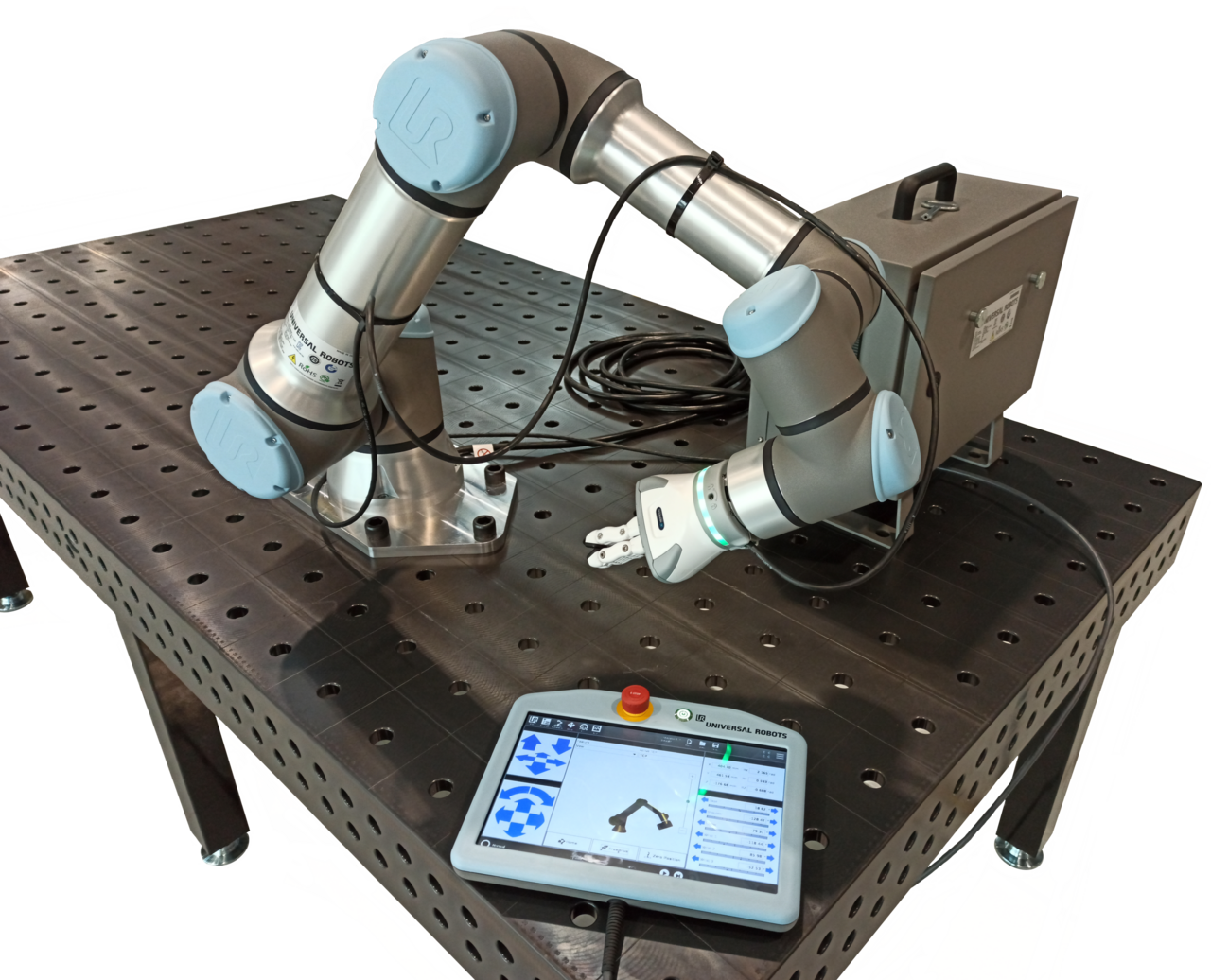
An industrial robot arm supplies real-world context for evaluating generated environments and physical action; it is a separate platform from the systems discussed here.
Auledas · Image source · CC BY-SA 4.0

A robot that can imagine a future has acquired something useful, but imagination alone cannot tell it whether a glass will slip. The June 1, 2026 Cosmos 3 preprint brings language, images, video, audio, and action sequences into a common modeling framework. It is a concrete advance in how researchers organize physical AI. The interesting question is what must happen between a persuasive generated future and a decision that remains correct when motors, friction, and incomplete observations intervene. That gap deserves as much attention as the visual demonstrations.
What Cosmos 3 actually unifies
The Cosmos 3 report describes modality-specific encoders feeding a mixture-of-transformers architecture. A language-oriented pathway generates tokens sequentially, while a generative pathway iteratively denoises nonlanguage representations. Actions are treated as an explicit modality rather than merely being described in captions. This gives the framework several operating modes, including predicting visual consequences from actions and inferring actions from observed changes.
A simple hypothetical example clarifies why those modes differ. Given a picture of an open drawer and a closing command, forward prediction asks what the camera should see next. Given the open and closed pictures, inverse prediction asks which motion could connect them. A policy must choose a motion that advances a goal. These are related questions with different missing information. Sharing a representation can make their relationship learnable, but it does not mean that success on one automatically establishes success on the others.
The platform extends beyond a checkpoint
NVIDIA's current repository organizes Cosmos as a platform with separate training, data-curation, and evaluation tools. It identifies a reasoner interface for text and vision, and a generator interface that can accept or produce additional modalities. The repository also records a July 2026 Cosmos3-Edge release. These are practical implementation surfaces; an experiment must still specify which variant, task, and execution environment it used.
The separation is scientifically useful. A training run can fail because its examples were poorly selected even when the architecture is sound. A convincing demo can conceal weak coverage if only familiar situations were collected. Treating curation and evaluation as explicit systems makes those choices visible. For a small robotics laboratory, the relevant question may be whether it can trace every test scenario to an independent data split, rather than whether it can afford the largest available model. Better bookkeeping can reveal a limitation that extra parameters would merely hide.
A camera does not observe every physical variable
A world model usually receives incomplete evidence about the underlying state. Two visually identical cups may have different masses. A surface can look dry while carrying a thin film of oil. In an original thought experiment, a robot observes a sealed box resting on a table. One version is empty and the other contains a heavy metal block. Before contact, the camera images could be indistinguishable even though the correct lifting command is very different.
This is a problem of partial observability, not necessarily a training defect. The appropriate prediction may be a range of possible outcomes rather than one authoritative video. A controller can then select an information-gathering action, such as a gentle initial lift, and revise its estimate from force or motion feedback. The Cosmos framework creates a place to represent actions and observations together. Whether a particular deployment handles hidden variables requires targeted tests that expose those variables, rather than visual inspection of ordinary footage.
Physical evaluation needs several independent rulers
The Cosmos 3 technical report includes both broad generation evaluations and a more targeted physics benchmark. It explicitly distinguishes general physical plausibility within mixed quality scores from a dedicated test of physical continuations. That distinction matters: a scene can receive favorable visual judgments while predicting the wrong trajectory. The report's benchmark results are results from its stated conditions and publication period, rather than proof of universal physical competence.
For an independent pendulum test, one could measure the predicted period, turning points, and energy loss across cycles. Attractive shadows should not compensate for a period that changes without a cause. For manipulation, an evaluator might instead measure final pose error, dropped objects, and recovery after a perturbation. No single score captures all of these. The evaluation should follow the intended use: a cinematic tool needs different tolerances from a system choosing whether a real robot arm can clear a shelf.
Generated experience can reproduce the generator’s blind spots
NVIDIA positions Cosmos for synthetic-data generation and physical-AI development. Its documentation also describes a broader model family with controllable transfer tools, including structure supplied through depth, edges, or segmentation. These controls can help vary appearance while retaining scene organization. They should not be confused with a guarantee that every resulting contact or material interaction matches an instrumented experiment.
Imagine a training library in which every generated slippery object is conveniently easy to grasp. A policy could become excellent at the synthetic task and worse prepared for the real one. This is an independent failure scenario, not a reported Cosmos result. A useful safeguard is to keep a real evaluation set that the generator never supplies or grades. Synthetic examples can then be judged by whether they improve performance on that set. Agreement between a generator and a policy trained on its outputs is weaker evidence than agreement with observations neither system controlled.
Reliable action requires a loop that can admit error
The Cosmos repository provides model artifacts and links to evaluation workflows, which makes external investigation more practical than a demonstration-only release. Openness allows researchers to inspect interfaces, adapt tasks, and publish failures. It does not remove the need to understand the license of each component or the assumptions embedded in the data. An accessible checkpoint is the beginning of a reproducible investigation.
An original deployment test could separate planning from execution: generate candidate actions, reject candidates violating geometric constraints, execute only a short segment, and compare the observed result with the predicted one. When the discrepancy grows, the system should replan or request assistance. This approach treats the model as a fallible source of useful forecasts. The most informative next result would show that those forecasts improve independently measured real-world outcomes across unfamiliar conditions, with failed attempts and intervention rates reported alongside successful demonstrations. That would connect a unified representation to reliable physical work.
The model should be allowed to imagine several futures
A useful world-model interface could expose disagreement instead of hiding it behind one polished sample. Imagine three plausible forecasts for a rolling ball: it stops before a doorway, crosses the threshold, or strikes the frame. If the control decision is identical in all three cases, uncertainty may be tolerable. If one forecast places the ball near a person's feet, the decision should account for that possibility. This is a proposed use of predictive diversity, not a claim that the published system already implements calibrated risk estimates.
Calibration would require repeated trials with observable outcomes. Among events assigned a particular probability, roughly that fraction should occur under the evaluation conditions. Merely producing several distinct videos does not establish calibration; diversity can include attractive but impossible outcomes. A practical investigation would compare predicted variation with measured variation and separate uncertainty caused by hidden state from uncertainty caused by model error. This would make the boundary of useful imagination measurable. The strongest world model may be the one that helps a controller recognize when its forecast is too weak to justify action.
Sources & further reading
Primary papers, project documentation, and research releases used in this article. Publication dates below refer to the sources themselves.
- Cosmos 3: Omnimodal World Models for Physical AIarXivPublished Checked
- NVIDIA CosmosNVIDIAChecked
- Introduction — NVIDIA NIM for Cosmos WFM (World Foundation Models)NVIDIAChecked
- NVIDIA Cosmos LabNVIDIAChecked
FOLLOW THE QUESTION
Study engineering foundations