ARTIFICIAL INTELLIGENCE
OpenVLA and the language of robot actions
An August 2026 simulation preprint tests OpenVLA-OFT on a cable-driven robot, revealing why action representations and embodiment still constrain transfer.
Research checked
Newest cited publication
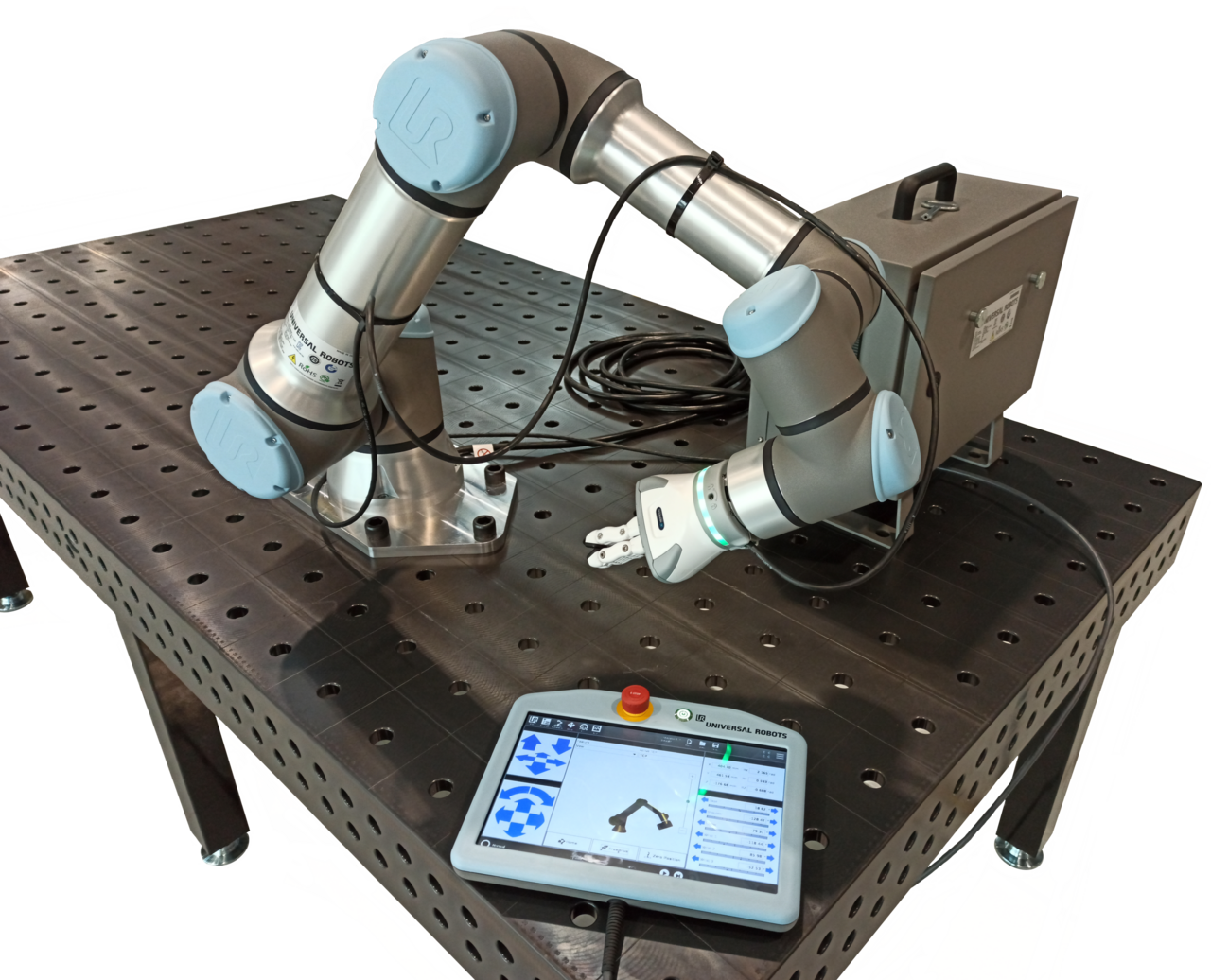
An industrial manipulator illustrates the physical action interface used in robotics. The photograph is general background for OpenVLA’s policy representation.
Auledas · Image source · CC BY-SA 4.0

An instruction such as move left sounds independent of the machine carrying it out. A robot controller knows otherwise: left depends on coordinate frames, camera placement, and the mechanism connecting a command to motion. An August 2, 2026 preprint investigates this problem by adapting OpenVLA-OFT to a cable-driven parallel robot without demonstrations collected for that embodiment. The result is deliberately narrower than general manipulation. Read alongside the original OpenVLA work and its 2025 fine-tuning successor, it shows how much useful research lies between understanding words and moving unfamiliar hardware.
A 2026 result with a sharply defined boundary
Nurtdinov, Kornaev, and Maloletov study reinforcement learning in simulation for a cable-driven robot with a gripper and a previously unseen control interface. Their preprint reports improved success on directional instructions after a second training stage. It also reports only 39 successful trials out of 400 for stricter object-conditioned commands. The authors explicitly avoid claiming robust manipulation. This is a simulated adaptation study, not a demonstrated deployment on the physical machine.
That modest boundary makes the result useful. A model that approaches the correct target but becomes unstable near arrival has learned something different from a model that completes the task. An evaluator who records only apparent intent could miss the difference. For a new mechanism, even basic directional grounding may require substantial learning. The study therefore offers a current test of transfer difficulty without treating a recognizable trajectory as evidence that unfamiliar embodiment has been solved.
What the original OpenVLA connected
OpenVLA's June 2024 paper introduced a seven-billion-parameter vision-language-action model trained using roughly 970,000 real robot demonstrations. Its architecture combines a language backbone with visual features from two pretrained image encoders. The important connection is that language and images condition actions rather than ending at a textual answer. A robot can thus associate an instruction with visual evidence and a corresponding control response.
Consider a hypothetical scene containing two identical mugs, one beside a plate and one beside a notebook. A command referring to the mug by the notebook requires relational visual grounding. A controller that merely detects the category mug has not identified the requested object. Even correct identification leaves the approach direction, grasp pose, and surrounding obstacles unresolved. This example explains why the action interface matters: semantic competence supplies useful structure, but the robot must still convert it into a state-dependent movement.
A faster action head can change the practical policy
The February 2025 OpenVLA-OFT paper studies adaptation choices rather than simply scaling the base model. Its recipe combines parallel action decoding, chunks of future actions, continuous outputs, and an absolute-error regression objective. The authors report an increase from 76.5 to 97.1 percent average success across four LIBERO simulation suites, alongside substantially higher action-generation throughput. They also evaluate fine-tuned policies on a real bimanual robot. Those two evaluation settings must remain distinct.
The general engineering issue is timing. If a model takes longer to choose an action than the environment takes to change materially, a semantically correct decision can already be stale. Predicting a short sequence in parallel reduces repeated computation. It also creates a commitment horizon: the longer the robot proceeds without new observations, the longer a mistaken forecast can influence it. An effective controller must balance efficient chunk generation with the opportunity to incorporate fresh visual feedback.
Embodiment is more than a different silhouette
The 2026 cable-driven study makes the control mismatch unusually visible. A cable mechanism moves through changes in coordinated cable lengths, rather than reproducing the joint interface of a conventional rigid arm. Its authors use staged reinforcement learning with simulator-derived geometric rewards to bootstrap alignment. Their absence of embodiment-specific demonstration data is an experimental condition, not an absence of supervision or task information: the reward and simulator still encode substantial knowledge.
For an original geometric example, imagine rotating a camera ninety degrees around the workspace while leaving the control axes unchanged. An image-based policy that interprets left as leftward pixels may now command the wrong physical direction. Adding a new gripper introduces another mismatch: the same visual alignment might no longer permit contact. These differences explain why a shared language vocabulary does not imply a shared motor vocabulary. A transfer experiment should document calibration and action scaling as carefully as the neural-network checkpoint.
The denominator is part of the result
The OpenVLA-OFT project publishes implementation details and qualitative examples, including failed behaviors. Its comparisons distinguish reliable task completion from approaches that select the wrong item or fail later in execution. This is a valuable reporting habit because a robot can make several apparently sensible decisions before the final outcome reveals a mistake. Videos are helpful when they show that progression, but they do not replace a complete trial table.
An independent protocol could score three stages separately: choosing the requested object, establishing a stable grasp, and placing it within a specified region. Suppose twenty attempts yield eighteen correct selections, twelve stable grasps, and nine completed placements. The selection rate is ninety percent, while end-to-end success is forty-five percent. Both numbers are correct and describe different capabilities. Reporting the former alone would overstate usefulness. For the 2026 simulation result, the strict object-conditioned success criterion is especially important because visually promising approaches often end unsuccessfully.
Reproduction starts with the interface contract
The OpenVLA repository releases training and evaluation machinery and directs users toward the optimized fine-tuning work. Access to code lets another laboratory inspect preprocessing, action normalization, and dataset assumptions. It also makes a stable baseline possible: researchers can change one component and check whether the effect persists. Public availability, however, does not imply that all robots, cameras, and task definitions are interchangeable.
Before comparing two policies, an original reproduction plan should freeze the observation frequency, image crop, instruction phrasing, reset procedure, and termination rule. A method that receives more frequent images has a different feedback channel. A method evaluated after carefully arranged resets may encounter fewer difficult states. When hardware is unfamiliar, small interface mistakes can dominate architectural improvements. The next persuasive extension of the cable-driven study would couple transparent simulation results with carefully bounded physical tests and recovery measurements. Until then, its strongest contribution is a reproducible question about grounding language in a new mechanism.
A reward can teach a shortcut as easily as a skill
The 2026 study's use of dense geometric rewards suggests a general question for follow-up work: what exactly becomes easier to optimize? In an original counterexample, reward a gripper only for reducing the distance to a target center. It might approach from below a tabletop, collide with an obstacle, or stop close without establishing a useful pose. A reward that tracks one geometric quantity can produce apparent progress while leaving the intended task incomplete.
A stronger independent protocol would define success outside the training reward, test instructions with varied phrasing, and introduce target layouts not used during optimization. It would then compare an adapted pretrained model against a smaller controller trained with the same simulator access and reward information. That comparison helps reveal whether language-action pretraining supplies transferable structure or merely an expensive initialization. The study's limited strict success rate makes this distinction particularly relevant. Progress need not be dismissed because it is partial, but a partial controller becomes scientifically valuable when its remaining failures are specific enough to guide the next experiment.
Sources & further reading
Primary papers, project documentation, and research releases used in this article. Publication dates below refer to the sources themselves.
- RL Bootstrapping of OpenVLA-OFT for a Novel Robot EmbodimentarXivPublished Checked
- OpenVLA: An Open-Source Vision-Language-Action ModelarXivPublished Checked
- Fine-Tuning Vision-Language-Action Models: Optimizing Speed and SuccessarXivPublished Checked
- Fine-Tuning Vision-Language-Action Models: Optimizing Speed and SuccessStanford UniversityChecked
- OpenVLA: An Open-Source Vision-Language-Action ModelOpenVLA teamChecked
FOLLOW THE QUESTION
Study engineering foundations