ARTIFICIAL INTELLIGENCE
SpatialVLA and the Shape of Robot Knowledge
SpatialVLA encodes geometry in observations and actions. A 2026 comparison asks how that design changes robot learning, transfer and the meaning of success.
Research checked
Newest cited publication
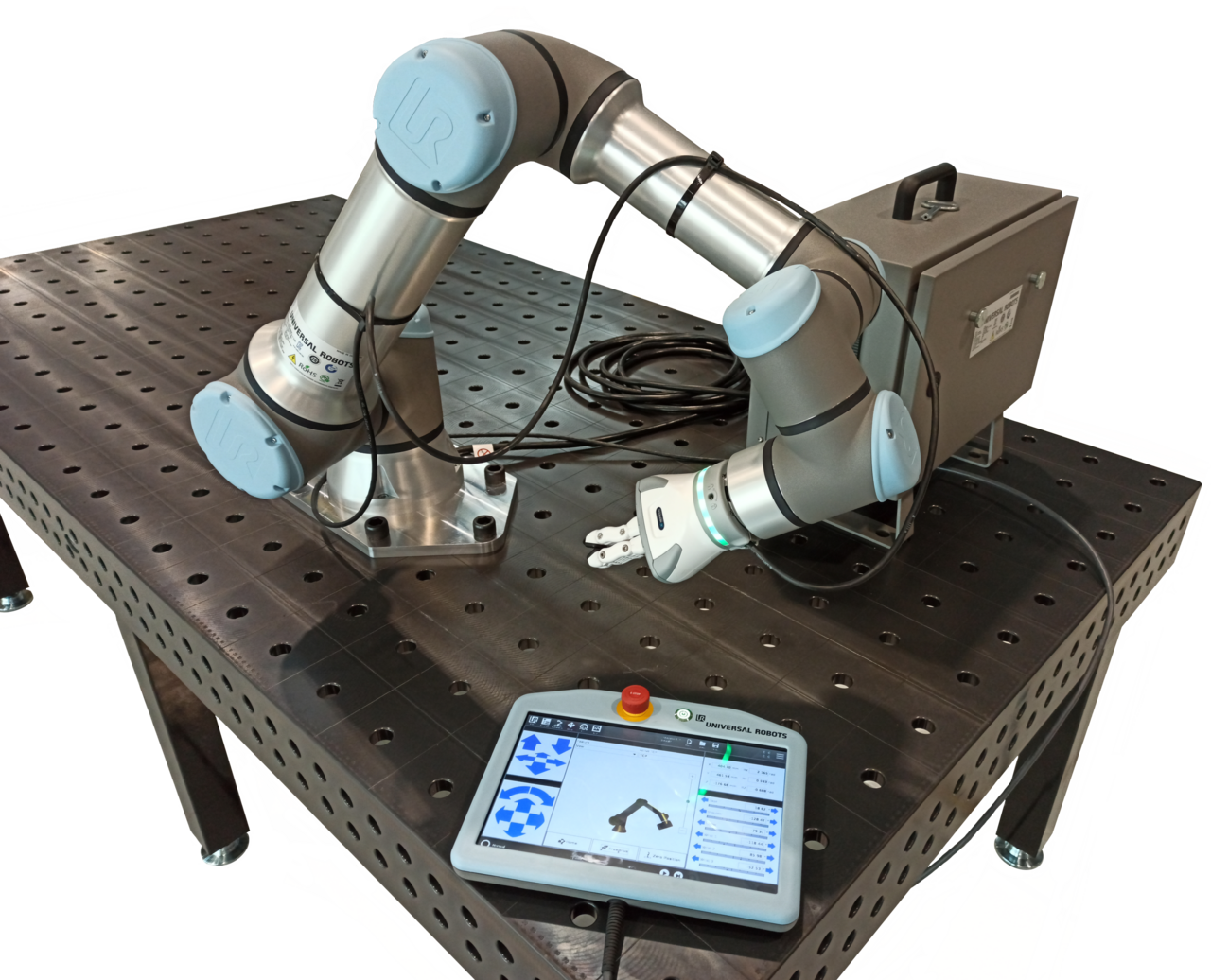
An industrial robot arm provides physical context for translating visual and language representations into actions; the photographed platform is a separate system.
Auledas · Image source · CC BY-SA 4.0

The instruction to move a cup slightly left contains a hidden coordinate system. Left can mean left in the camera image, left relative to the robot, or left from the speaker's viewpoint. A model trained to connect pictures and sentences to actions must resolve such geometry somehow. SpatialVLA, introduced in January 2025 and published at Robotics: Science and Systems that year, makes spatial representation an explicit design choice. The continuing relevance is visible in August 2026's GaussVLA work, which proposes another geometric representation and compares with SpatialVLA. Together they frame a practical question: which structure should be built into a robot model, rather than left for it to rediscover from examples?
The observation and the action both need structure
SpatialVLA adds Ego3D Position Encoding to visual observations and uses Adaptive Action Grids for spatial movement. Its paper describes pretraining on 1.1 million real-world robot episodes on top of a vision-language model. The two modifications address different parts of the learning problem: representing where visual information lies in three dimensions and expressing robot movement through discretized spatial action tokens. The aim is transferable spatial knowledge across tasks and robot setups, rather than treating every action coordinate as an unrelated symbol.
The distinction can be explained without assuming that a neural network reasons like a person. An input representation decides which distinctions are immediately available to later computation. An output representation decides which predictions can be expressed economically. If nearby movements receive unrelated codes, the learner must reconstruct their relationship through experience. If the code reflects spatial neighborhood, some useful regularity is supplied in advance. That can simplify learning, but it can also impose the wrong regularity when the coordinate convention or task changes. A structured representation remains an assumption that needs testing.
A three-dimensional encoding still inherits uncertainty
The project page describes a pipeline that extracts semantic visual features, adds three-dimensional spatial context, predicts action tokens and converts them to continuous robot actions. It evaluates spatial understanding alongside zero-shot behavior and adaptation. These are useful distinctions because a model can recognize the requested object while making a poor movement toward it. Additional geometry is intended to make the relationship between a visual observation and a spatial action easier to learn.
An independent example illustrates the remaining uncertainty. Two cups may look similar in image size even though one is smaller and closer to the camera. Recovering depth from a single view involves assumptions about shape, scale and perspective. A dark reflection can resemble a boundary; a transparent surface can reveal background texture. Encoding an estimated position does not turn the estimate into a measurement with guaranteed accuracy. A compelling ablation therefore changes the quality of geometric input, rather than merely comparing an architecture with and without additional parameters. It asks whether improvement survives the kinds of depth error the intended environment actually produces.
The grid changes what the model can express
The authors describe adapting their action grids when fine-tuning for a new setup. This is more specific than claiming that one set of action tokens directly controls every robot. A different arm, controller or task distribution can have different useful motion scales. Re-discretizing a representation allows the learned vocabulary of movement to be adjusted, while preserving the broader model as a starting point.
For an independent toy example, divide a hypothetical displacement interval from minus ten to plus ten centimeters into twenty equal bins. Each bin spans one centimeter. A task requiring repeatable millimeter placement cannot be represented accurately by choosing only the center of those bins, unless the system has another refinement mechanism. Allocating more bins around small motions can improve local resolution but leaves fewer distinctions elsewhere for a fixed vocabulary. This is not SpatialVLA's exact numerical grid. It explains why discretization, normalization and adaptation deserve attention when an action model is compared across tasks. Representation has an error budget just as a sensor does.
Open code exposes the conventions behind a result
The official repository provides pretrained model loading, action decoding, evaluation and fine-tuning instructions. It identifies a PaLiGemma2 backbone and describes its demonstration mixture, including Open X-Embodiment and RH20T data. Its example decodes an action using a dataset-specific normalization key. Such details matter because the numbers output by a policy gain physical meaning only after the appropriate transformations. Reproducing a result involves those conventions as well as downloading weights.
Suppose two implementations both output a displacement value of 0.2. In one, it might represent a normalized location within a training distribution; in another, a distance in meters; in a third, an increment accumulated by a controller. The same printed number could produce unrelated motions. A sound replication checks a small set of known observations and expected action transformations before attempting an aggregate benchmark. It also records control frequency and resets. Otherwise a change attributed to better spatial reasoning may actually come from an action-scaling difference or a more forgiving execution setup.
GaussVLA asks for richer geometry, with bounded evidence
The GaussVLA preprint appeared August 25, 2026 and is marked accepted to BMVC 2026. It proposes Gaussian spatial tokens and a depth-aware reasoning component, arguing that scalar depth alone does not express surface orientation or geometric confidence. Its abstract reports 93.5 percent average success on LIBERO and 100 percent on the Spatial suite with 200 million parameters. The authors report a 19.7 percent relative average-success improvement over SpatialVLA in that comparison. These are the authors' benchmark findings, not evidence of universal dominance across robot platforms.
The relative qualifier matters. If a baseline scores 50 and a new system scores 60 on the same hundred-point scale, the increase is ten percentage points but twenty percent relative to the baseline. More broadly, a perfect score on a finite benchmark suite means every evaluated case passed under that protocol. It does not establish success on every possible scene. My inference is that the comparison strengthens interest in explicitly geometric representations while leaving open how much of the gain comes from the representation, training mixture, architecture and evaluation choices. Matched ablations and independent replication are needed to separate those contributions.
The useful question is what changes without retraining
A revealing next experiment would vary object position, camera viewpoint and robot embodiment separately. Those are proposed tests, not additional published results. A policy might tolerate a moved object because the visual representation preserves relative geometry, yet fail under a camera shift because its estimated frame is unstable. It might transfer to a similar robot after normalization while requiring new demonstrations for a different gripper. Calling all of these cases generalization hides which capability was actually tested.
SpatialVLA's contribution is a concrete attempt to put geometry into both sides of the perception-to-action mapping. GaussVLA shows that the representation question remains active in 2026, rather than being settled by larger language models alone. The most useful future robot knowledge may combine semantic information with coordinates, uncertainty and contact evidence in a form that controllers can use. That is an interpretation of the research direction, not a claim that either system already contains a complete physical model. Progress will be clearest when the same experimental record shows what the robot understood, what it attempted and why the attempt succeeded or failed.
Sources & further reading
Primary papers, project documentation, and research releases used in this article. Publication dates below refer to the sources themselves.
- SpatialVLA: Exploring Spatial Representations for Visual-Language-Action ModelSpatialVLA authors / arXivPublished Checked
- SpatialVLA: Exploring Spatial Representations for Visual-Language-Action ModelsSpatialVLA research teamChecked
- SpatialVLA: Exploring Spatial Representations for Visual-Language-Action Models — official repositorySpatialVLA research team / GitHubChecked
- GaussVLA: Geometry-Aware Spatial Reasoning for Vision-Language-Action ModelGaussVLA authors / arXivPublished Checked
FOLLOW THE QUESTION
Study engineering foundations