ARTIFICIAL INTELLIGENCE
Browser agents beyond a success screenshot
WebArena-Verified’s 2026 release and BrowserGym show how web agents should be judged through reproducible actions, structured results, and evidence of state changes.
Research checked
Newest cited publication
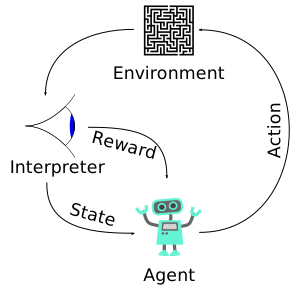
A general action-and-feedback diagram illustrates the interaction loop studied by browser-agent benchmarks.
Megajuice · Image source · CC0 1.0

A browser agent announces that it updated an issue, booked a room, or found the cheapest compatible part. Its screenshot looks convincing. What would establish that the underlying task is actually complete? This question sits at the center of current web-agent evaluation. BrowserGym offers a shared experimental environment; WebArena supplies realistic, controllable websites; and WebArena-Verified has reworked the dataset and grading machinery, with an official package release dated February 7, 2026. The interesting development is therefore broader than a new leaderboard position. It concerns the chain of evidence between a user's instruction and a changed application state. That chain can break even when an agent clicks the right-looking button and writes a perfectly fluent final message.
A controlled website makes the claim testable
The original WebArena paper, first submitted in July 2023, introduced a self-hostable collection of websites and tasks intended to evaluate functional completion rather than the plausibility of an answer alone. Its continuing relevance is experimental control. A public shopping website changes products, login behavior, and page structure; a reproducible environment can restore a known starting state. That allows different agents to encounter comparable tasks, although it also narrows the environment relative to the variety and unpredictability of the public web.
Imagine the instruction: change the delivery address for an order without changing its contents. A screenshot of the new address does not prove that the correct order was modified. The evaluator needs the order identifier, the final address, and evidence that the line items remained intact. Restoring the starting database before each attempt prevents a previous run from accidentally doing the work for the next agent. In this original example, the meaningful unit of evaluation is a constrained state transition, not a visible page or a declaration of success.
Shared machinery reduces hidden differences
The BrowserGym ecosystem paper was first posted in December 2024 and revised in February 2025. It describes a common environment interface and AgentLab tooling for creating, running, and analyzing agents across web benchmarks. This matters because an observation is an experimental choice: an agent might receive a screenshot, an accessibility representation, textual page content, or some combination. An action space is another choice. Clicking a coordinate and invoking a structured element action can impose different perception and control demands even when they target the same page.
A useful comparison keeps those choices visible. Suppose one agent receives element labels and another sees only pixels. If the first performs better, the result may reflect stronger reasoning, easier observations, or both. The same issue appears when a framework truncates a large page or decides which tabs enter context. A shared interface does not magically make all experiments identical. It makes the differences easier to specify and inspect, which is a prerequisite for learning why one approach works better than another.
The 2026 release focuses on the acceptance rule
The official WebArena-Verified documentation describes an audited set of 812 tasks and a difficulty-prioritized subset of 258. Its evaluators use structured comparisons and captured network traces, with support for scoring recorded runs without keeping the websites live. The repository announced package availability in January 2026 and further distribution improvements in February. Version 1.2.3, released February 7, specifically includes dataset-parity and build-artifact fixes. These dated maintenance changes are part of evaluation reliability, rather than evidence of a newly discovered general agent capability.
Structured grading can express distinctions that substring matching misses. If the requested answer is a set of three product identifiers, finding one identifier somewhere inside a long response is inadequate. An evaluator should compare the expected type and membership, and decide whether extra items invalidate the answer. If an agent changes a setting, a recorded request can identify what was submitted. The quality of that check depends on its semantics: sending a request and obtaining the intended durable state are related events, but they need not be identical.
A trace answers some questions and leaves others open
Captured network activity is valuable because it records interactions that a final screenshot can hide. It can show that an agent attempted to modify the intended object with particular parameters. Replay also enables another investigator to revisit grading without repeating an expensive model run. However, the evaluator must know which events establish success. A request can be rejected, accepted asynchronously, or applied only partly. The correct evidence depends on the endpoint and application behavior. Trace-based evaluation is a mechanism that must be validated, rather than a universal guarantee.
For an original asynchronous example, imagine a report-generation request that returns an accepted status immediately while a background job writes the file later. The accepted response proves the job was queued. It does not establish that the report exists or contains the required date range. A valid task-specific grader could inspect the eventual artifact or a documented completion event. This distinction prevents an agent from receiving full credit for stopping at an intermediate acknowledgment. It also explains why preserving raw observations alongside the computed score is useful for later audits.
Finding information creates its own failure modes
Many web tasks combine navigation with information integration. An agent might need to identify a project from one page, read its discussion on another, and update a related object in a third. The challenge is not merely reaching each destination. The agent must preserve identifiers and constraints across context changes. A page title that looks similar to the target can pull the workflow toward the wrong record. After that mistake, a technically successful edit becomes a failure of the user's actual request.
One practical design hypothesis is to maintain a compact evidence ledger containing the target identifier, relevant source facts, unresolved ambiguities, and checks still needed. This is an author proposal, not a measured result from the cited releases. Its value would need an ablation: compare otherwise identical agents with and without the ledger on held-out tasks, including misleadingly similar records. Measure incorrect edits as well as successful ones. An agent that acts less often but avoids damaging the wrong object may serve users better than one whose aggregate completion count is slightly higher.
A useful retained record would also distinguish an observed fact from an assumption. An account name inferred from a familiar avatar should remain unconfirmed until a reliable identifier is checked. Making that uncertainty explicit allows later observations to revise the plan before an incorrect state change becomes difficult to reverse.
Report the conditions behind the percentage
A meaningful web-agent result should identify the task and environment versions, allowed observation formats, action limits, model settings, retry policy, and evaluator version. It should also distinguish navigation failures, invalid actions, incorrect final answers, and unwanted state changes. These categories point to different improvements. Better visual grounding helps with a mislocated button; it does little for a correct button attached to the wrong account. More retries may overcome transient page errors while repeatedly reproducing the same faulty interpretation of a request.
The 2026 WebArena-Verified release and the BrowserGym framework make this style of investigation more practical, but they do not eliminate the distance between a controlled benchmark and deployment. Real sites introduce shifting layouts, permissions, live users, and consequences that a resettable database cannot fully reproduce. The most credible progress claim therefore combines transparent benchmark evidence with carefully bounded deployment tests. A success screenshot can introduce that evidence. The decisive question remains whether the system changed exactly what the user intended, under conditions that another evaluator can understand and reproduce.
Sources & further reading
Primary papers, project documentation, and research releases used in this article. Publication dates below refer to the sources themselves.
- WebArena: A Realistic Web Environment for Building Autonomous AgentsarXivPublished Checked
- The BrowserGym Ecosystem for Web Agent ResearcharXivPublished Checked
- Welcome to WebArena-VerifiedServiceNowChecked
- Release v1.2.3ServiceNowPublished Checked
- WebArena-VerifiedServiceNowChecked
FOLLOW THE QUESTION
Study engineering foundations