ARTIFICIAL INTELLIGENCE
Olmo 3 and the scientific value of an open training record
Olmo 3 and the October 2026 Olmo-core release show why inspectable checkpoints, data and training infrastructure matter beyond a model's final score.
Research checked
Newest cited publication
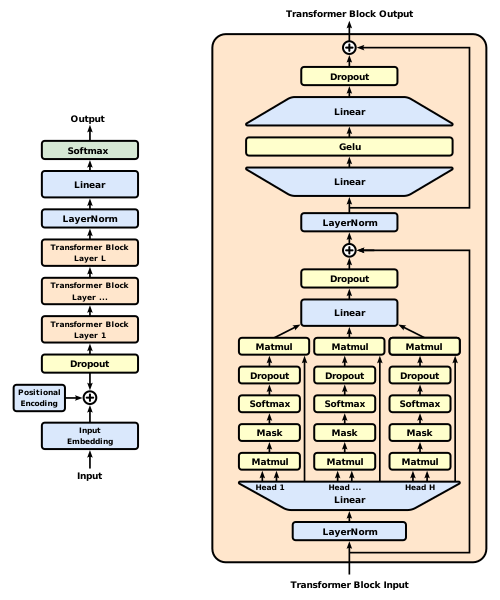
A transformer architecture schematic provides background for the open training artifacts and reproducibility questions discussed in the article.
Marxav; vectorization by Mrmw · Image source · CC0 1.0

Imagine receiving an excellent scientific instrument with no account of its calibration. You can measure what it does today, but investigating a surprising result becomes difficult. A language model distributed only as final weights creates a related problem: researchers can inspect its behavior without knowing which development decisions produced it. Ai2's Olmo project makes the training record part of the research object. The latest development examined here is the October 1, 2026 release of Olmo-core 3, an infrastructure upgrade. That should be distinguished from Olmo 3, the dense model family announced on November 20, 2025. Together they illustrate why open development needs both experimental evidence and tools that other laboratories can actually use.
A model can be a result and an experiment
Olmo 3 provides multiple development paths from related starting points: base models, instruction-following models, thinking models and reinforcement-learning experiments. Ai2 describes releasing data, code, weights and intermediate checkpoints rather than only an endpoint. The technical report was first submitted on December 15, 2025 and revised on April 14, 2026. These dates matter because a living research record can contain corrections or additional evidence after the initial product announcement. A reader should identify the report version alongside the model checkpoint before comparing results.
The scientific advantage is a stronger counterfactual question. Suppose a final model performs well on algebra but badly on extracting facts from lengthy reports. With only its final output, several explanations remain entangled: its data mixture, attention design, training schedule and later conversational tuning. An intermediate checkpoint lets an experiment begin before a suspected intervention. This does not automatically establish causality. The investigator still needs comparable training budgets and evaluation conditions. It does make a controlled comparison possible without recreating every earlier stage.
Training stages are opportunities to intervene
The Olmo 3 report separates broad pretraining, targeted mid-training, context extension and post-training. These names describe different jobs. Pretraining learns statistical structure from large corpora. Mid-training can change the emphasis toward particular kinds of material. Context extension changes the conditions under which long sequences are learned. Post-training shapes how a model responds to instructions or rewards. The published model flow makes artifacts associated with those transitions available for inspection. A claim about one transition should therefore be checked against the relevant artifacts rather than assigned to the entire pipeline.
Consider an independently designed experiment about report comprehension. Start two copies of the same checkpoint. Give one a collection of long technical reports and the other an equal number of tokens from shorter technical passages. Preserve optimizer settings, preprocessing and evaluation prompts. Then measure both retrieval and synthesis on documents excluded from training. If one improves, repeat the experiment with different sampled documents. The important observation is the difference between conditions, with uncertainty, rather than a single impressive answer. Access to an earlier checkpoint reduces the cost of asking that more precise question.
What the October 2026 infrastructure release actually shows
Olmo-core 3 concerns mixture-of-experts training. In such a system, a routing mechanism selects a subset of specialized parameter blocks for each token. Ai2's release reports a benchmark in which the expert pool increased from eight to 128 while four experts remained selected per token. Total capacity rose from 4.6 billion to 47 billion parameters, with approximately 3.2 billion active parameters per token, and training throughput fell by less than five percent. This is a reported infrastructure result under a particular configuration, not evidence that every larger expert model will have the same overhead.
Keeping active work roughly fixed does not make the rest of the machine disappear. Inactive parameters occupy memory, optimizer state must be maintained during training, and token representations must reach the appropriate devices. Communication can consume the advantage gained by sparse computation. The announcement describes keeping experts resident on accelerators and routing data toward them, instead of repeatedly gathering their weights. It also explicitly distinguishes this sparse training system from the dense Olmo 3 architecture. A new framework version should not be mistaken for an already released trillion-parameter language model.
A downloadable recipe still has a resource bill
The Olmo-core repository supplies implementation building blocks and documents optional attention, low-memory and expert-computation dependencies. Its instructions caution that supplied environments may behave differently with other hardware, drivers or CUDA versions. This is useful operational evidence. A project can publish its intended algorithm while execution still depends on numerical kernels, software versions and device topology. Reproduction therefore requires an environment description and an immutable code revision, alongside the obvious model and data identifiers. Recording those details gives an independent result a chance of being interpretable months later.
There are also levels of reproduction. Running released weights checks deployment. Repeating a small post-training intervention tests a local hypothesis. Repeating full pretraining tests a much larger claim and demands a different budget. A university group should not have to claim the last achievement to contribute the first two. My interpretation is that open intermediate artifacts expand the set of experiments that limited budgets can support. They do not make the original compute expense negligible, and they do not guarantee that a smaller intervention preserves every property of the full run.
What to ask when a checkpoint improves
A benchmark score is shorthand for a measurement procedure. For a thinking model, the procedure includes the allowed number of generated tokens, sampling settings, answer extraction and whether more than one attempt is permitted. Two checkpoints can exchange places when these conditions change. An evaluation record should also distinguish tasks used to guide development from tasks reserved for final assessment. The Olmo release reports multiple capability groups, but those groupings remain an evaluation design rather than an exhaustive inventory of intelligence. General deployment claims require evidence beyond the named tests.
An instructive independent test would report accuracy together with median latency, worst-case latency, output length and failed-response categories. Imagine two systems answering 200 unseen engineering questions. One produces longer explanations and solves ten additional questions but makes several unsupported claims about units. Whether that is preferable depends on the task. A useful release record would preserve the individual outputs so another reviewer could classify those errors differently. Inspectable training helps explain differences; inspectable evaluation helps establish what the differences actually are. Both records are necessary for a convincing comparison.
The next useful result is an independently checked intervention
The code repositories use Apache 2.0 licenses, but a software license should never be silently extended to every underlying training document. Code, model weights, dataset packaging and source material are distinct artifacts. Researchers need the relevant terms and provenance for the actual artifact they redistribute. Similarly, a traceable training process is not a certificate that a model cannot produce false, biased or sensitive output. The practical value of the record is that claims can be investigated more directly, including claims that the developers themselves did not anticipate.
The most persuasive follow-up would be a replication that identifies a specific intervention, reproduces its benefit across independent data samples, and discloses its costs and regressions. The October infrastructure result suggests another test: compare throughput at several cluster sizes while keeping routed work and precision fixed. Such work would turn an appealing engineering claim into a better understood operating range. Olmo's contribution is therefore larger than one leaderboard position. It offers a substrate for asking how particular training decisions change particular behaviors, with enough of the experiment available for someone else to disagree productively.
Sources & further reading
Primary papers, project documentation, and research releases used in this article. Publication dates below refer to the sources themselves.
- Olmo 3: Charting a path through the model flow to lead open-source AIAi2Published Checked
- Olmo 3Team Olmo / arXivPublished Checked
- Introducing Olmo-core 3: Open, scalable training infrastructure for large MoEsAi2Published Checked
- Olmo-core: PyTorch building blocks for the OLMo ecosystemAi2 / GitHubChecked
- Open Instruct: AllenAI's post-training codebaseAi2 / GitHubChecked
FOLLOW THE QUESTION
Study engineering foundations