ARTIFICIAL INTELLIGENCE
Pi0.7 and learning beyond the training room
Physical Intelligence’s April 2026 Pi0.7 and October API beta connect diverse training data to robot skills while leaving generalization claims testable.
Research checked
Newest cited publication
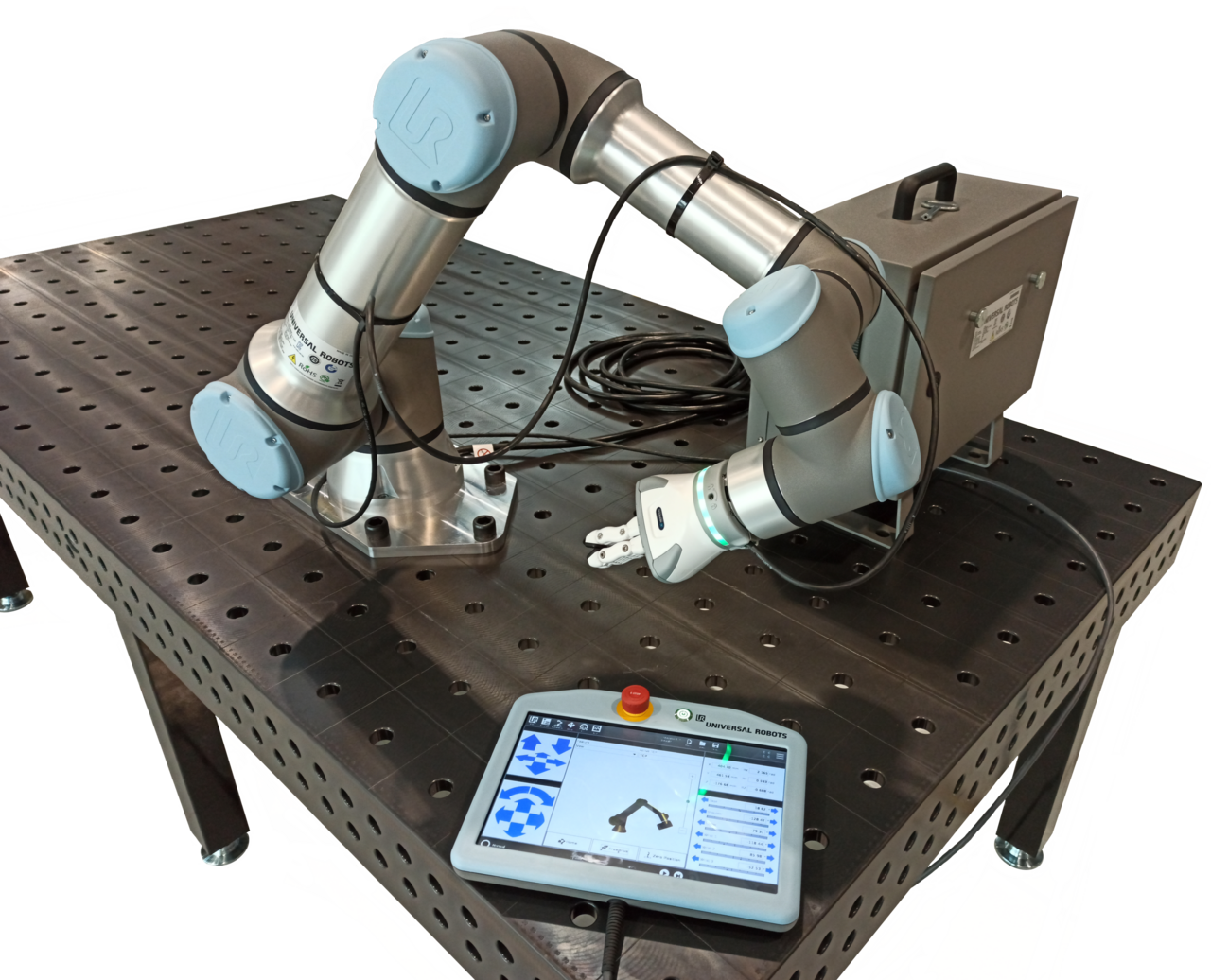
An industrial robot arm illustrates the physical constraints behind action policies; the pictured robot is not a π0 experimental platform.
Auledas · Image source · CC BY-SA 4.0

A robot can memorize where a drawer handle was yesterday. Useful generalization begins when that knowledge survives a different kitchen, a different arm, or a new combination of familiar actions. Physical Intelligence's April 16, 2026 Pi0.7 release explores this problem through richer conditioning and diverse experience. Its October 13 API beta adds a second development: outside teams can begin adapting hosted models to their own machines. These announcements address connected but distinct problems, namely learning transferable behavior and making adaptation practical. Neither should be mistaken for a robot that can already perform every household task.
A generalist becomes more steerable
The Pi0.7 research release reports a model conditioned on more than a plain task sentence. Its training prompts can include language, visual subgoals, control-modality labels, and metadata describing execution quality or speed. The authors' explanation is that this context disambiguates heterogeneous behavior, allowing differently collected experience to contribute without treating every episode as equally desirable.
An original analogy is a driving dataset containing both cautious parking and urgent obstacle avoidance. Without context, identical-looking situations may be paired with incompatible motions. A learner could average those responses into an unhelpful compromise. Labels describing the strategy make the conditional question more precise. In robotics, that does not guarantee the model will obey a speed request in an unfamiliar contact situation. It does identify a testable mechanism: hold the scene and task fixed, change the conditioning, and measure whether behavior changes in the intended direction.
What Pi0 and Pi0.5 contributed
Pi0, announced October 31, 2024, connected visual and linguistic representations with continuous motor-command generation. Pi0.5 followed on April 22, 2025, emphasizing training across mixed data sources and generalization to new homes. Its published explanation separates high-level textual subtask selection from low-level action chunks. These older releases provide context for Pi0.7; their names should not be used interchangeably when discussing results.
The separation between a subtask and its motions helps explain a common failure. A hypothetical robot may correctly decide to put a spoon into a drawer, then choose an approach that collides with the drawer edge. Another may execute a perfect grasp on the wrong object. The first needs better geometric or motor reasoning; the second needs better grounding of the instruction. Reporting only whether the robot looked purposeful obscures which part improved. A generalist architecture is valuable when it can transfer both kinds of knowledge while retaining a way to diagnose their failures.
Compositional demonstrations need careful interpretation
Pi0.7's release includes an air-fryer task to illustrate combinations of previously learned behavior. The authors show an initial incomplete attempt, stronger performance with step-by-step language coaching, and subsequent execution using a high-level policy trained from that coaching. They also discuss related air-fryer episodes found in the broader training corpus. This is more informative than describing the demonstration as learning an entirely unknown object from nothing.
The methodological question is which component is new. A scene can be unfamiliar while its object categories are familiar; a requested sequence can be new while every individual motion has appeared elsewhere. An original evaluation could vary these factors independently: a familiar appliance in a new room, a new appliance with familiar controls, and a genuinely new action sequence. The resulting pattern would reveal where composition helps and where it breaks. Human coaching is itself an input and should be counted, rather than disappearing from a headline about autonomous capability.
Cross-embodiment transfer is a physical test
The Pi0.7 report also describes laundry folding on a bimanual UR5e setup without folding demonstrations for that particular setup. The comparison concerns a defined task and embodiment combination, not arbitrary transfer to any hardware. A heavier arm, different reach, or less precise gripper can require a different physical strategy even when the instruction and cloth are unchanged.
Imagine two people folding the same large towel, one seated at a narrow desk and one standing at a wide table. The goal is shared, but the reachable intermediate configurations differ. Robots face an analogous issue with additional constraints from joint limits and actuator dynamics. A convincing transfer evaluation therefore needs to expose task geometry and reset conditions. Independent testing should also include failed grasps and recovery attempts, because the ability to finish a favorable initial arrangement can coexist with difficulty recovering from a small disturbance.
The API beta changes who can run the iteration loop
On October 13, 2026, Physical Intelligence announced a Pi API beta for uploading demonstrations, launching managed fine-tuning, and accessing hosted inference. The company describes early partners iterating on real tasks and explicitly mentions network-connectivity challenges in some deployments. The API announcement does not establish that every hosted model is identical to the publicly documented Pi0.7 research checkpoint or that all users receive unrestricted access.
Moving infrastructure into a service can reduce the setup burden, but it does not eliminate experimental work. A hypothetical team teaching a robot to stack irregular packages still needs representative demonstrations, a success definition, and failure records. Hosted inference also adds a communications path whose delay and availability matter to control. The deployment question becomes how much action can proceed safely during a delayed response, and which local component handles stopping or recovery. Those are system-design questions beyond the accuracy of the model's next prediction.
Measure how often somebody has to step in
The openpi repository provides an implementation surface for parts of the Pi research lineage, including available model and training workflows. Open artifacts and hosted services support different forms of investigation: one favors inspection and reproducibility, the other can simplify adaptation infrastructure. A publication should identify which surface produced its results, because a named family does not fix the precise data, model weights, or operational setup.
An original operational metric would report completed tasks per hour alongside interventions per hundred attempts. A robot that works quickly but needs frequent rescue may impose more human effort than a slower, reliable one. Evaluation should include time spent resetting the environment and collecting corrective data. For research on generalization, reserve unfamiliar environments before training and document any feedback subsequently collected there. Pi0.7 and the October beta make these questions more practical to investigate. Their lasting significance will depend on independently measured transfer and adaptation, not merely on how broad the demonstration gallery appears.
Failures need labels that preserve what happened
Consider an original data-collection exercise in which a robot repeatedly drops a soft pouch while transferring it between bins. Recording only successful retries removes information about the states that caused trouble. Recording every frame without context creates another problem: the learner may imitate the failed grasp as if it were desirable behavior. A useful record would separate the intended subtask, the observed failure, the corrective intervention, and the eventual outcome.
That design is consistent with the broader motivation for distinguishing diverse behaviors through context, but it is an editorial proposal rather than a new result attributed to Pi0.7. It also changes the question asked of a hosted fine-tuning service. Instead of asking how many demonstrations to upload, ask which uncertainty each new demonstration is meant to resolve. A small collection targeted at a recurring failure may be more informative than many repetitions of a favorable initial state. To establish that experimentally, the team must reserve a fixed evaluation set and compare improvement per unit of collection effort, including the time spent reviewing and correcting the records.
Sources & further reading
Primary papers, project documentation, and research releases used in this article. Publication dates below refer to the sources themselves.
- π0.7: a Steerable Model with Emergent CapabilitiesPhysical IntelligencePublished Checked
- Frontier Models for Every Robot: Announcing our API betaPhysical IntelligencePublished Checked
- π0.5: a VLA with Open-World GeneralizationPhysical IntelligencePublished Checked
- π0: Our First Generalist PolicyPhysical IntelligencePublished Checked
- openpiPhysical IntelligenceChecked
FOLLOW THE QUESTION
Study engineering foundations