ARTIFICIAL INTELLIGENCE
Continual learning without erasing the past
Recent work on uncertainty and stabilization sharpens the continual-learning problem: preserve useful knowledge while keeping the ability to learn something new.
Research checked
Newest cited publication
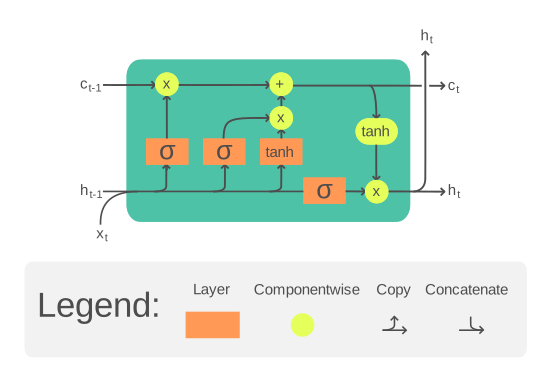
An LSTM memory-cell diagram illustrates one historical approach to retaining information; the article examines the broader problem of learning across tasks.
Guillaume Chevalier · Image source · CC BY-SA 4.0

A model can fail tomorrow in two opposite ways. It can learn the new task and damage yesterday's competence, or preserve yesterday's behavior so rigidly that it cannot learn tomorrow's task. These problems are often compressed into one slogan about forgetting, but the distinction matters when evaluating progress. Research published in 2025 and 2026 offers several ways to regulate change, from uncertainty-dependent updates to slowly evolving feedback. None establishes a general solution for an indefinitely learning assistant. The useful advance is a clearer set of mechanisms and measurements. To judge a model that keeps learning, we need to know not only what it remembers, but how quickly it can acquire a new skill after a long and complicated history.
Forgetting and lost plasticity are different
The 2024 Nature study Loss of plasticity in deep continual learning demonstrated declining ability to learn new tasks in extended sequences of supervised and reinforcement-learning experiments. It also investigated continual backpropagation, which selectively reinitializes a small fraction of less-used units. The result concerns the tested systems and sequences, rather than a theorem that all gradient-trained networks inevitably stop learning. Its central distinction remains useful: poor performance on a new task is not the same measurement as damage to an old one.
An original classroom analogy separates the two. A student might learn a new notation and then confuse an earlier notation; that resembles interference. Another student might remember earlier material yet struggle to acquire any new notation; that resembles reduced plasticity. A single final exam combining everything could conceal both patterns. In an experimental model, old-task accuracy and new-task learning speed should therefore be reported separately. The learning curve contains information that a final average discards.
MESU treats confidence as part of the update
Bayesian continual learning and forgetting in neural networks, published on 30 October 2025, introduces Metaplasticity from Synaptic Uncertainty, or MESU. It uses uncertainty to modulate parameter updates and includes a forgetting mechanism without requiring explicit task boundaries. The authors evaluate image-classification settings including sequential Permuted-MNIST and task-incremental CIFAR-100. They report improvements in retention, later-task learning, and uncertainty-based detection relative to tested comparisons. These are controlled benchmark results, not evidence that the method already scales to a general continually updated language assistant.
The underlying intuition can be explored without equating uncertainty with truth. Suppose a fictional model has seen many consistent examples for one association and few examples for another. It could allow larger changes in the poorly supported association while protecting the well-supported one. That is sensible only if its confidence remains calibrated when the world changes. A confidently wrong model can protect an obsolete belief. A serious test therefore needs both new information and evidence that a previously reliable relationship has stopped applying.
A slower signal can regulate a faster one
A March 2026 Nature Communications paper studies intrinsic Top-Down Stabilization, abbreviated iTDS. It combines supervised learning with a signal tracking the network's own output over time. The authors evaluate recurrent, feedforward, and reservoir networks across sixteen tasks, reporting benefits in learning, generalization, and noise robustness. This is computational work on a proposed learning rule. It should not be presented as a complete continual-learning solution or as an experimental demonstration that biological brains use the same mechanism.
A slow signal can provide a reference against which rapid fluctuations are interpreted. For an independent analogy, consider a display that reports both an instantaneous reading and a smoothed trend. The trend can make noise easier to recognize, but it can also lag behind a genuine change. A model's update rule faces a related design issue: stabilization must preserve useful structure without making adaptation impossibly slow. The correct balance depends on the stream, so a method's settings should be tested under both abrupt transitions and gradual drift.
Similarity can help and interfere
A Nature Human Behaviour study published online on 30 October 2025, in a 2026 volume, compared humans and neural networks on sequential rule-learning tasks. It found related patterns in which similarity supported transfer while also increasing interference. The study offers a specific experimental comparison, not a claim that human and artificial learning are generally equivalent. Its publication date also illustrates why a 2026 volume label should not be used to invent a later discovery date.
An original example makes the trade-off intuitive. Learning one software command system can speed learning a similar system because familiar structure transfers. The similarity can also produce mistakes when one familiar command has a different meaning. Making the representations completely separate might reduce confusion but sacrifice the benefit of shared structure. A model that never forgets because it never reuses anything could require unbounded growth. A useful continual learner must find a productive compromise rather than optimize retention in isolation.
The stream is part of the problem
A continual-learning benchmark needs a precise account of what changes. New classes, altered input appearance, new label meanings, and entirely new tasks are different settings. A method can benefit greatly from being told when one task ends and another begins. A deployed stream may provide no such signal. Comparing a boundary-aware system with a boundary-free one without stating the difference can misattribute the advantage. The benchmark's information policy belongs alongside model size and compute in the experimental description.
For a fictional visual inspection task, imagine a factory changes lighting while the defect definitions stay fixed. Later, it introduces a new material that changes which marks count as defects. The first shift concerns appearance; the second changes the target concept. A system that treats both as the same event might adapt correctly to one and fail on the other. Evaluators should score performance before, during, and after each change, and should preserve a separate set of unchanged cases to detect collateral damage.
Memory and computation need a lifetime budget
A model can appear to learn continually by retaining more examples, adding modules, or repeating more training after every transition. Those are legitimate strategies, but their costs grow differently. An honest comparison should count stored data, parameters, optimizer state, and cumulative computation. It should also distinguish learning from newly arriving examples from replaying old ones. Without a lifetime budget, a small early advantage may be purchased through a resource demand that becomes impractical after many tasks.
An original evaluation could fix a total memory allowance and a daily update budget, then run a long sequence containing recurring and novel problems. Methods would decide what to retain and how to spend their budget. Reporting time to recover an old skill would complement retention accuracy: a model might lose exact performance yet relearn quickly. That behavior can be useful, but it should be named correctly. Immediate recall, rapid relearning, and permanent retention are different services for a person relying on the system.
A credible result survives a long history
The recent work supports several concrete directions: preserving useful representation diversity, regulating change through uncertainty, and using signals operating at different timescales. These directions can be complementary without being interchangeable. Their evidence comes from different architectures and tasks, and combining them would require a new experiment. As of the October 2026 cutoff, the strongest conclusion is that the stability-plasticity problem is becoming more precisely testable, rather than that it has disappeared.
I would be most persuaded by a preregistered long-running comparison that measures old competence, new learning speed, recovery, calibration, and resource use throughout the stream. It should include misleading updates and genuine corrections, with no hidden resets that erase a difficult history. Such an evaluation would reveal whether a method remains adaptable after success has made its representations confident and specialized. Continual learning becomes meaningful when the system can carry useful experience forward while still making room for evidence that changes its mind.
Sources & further reading
Primary papers, project documentation, and research releases used in this article. Publication dates below refer to the sources themselves.
- Loss of plasticity in deep continual learningNaturePublished Checked
- Bayesian continual learning and forgetting in neural networksNature CommunicationsPublished Checked
- Intrinsic stabilization of synaptic plasticity improves learning and robustness in artificial neural networksNature CommunicationsPublished Checked
- Humans and neural networks show similar patterns of transfer and interference during continual learningNature Human BehaviourPublished Checked
FOLLOW THE QUESTION
Study engineering foundations