ARTIFICIAL INTELLIGENCE
Test-time training and the changing model
October 2026’s Universal Test-Time Training extends a growing family of models that learn from context, with different objectives and different guarantees.
Research checked
Newest cited publication
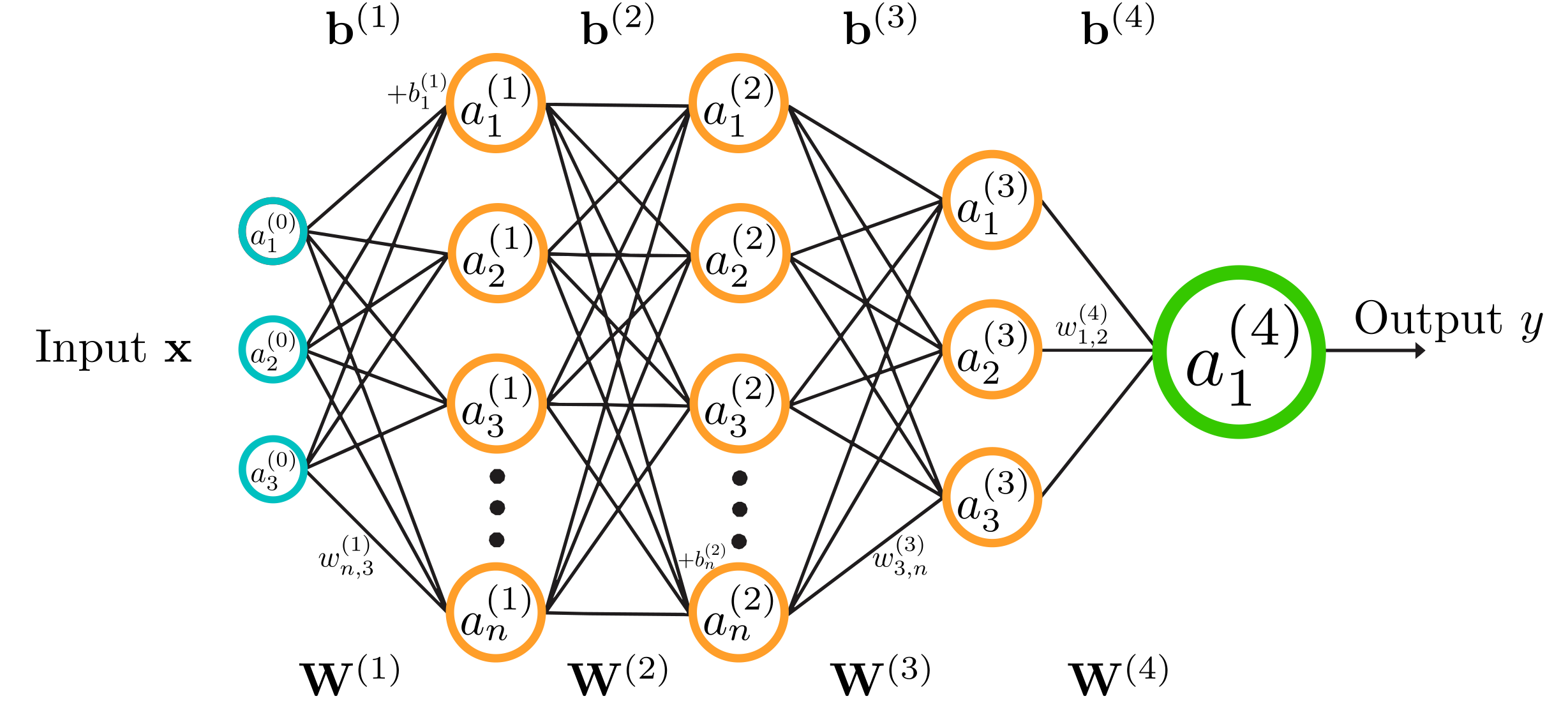
A layered neural-network diagram provides context for discussing which model parameters can change during inference-time adaptation.
QuantuMechaniX8 · Image source · CC0 1.0

Reading a long document can mean storing it, searching it, or changing how a model responds after encountering it. Test-time training explores the third possibility. The phrase names a family of methods rather than one algorithm, and that distinction has become more important as the work has developed. Earlier TTT layers made a small learned model the recurrent state. End-to-end work in December 2025 adapted a transformer to learn from its own context. By October 2026, Universal Test-Time Training was asking whether different layers should share one memory. These approaches use learning during inference in different ways. The promise is better use of limited state; the challenge is explaining what changes, why the update helps, and when the evidence should be discarded.
The original TTT layer idea
The TTT-layer paper was first submitted on 5 July 2024 and revised through August 2025. It makes the recurrent hidden state a machine-learning model, updated through a self-supervised objective. The authors study a linear model and a small multilayer perceptron as the adaptive state, evaluating language models from 125 million to 1.3 billion parameters. This differs from simply asking a frozen model to read a longer prompt. Some parameters serving as state change while the sequence is processed.
A useful independent example is a tiny predictor adapting to a document's naming convention. If every locally defined variable follows a pattern, updating a compact predictor might capture that regularity without retaining each occurrence. The example does not describe a specific experiment in the paper. It illustrates why a learned state could encode reusable structure. The trade-off is compression: remembering the pattern does not necessarily preserve the exact unusual identifier that appears once and becomes important much later.
Training a model to benefit from adaptation
End-to-End Test-Time Training for Long Context was submitted on 29 December 2025. It uses a transformer with sliding-window attention, applies next-token learning to the incoming context, and meta-learns an initialization suited to that adaptation. In the reported three-billion-parameter experiments trained on 164 billion tokens, it shows favorable context scaling and a 2.7-times latency comparison against full attention at 128K-token context on an H100. This is a specific experimental operating point, not a speed guarantee for every model or service.
There are two distinct optimization questions. The inner process asks how to update from the current document. The outer process asks what starting model will make those updates useful. An original analogy is training a musician not merely to play a rehearsed piece but to learn a new score quickly. A model optimized only for immediate prediction may not have parameters arranged for rapid adaptation. Evaluating the entire learning procedure, rather than just its starting weights, is therefore essential to understanding the reported benefit.
The October 2026 question: who owns memory?
Universal Test-Time Training was submitted on 4 October 2026. It proposes sharing fast-weight memory across layers while retaining layer-specific backbone parameters. The paper studies routed and dense variants. Its reported language experiments include 124-million- and 760-million-parameter models, with RULER retrieval scores above layer-private counterparts under the stated matched budgets. This is a recent preprint with modest model scales relative to frontier systems. Sharing memory is the tested design change; general superiority at much larger scales remains an open question.
The architectural intuition can be explored with a fictional multi-stage analysis pipeline. A later stage discovers a useful association, but a separate private notebook prevents an earlier stage from using it when the next chunk arrives. A shared notebook creates a route for that information. It also creates interference: different stages may write incompatible representations into the same space. The experiment must show that the access benefit exceeds that interference under comparable capacity and compute. A larger shared pool alone would not isolate the effect of sharing.
Learning from the wrong span can hurt
A July 2026 preprint, Self-Guided Test-Time Training for Long-Context LLMs, investigates which context spans should drive adaptation. The authors report that random-span adaptation can hurt performance in their long-context setting, while evidence-focused selection improves results on the tested benchmarks and models. This approach is distinct from the architectural TTT-layer work. It highlights a general experimental issue: an update can be mathematically well-defined while optimizing the model on information irrelevant to the user's question.
Imagine a fictional technical report containing many routine appendices and one short paragraph stating the changed test condition. Uniformly sampling text could give the appendices most of the learning budget. Selecting the changed condition could be more useful, but it introduces another possible error: the selector may miss a subtle dependency elsewhere. A robust evaluation would perturb distractors, relocate key evidence, and include questions requiring several separated spans. Otherwise, the system might learn a benchmark's document layout instead of a dependable evidence-selection strategy.
An online update is not necessarily permanent learning
The word learning can invite a stronger interpretation than an experiment supports. Updating a temporary state for one sequence does not show that the model accumulates durable knowledge across months. An evaluation may reset adaptive weights between examples, making the method closer to instance-specific processing than lifelong learning. Neither choice is inherently wrong. The important point is to specify the lifetime of each state and whether future predictions depend on earlier users, documents, or evaluation items.
That distinction suggests a simple independent accounting table for any implementation: identify frozen weights, adaptive weights, optimizer state, attention cache, and external records. For each, state its size and reset rule. The table would reveal whether a claimed fixed memory excludes a growing cache or whether a fast inference measurement omits update work. It would also make experiments easier to reproduce. A name such as TTT says that some learning happens during use; it does not identify every resource involved.
A useful system must recover from bad updates
If context can change a model, irrelevant or mistaken context can change it too. A practical system therefore needs to measure adaptation quality over a sequence, including recovery after an unhelpful update. This is a proposed evaluation requirement, rather than an established defect in every TTT model. It follows from treating the update as part of the computation. A strong first answer after clean initialization says little about behavior after several conflicting documents.
An original stress test could present a fictional manual, a clearly marked obsolete revision, and then a verified correction. Questions would distinguish current rules from historical ones. The evaluator would measure whether the system learns the correction, preserves unaffected facts, and returns to baseline after reset. Recording update counts and failed answers would prevent unlimited retraining from masquerading as a cheap forward pass. The same test should be applied to retrieval and frozen-context baselines, because adaptation is useful only in comparison with realistic alternatives.
Judge the whole learning procedure
The evidence through 18 October 2026 supports a growing design space: adaptive hidden-state models, meta-trained context learners, shared fast weights, and evidence-selected updates. These mechanisms should not be folded into a single capability claim. Their training assumptions, parameter scales, tasks, and state lifetimes differ. The newest preprint is especially interesting as a hypothesis about memory ownership, while still needing replication and tests beyond the reported settings.
My preferred next result would report the cost of a correct answer from a cold start, including selection, learning, generation, and recovery. It would publish distributions rather than only averages, because rare expensive failures matter in interactive work. It would also compare exact retrieval with approximate adaptation on tasks that need different kinds of memory. That combination would show where changing a model is an efficient way to use experience and where keeping a clear, searchable record remains the better tool.
Sources & further reading
Primary papers, project documentation, and research releases used in this article. Publication dates below refer to the sources themselves.
- Learning to (Learn at Test Time): RNNs with Expressive Hidden StatesarXivPublished Checked
- End-to-End Test-Time Training for Long ContextarXivPublished Checked
- Universal Test-Time TrainingarXivPublished Checked
- Self-Guided Test-Time Training for Long-Context LLMsarXivPublished Checked
FOLLOW THE QUESTION
Study engineering foundations