ARTIFICIAL INTELLIGENCE
SmolLM3 and what a small model can teach about deployment
SmolLM3's open recipe and October 2026 runtime conversion expose the separate roles of model size, memory, context, reasoning budgets and deployment fidelity.
Research checked
Newest cited publication
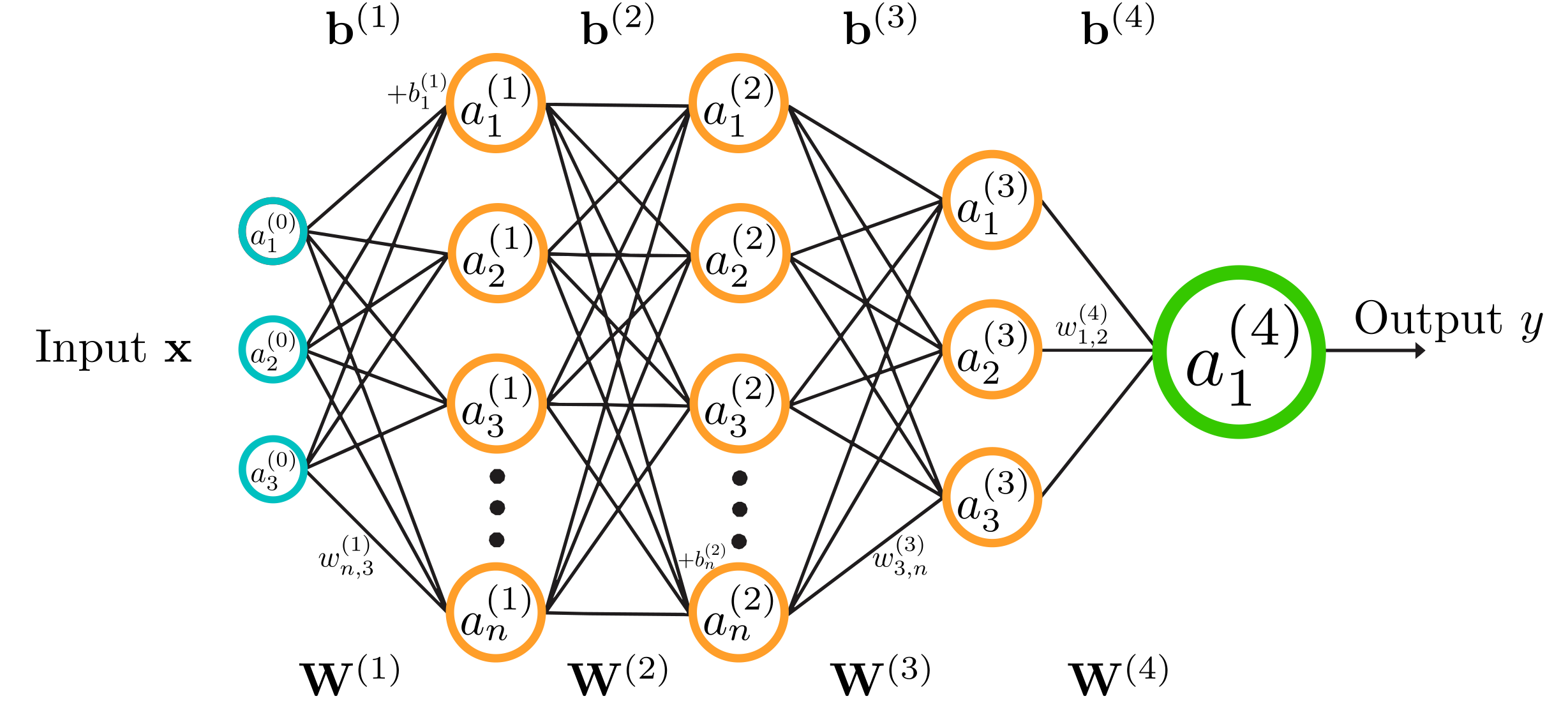
A layered-network diagram introduces the connection between model structure and capacity, before the article examines small language models in detail.
QuantuMechaniX8 · Image source · CC0 1.0

Small language models are useful partly because their limitations are easier to encounter directly. Memory budgets, slow responses and fragile conversions become concrete engineering questions rather than distant data-center concerns. Hugging Face released SmolLM3 on July 8, 2025, providing a three-billion-parameter model and an unusually detailed training account. Its continuing relevance in October 2026 comes from the practical ecosystem around the checkpoint, including a LiteRT community conversion updated on October 6. The original release and the later runtime work answer different questions. One concerns what the model learned; the other concerns whether a particular device can execute that learned computation faithfully and efficiently.
A small checkpoint can have an expensive education
SmolLM3's model card describes a decoder-only transformer trained on 11.2 trillion tokens through a staged mixture of web text, code, mathematics and reasoning material. That juxtaposition is the first lesson: parameter count measures the size of the learned representation, not the total work invested in producing it. A compact final artifact can embody a long training process. Calling a model small should therefore specify the quantity being discussed: stored weights, active computation, training cost, runtime memory or a particular device's power consumption.
An illustrative storage calculation makes the distinction tangible. Three billion parameters stored at two bytes each require about six billion bytes for the raw values alone. At four bits each, the idealized payload is about 1.5 billion bytes. Real packages also need scales, metadata and sometimes higher-precision tensors, while execution requires memory for temporary state. Neither calculation predicts end-to-end speed. It only identifies one part of the budget. A compressed checkpoint that fits on a device can still leave too little working memory for the desired conversation length.
The conversation has its own memory cost
The published architecture uses grouped-query attention, which shares key and value representations among groups of query heads. During autoregressive generation, the model caches information from earlier tokens so it does not recompute the entire conversation at every step. The Transformers documentation exposes the architecture and usage interface, while the model card distinguishes its trained context length from its extended supported length. These are implementation properties, not promises that any application will understand every detail of a document occupying the full window.
The general engineering tradeoff is easy to miss when a benchmark reports only maximum context. Doubling a cached conversation can increase memory even when the downloaded weights remain unchanged. A product must budget for the longest active sessions and for concurrent users, not merely an empty model. A sensible local experiment measures available memory before loading, after loading, after a long prompt and during generation. This separates persistent weights from growing conversation state. It also reveals whether the operating system is reclaiming memory or whether an application is approaching an abrupt allocation failure.
Reasoning mode changes the measurement
The launch account describes reasoning and direct-response modes selected through the conversation template. It reports stronger results for extended reasoning on several challenging tests, while acknowledging stronger competitors in some comparisons. The useful result is conditional: a particular checkpoint, prompt format and generation allowance produced particular scores. A deployment that shortens the output budget or changes its template is running a different condition. A compact reasoning model is therefore not a fixed point on an accuracy chart; its operating behavior depends on how much inference work the application permits.
For an independent illustration, suppose a direct response uses 80 output tokens while extended reasoning uses 800. Even at the same generation rate, the latter occupies the device for roughly ten times as much decoding work. It may solve a harder problem, but the application needs a way to justify that extra work. One experiment could route easy requests directly and reserve reasoning for tasks with a verifiable answer. Report the fraction routed, overall success and total generated tokens. Without those measurements, an apparent efficiency gain can merely hide a larger inference budget.
What the October 2026 conversion adds
The LiteRT community model card documents a GPU graph rewrite dated October 6, 2026, explicitly stating that its weight bytes were unchanged. It describes changes to cache-update and attention operations and adds a shorter prefill signature. The card reports device-specific timing results, identifies which older measurements were not repeated, and distinguishes the four-bit package's 4,096-token cache from the original model's much larger supported context. This is primary evidence from the converter's maintainers, rather than an independent verification of every performance claim.
The distinction is valuable even without adopting the reported speed figures. A graph describes how calculations are arranged for a runtime; the weights are their learned numerical inputs. Two packages can share learned values yet execute with different scheduling, temporary allocations or operator support. Conversely, preserving weights alone cannot prove identical output after changes to precision or tokenization. My inference is that conversion quality deserves its own acceptance test. The model's research benchmarks cannot establish that a separate application packaged the tokenizer, prompt template and execution graph correctly.
A deployment test should begin before the answer
A practical acceptance test can start with strings rather than benchmark questions. Compare token identifiers for accented words, mathematical symbols, emoji, mixed scripts and empty system messages. Then compare the fully rendered conversation, including special markers, against the upstream template. This is an original proposed procedure, not a claim that every conversion has the same defects. It tests whether the runtime sends the model the intended input. If those inputs differ, comparing the resulting answers confounds model capability with a packaging error that could have been identified earlier.
After input fidelity, measure output behavior. Use a frozen prompt set covering extraction, short arithmetic, structured responses and refusal behavior appropriate to the application. Record cold startup, time to first token, generation rate, peak memory and repeated-run variability. Keep prompt length and output allowance fixed when comparing backends. For an interactive tool, a fast median can conceal an unacceptable slow tail. For an offline device, thermal throttling after repeated requests can matter more than the best result immediately after startup. These measurements determine whether a small model is useful under the actual workload.
The open recipe makes tradeoffs inspectable
The SmolLM repository links model families, training resources and evaluation material; the SmolLM3 model card identifies its Apache 2.0 license and public training configuration. Such access makes it easier to inspect where a behavior may have come from or to adapt a checkpoint for a narrower task. It does not imply that all source documents have identical reuse terms. Nor does a model's support for six named languages establish equal reliability across dialects, specialist vocabularies or code-switching. The relevant deployment population still needs representative evaluation.
My assessment is that SmolLM3 is most instructive when treated as a platform for explicit choices. Which tasks need local inference? Which requests justify extra reasoning? How much context can a particular package retain? What accuracy is lost after compression, and what behavior changes after conversion? Answers can be tested using publicly available artifacts rather than guessed from the parameter count. The October 2026 runtime work illustrates the continuing nature of that process: a released model may stay fixed while its usable operating range changes through better software. A good deployment report preserves both identities.
Sources & further reading
Primary papers, project documentation, and research releases used in this article. Publication dates below refer to the sources themselves.
- SmolLM3: smol, multilingual, long-context reasonerHugging FacePublished Checked
- HuggingFaceTB/SmolLM3-3BHugging FaceChecked
- SmolLM3Hugging Face Transformers documentationChecked
- Everything about the SmolLM and SmolVLM family of modelsHugging Face / GitHubChecked
- SmolLM3-3B — LiteRT-LM (blockwise int4)LiteRT Community / Hugging FaceChecked
FOLLOW THE QUESTION
Study engineering foundations