ARTIFICIAL INTELLIGENCE
Data quality is an experimental variable, not a magic ingredient
A June 2026 web-graph experiment extends DataComp-LM and shows how controlled sampling, fixed budgets and task-specific evaluation can test claims about data quality.
Research checked
Newest cited publication
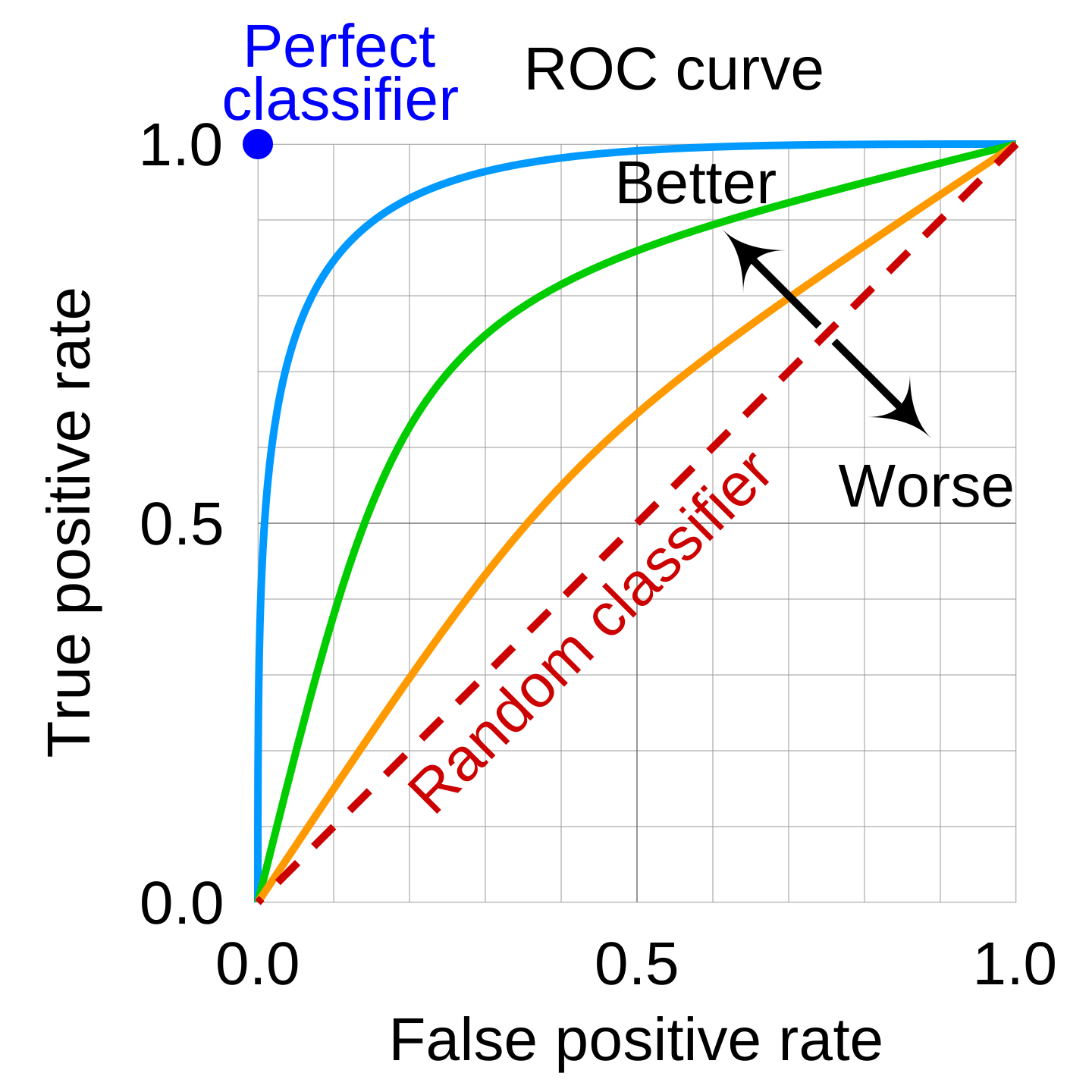
Illustrative ROC curves show how a decision rule can change measured errors, providing context for designing comparable data-quality experiments.
CMG Lee and Martin Thoma · Image source · CC BY-SA 4.0

When a language model improves, better data is an appealing explanation because almost every training pipeline contains some filtering. Yet the phrase can hide several changes at once: fewer duplicates, different subjects, more examples resembling a test, or a larger effective training budget. DataComp-LM made those decisions into controlled experiments. A June 2026 preprint extends that approach using the web's link structure. This opens an interesting question: can where a document sits in a network complement what a text classifier thinks about its contents? A convincing answer needs a comparison that identifies the selection decision and keeps the rest of the learning opportunity stable.
A fixed training recipe changes the question
DataComp-LM was first submitted on June 17, 2024, with a revised version dated April 21, 2025. Its central research design provides a common corpus, model-training framework and evaluation environment so that participants can compare data-selection strategies. That differs from comparing unrelated model releases whose architectures, token budgets and post-training procedures all vary. The testbed asks a narrower question: under specified conditions, which selected training distribution produces better evaluated models? Its published code makes those conditions inspectable rather than leaving them implicit in a leaderboard entry.
The distinction resembles an agricultural trial. If two farms have different seed, soil, rainfall and fertilizer, their harvests cannot isolate fertilizer quality. Holding more conditions fixed does not make the trial universal, but it makes one causal question more tractable. In language-model experiments, the comparable controls include initialization, optimizer schedule, sequence length, tokenizer and total processed tokens. A data intervention should identify exactly which of these remain fixed. Otherwise an improvement may come from a changed training opportunity rather than the selection rule being investigated.
The current result adds the web's structure
On June 9, 2026, the Hubs or Fringes authors proposed WebGraphMix, which selects host-level web material using centrality. Its one-billion-scale experiment reports 41.4 percent average accuracy across 23 tasks for an equal central and peripheral mixture, versus 39.8 percent for uniform sampling. Combined with a quality classifier, it reaches 43.8 percent, versus 42.3 percent for the classifier alone. These are within-study comparisons under a particular recipe, rather than evidence of the same gain for a frontier model.
The measured differences are percentage points: 41.4 minus 39.8 is 1.6 points, while 43.8 minus 42.3 is 1.5 points. The preprint tests 400-million and one-billion scale settings, the latter using 28 billion tokens. My interpretation is that structural and content-based selectors can carry complementary information. This suggests another variable worth testing, rather than an unlimited scaling law. An independently repeated result would help distinguish a general advantage from a feature of the particular corpus, evaluation suite and training regime.
A graph score describes position, not truth
Centrality is a family of measurements about connections. A site can be structurally prominent because many others connect to it or because it lies along routes joining different parts of a network. None of those facts verifies its claims. A peripheral specialist site may contain an unusually clear explanation of an obscure instrument; a highly connected site may contain repeated navigation and outdated material. This is an original explanatory example, not an assertion about a particular host in the experiment. Network position can be informative without serving as a truth detector.
The authors identify host-level scoring and structural bias as limitations. My interpretation is that graph selection should be audited by language, region and genre in addition to task performance. A shared host score cannot represent every page's individual contribution. Otherwise an aggregate gain could be purchased by removing a community's relatively disconnected material. A more accurate model for one evaluation suite is not automatically a more representative archive of human knowledge. Researchers should inspect the retained distribution before adopting its apparent benefits as an unqualified improvement.
The target task defines which data is useful
Suppose a curator favors textbook-like prose. That may help answer school-style questions while reducing exposure to conversational repairs, regional expressions or practical troubleshooting. Alternatively, keeping diverse forum discussions may improve interpretation of incomplete requests while introducing more factual noise. Neither outcome can be described adequately by a single universal quality label. The objective should be declared before the selector is tuned. A project seeking reliable technical extraction needs different evidence from one seeking broad conversational fluency or documentation of low-resource language use.
DATE-LM, a benchmark first submitted on July 12, 2025, provides a related warning about evaluating data attribution. It tests training-data selection, toxicity and bias filtering, and factual attribution, finding that no method dominates all tasks. Attribution asks which training examples influenced behavior; selection asks which examples to train on next. These are distinct operations, even when an attribution method informs selection. The benchmark's task-dependent outcomes support a careful principle: evidence that a method is useful for one intervention should not be silently promoted into evidence that it solves all data-curation problems.
An ablation should test a decision someone could reverse
A useful independent experiment might compare uniform sampling, content filtering, graph filtering and their combination. Keep token counts, architecture and training schedule identical. Reserve one evaluation group for choosing thresholds and another for final reporting. Repeat selected conditions with different random seeds or independently sampled training subsets. Publish per-task changes alongside the mean, because a method that improves factual questions while damaging symbolic reasoning has revealed a tradeoff. The point is to isolate a reversible decision, rather than celebrate a bundle of changes whose individual effects cannot be identified.
Cost accounting should include the selector itself. A sophisticated filter may consume enough accelerator time to erase part of the training savings it creates. Record preprocessing time, storage, retraining cost and the burden of maintaining annotations or graphs. An illustrative budget can make this concrete: saving 100 accelerator-hours during training is not an operational saving if selection consumes 150 additional hours under comparable accounting. This arithmetic is hypothetical, not a reported result from WebGraphMix. It demonstrates why downstream accuracy alone cannot establish that a curation method is efficient.
Keep the rejected examples and the uncertainty
A strong curation record preserves enough information to understand rejection: source identifiers, selection scores, deduplication decisions and the version of the rule that ran. It need not publicly redistribute material that cannot lawfully or responsibly be shared. It should make the experiment traceable. If a later audit finds that a filter systematically discards mathematical notation, investigators need to reconstruct which examples were affected. A final cleaned file without its processing history prevents that diagnosis and makes the next improvement harder to distinguish from a fresh guess.
The next persuasive step is independent reproduction across larger models, other languages and tasks excluded from development, with selection costs included. Some gains may persist, while others may reveal a narrower operating range. Either outcome improves understanding. Treating data quality as an experimental variable means accepting that a well-designed negative result is useful: it identifies which attractive assumptions failed and leaves a clearer record for the next training decision. The practical prize is a pipeline whose choices can be justified and reversed when new evidence arrives.
Sources & further reading
Primary papers, project documentation, and research releases used in this article. Publication dates below refer to the sources themselves.
- DataComp-LM: In search of the next generation of training sets for language modelsJeffrey Li and collaborators / arXivPublished Checked
- DataComp for Language ModelsML Foundations / GitHubChecked
- Hubs or Fringes: Pretraining Data Selection via Web Graph CentralityVedant Badoni, Danqi Chen and Xinyi Wang / arXivPublished Checked
- DATE-LM: Benchmarking Data Attribution Evaluation for Large Language ModelsCathy Jiao and collaborators / arXivPublished Checked
FOLLOW THE QUESTION
Study engineering foundations