ARTIFICIAL INTELLIGENCE
LLaDA and language without a fixed left edge
From LLaDA to June 2026’s iLLaDA, masked diffusion explores a different order for writing language, with important questions about training and evaluation.
Research checked
Newest cited publication
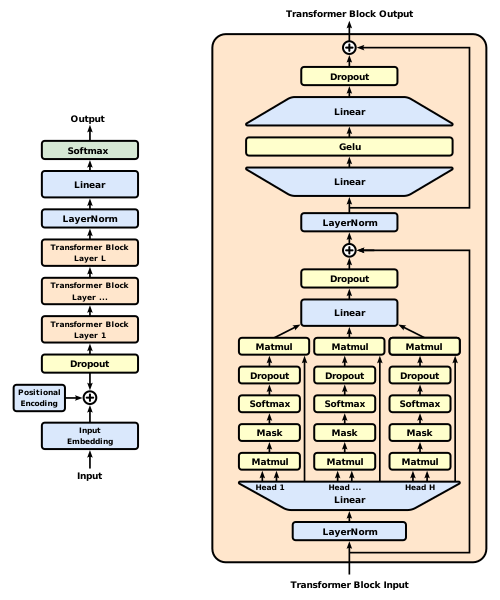
A transformer diagram introduces shared neural building blocks; LLaDA’s diffusion-style generation process is explained separately.
Marxav; vectorization by Mrmw · Image source · CC0 1.0

When a language model writes a sentence, the first visible word can appear to determine everything that follows. That familiar interface hides a design choice: text can be modeled through a different sequence of decisions. LLaDA made that alternative concrete at useful scale in February 2025. By June 2026, iLLaDA was testing a more extensively trained version of the same broad idea. These developments are interesting because they let researchers vary the order in which uncertainty is resolved. They do not establish that every application should abandon left-to-right generation. An editor inserting a missing clause, a programmer repairing a function, and a chatbot answering an open question ask different things of a model. Understanding those differences makes the diffusion discussion more useful than another universal ranking.
What the original experiment established
The original LLaDA paper, first submitted on 14 February 2025, described an eight-billion-parameter model trained from scratch. Its forward process hides tokens; its learned reverse process predicts missing tokens using the available context. The training objective is connected to a lower bound on likelihood. The authors reported competitive results against their own autoregressive baselines and comparisons with LLaMA 3 8B. Those comparisons support the feasibility of the approach at that scale, rather than equivalence across every task or training budget.
An independent way to picture the design is a partially completed train timetable. Several cells are blank, but destinations and departure constraints remain visible on both sides. Filling a blank near the bottom can clarify a blank near the top. No individual cell has to be the first permanent commitment. This analogy concerns the order of using evidence; it does not suggest that a text model has a timetable solver or checks physical constraints automatically. The useful question is whether the available surrounding information reduces ambiguity.
Generation order becomes a decision
For a toy sentence, suppose three missing positions concern a person's name, a verb, and a place. The place might be obvious from a visible address while the name remains ambiguous. An algorithm could resolve the place first and leave the name uncertain. This example illustrates an opportunity, not a measured LLaDA result. Confidence is also fallible: a model can be certain about the wrong completion, and committing to it can influence later choices. Flexible ordering changes the failure modes; it does not remove them.
The original paper also investigated reversed poem completion. Its reported advantage on that specific test is evidence about a directional weakness in a particular setting. It should not be expanded into a claim that diffusion has solved reversible reasoning. A careful follow-up would separate familiar text retrieval from genuinely novel relational inference, then test both directions under matched prompts. If the benefit disappears when memorized passages are excluded, the explanation would be narrower and more informative than a general claim about reasoning.
Training from scratch and converting a model
LLaDA2.0, first submitted on 10 December 2025, explored another route: converting pretrained autoregressive models into diffusion models. The paper describes a progression through different block sizes and reports mixture-of-experts variants with sixteen billion and approximately one hundred billion total parameters. This is not the same experiment as training the original LLaDA from scratch. Reusing an existing model changes what knowledge is inherited and which portion of the total development cost the diffusion adaptation must pay.
Consider two hypothetical laboratories comparing these routes. One starts with random weights and the other with a strong pretrained checkpoint. Equal adaptation hours would not mean equal total compute, because the second laboratory benefits from earlier training. Conversely, discarding inherited capability would be wasteful when the practical objective is deployment. Both questions are legitimate. A research report should state whether it measures the cost of discovering an architecture, converting an available model, or serving an already trained system. Combining those costs into one number obscures the decision.
What changed with iLLaDA in 2026
The iLLaDA preprint was submitted on 24 June 2026. It reports an eight-billion-parameter model trained from scratch with fully bidirectional attention, twelve trillion pretraining tokens, and a masked objective retained during supervised fine-tuning. The authors also introduce variable-length generation and confidence-based multiple-choice scoring. Reported benchmark improvements over LLaDA include gains in general, mathematical, and coding evaluations. These are results from a newer training recipe, not proof that the generation order alone caused the improvement.
That causal distinction matters whenever several ingredients change together. Imagine improving a bakery's oven, flour, recipe, and staff training in one month. Better bread is real evidence that the combined system works, but it does not identify the oven's contribution. For models, controlled experiments would hold data, initialization, token budget, evaluation format, and inference resources steady while varying one component. Scaling studies can then show whether an apparent advantage persists as resources increase. Without that separation, an architectural headline can accidentally become a claim about additional training.
Parallel decisions still consume resources
A useful independent accounting exercise starts with a fictional hundred-token answer. Resolving twenty uncertain positions during each of five rounds does not automatically cost less than a hundred inexpensive sequential decisions. Each round may revisit a substantial sequence, and the actual accelerator can be limited by memory movement, attention, or kernel overhead. The number of simultaneously predicted tokens is therefore an incomplete performance metric. Wall-clock latency, throughput at realistic batch sizes, and answer quality need to be measured together.
Interactive products also distinguish the first useful output from the final output. A streaming assistant can expose partial text early; an infilling editor may care only about the completed patch. A refinement-based model could fit the second experience especially well even if its first visible answer arrives later. That is a product inference, not a benchmark conclusion from these papers. Evaluating the intended workflow avoids rewarding a model for producing a stream the user cannot safely act on, or penalizing one for withholding an unfinished edit.
Evaluation changes deserve their own audit
Multiple-choice scoring illustrates why the measurement procedure belongs beside the model description. An answer can be selected by comparing candidate scores or by asking the model to generate a letter. Those procedures can fail differently even when the underlying knowledge is identical. If a new model changes the scoring rule, a fair investigation should also apply that rule to relevant baselines when possible. Otherwise, part of an apparent capability gain may come from a better interface between the model and the test.
For open-ended work, correctness needs an external anchor. A generated mathematical solution can be checked against its assumptions, while a program can be exercised on withheld tests. Inserting a sentence into an essay requires a different judgment about coherence and meaning. The ability to revise several positions together does not supply any of these standards. A strong evaluation would report the same completion under multiple seeds, lengths, and resource settings, exposing brittle successes instead of presenting only the most attractive sample.
The question worth carrying forward
As of the October 2026 cutoff, the verified sequence here runs from LLaDA through LLaDA2.0 to iLLaDA's June preprint. It shows multiple credible ways to build and adapt diffusion language models. The evidence is more specific than a replacement narrative: training objective, initialization, decoding policy, and evaluation method all remain active design variables. Keeping those variables distinct makes comparisons interpretable and gives future replication a practical starting point.
My preferred next experiment would use realistic editing jobs with hidden acceptance tests, matched end-to-end budgets, and a published distribution of completion lengths. It would measure how often an initially plausible patch survives evaluation and how much extra computation recovery requires. Such a test would connect the distinctive freedom of diffusion to a concrete user benefit. The most consequential advance may be a better fit between the order of generation and the structure of a task, rather than a single model winning every form of writing.
Sources & further reading
Primary papers, project documentation, and research releases used in this article. Publication dates below refer to the sources themselves.
- Large Language Diffusion ModelsarXivPublished Checked
- LLaDA2.0: Scaling Up Diffusion Language Models to 100BarXivPublished Checked
- Improved Large Language Diffusion ModelsarXivPublished Checked
FOLLOW THE QUESTION
Study engineering foundations