ARTIFICIAL INTELLIGENCE
Dream and the diffusion language model
Dream 7B and February 2026’s DreamOn show why language diffusion is an editing problem as well as a generation problem, especially when output length is unknown.
Research checked
Newest cited publication
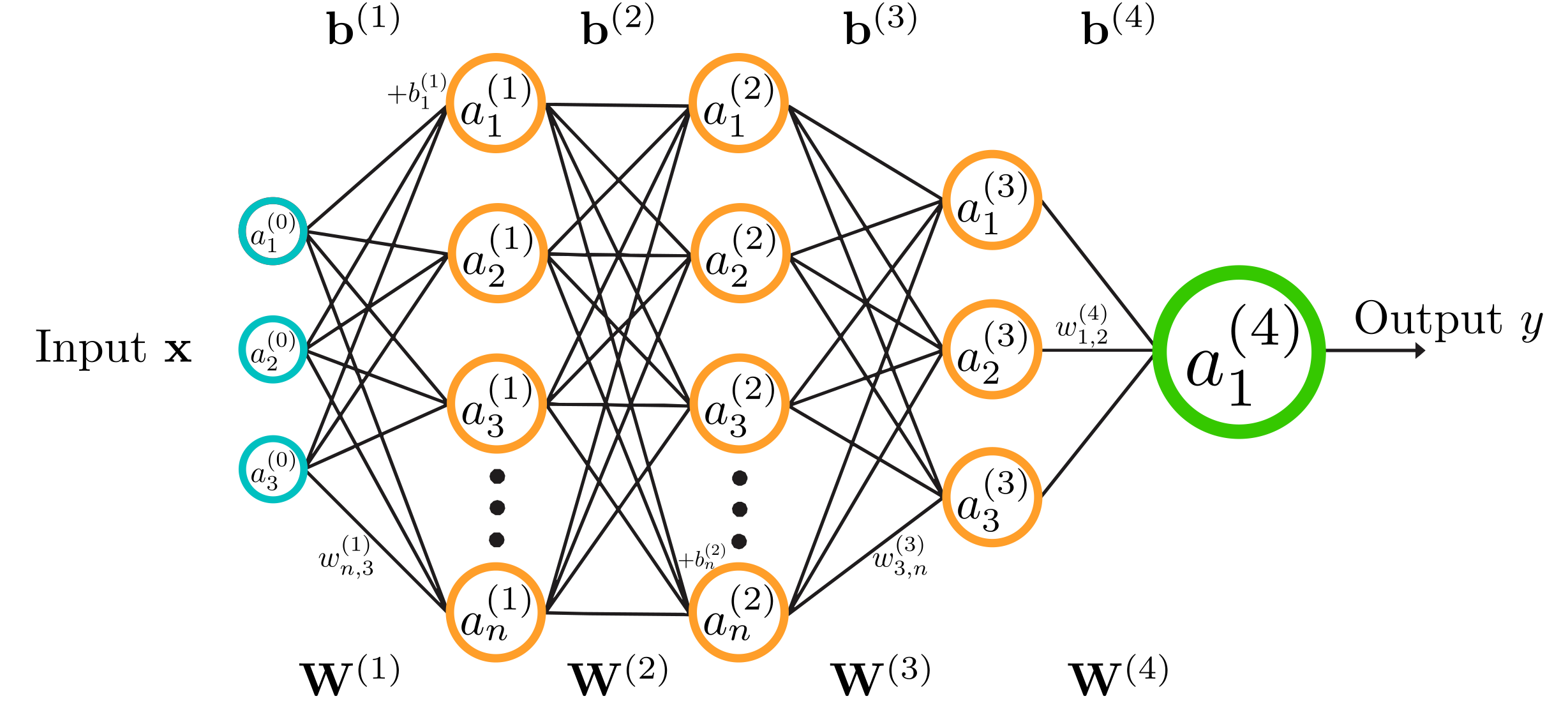
A layered-network illustration supplies background for a learned denoising model and its repeated prediction steps.
QuantuMechaniX8 · Image source · CC0 1.0

A missing passage has two boundaries. The text before it sets expectations, while the text after it constrains what would make sense. That ordinary editorial problem is an awkward fit for a writer that sees only a growing prefix. Dream 7B made bidirectional text generation a practical research subject in 2025, and DreamOn addressed a particularly tangible limitation in February 2026: a blank passage rarely announces exactly how many tokens it needs. Together, these projects make a useful case study in turning an appealing generative mechanism into an actual editing tool. Their results concern specific models and tasks. The wider lesson is about the interface between uncertainty, output length, and a user's definition of a successful completion.
A diffusion model with an inherited starting point
Dream's official research announcement appeared in April 2025; the arXiv paper was submitted on 21 August 2025. The seven-billion-parameter model was initialized from an autoregressive language model and adapted for discrete diffusion. Its training approach also adjusts token-level noise according to context. The paper reports general, mathematical, coding, and planning evaluations, along with base and instruction-tuned releases. These details distinguish Dream from a diffusion model trained entirely from random weights, and the release chronology should not be mistaken for a new 2026 base model.
Inheritance creates an interesting scientific question. If a model already knows vocabulary, syntax, and many associations, adaptation can concentrate on learning to use that knowledge through a different generation process. A useful analogy is asking an experienced translator to reconstruct shuffled notes rather than translate a clean paragraph. Existing knowledge remains valuable, but the procedure and its errors change. An ablation comparing different starting checkpoints can indicate how much the new behavior depends on that inherited preparation, rather than attributing every success to diffusion itself.
What surrounding context buys an editor
The team's public examples demonstrate continuation, infilling, and configurable generation order. Those affordances make a model interesting for interfaces where users preserve parts of a document and replace others. They do not mean every surrounding constraint will be obeyed. A system still has to determine which spans are fixed, how they are represented, and what counts as an acceptable replacement. A model that silently changes the surrounding contract would be a poor editor even if the replacement reads fluently.
Imagine an original example in which a paragraph must end with a previously approved safety instruction. A replacement sentence has to connect the opening explanation to that fixed ending. Seeing both boundaries makes certain contradictions easier to notice, but it does not establish the instruction's factual correctness. The application should preserve the fixed text byte for byte and separately check the inserted claim. This distinction separates mechanical editing guarantees, which software can enforce, from semantic judgments that remain uncertain.
Why a denoising slider needs a task label
Dream evaluates a quality-speed trade-off obtained by varying diffusion steps. A reported comparison on the Countdown planning task illustrates that this control can be useful. It does not establish a universal latency advantage for arbitrary conversations. The task, hardware, generation length, and quality target define the comparison. A small number of refinement rounds can be attractive when it preserves the property an application cares about; a speed gain that breaks the required output is simply a different operating point.
For an independent toy example, suppose an editor offers a fast preview and a slower verified patch. The preview might help a person decide whether the proposed direction is worthwhile. The patch must still survive checks for syntax, missing cases, and consistency with the fixed suffix. Measuring only preview latency would overstate the productivity gain, while measuring only the final patch could miss a useful interaction benefit. A thoughtful experiment would log both times and ask whether early feedback reduces total human correction effort.
The fixed canvas becomes a real bottleneck
DreamOn, submitted on 1 February 2026, introduces length-control states that let a diffusion process expand or contract its output. The paper applies the approach to Dream-Coder-7B and DiffuCoder-7B and evaluates code infilling on HumanEval-Infilling and SantaCoder-FIM. It reports strong results relative to tested autoregressive systems and to a length oracle that receives the correct completion length. This is evidence about those infilling experiments, not a demonstration that all open-ended generation problems now have reliable length control.
Why does length deserve a separate mechanism? Consider a fictional function whose missing body could be a three-line direct return or a twenty-line branch handling several cases. If an interface allocates too few slots, a logically necessary step may not fit. Too many slots can encourage needless material or awkward endings. Giving the algorithm permission to change the canvas removes that artificial commitment. It still must choose good content. A larger box does not make the answer correct, but a box of the wrong size can make a correct answer unnecessarily difficult.
Code infilling needs more than resemblance
A useful infilling evaluation distinguishes executable behavior from textual similarity. Two patches can use very different expressions and still implement the same function. Conversely, a patch can resemble a reference answer while mishandling empty input. The published DreamOn results should therefore be read through the benchmarks' actual procedures, rather than through visual appeal. My inference is that length adaptation becomes most meaningful when paired with tests that examine the completed program, including its interaction with the untouched surrounding code.
An original test design could hide the target length and include several valid solution styles. Evaluators would vary the initial allocation deliberately, then record success, final length, refinement rounds, and execution cost. They would also include cases where a short patch is correct and a long explanation is harmful. This would test whether the model has learned to use length as a tool rather than as a proxy for sophistication. Human review would remain useful for maintainability, while executable checks would anchor functional claims.
Revision has to reveal its failures
Flexible generation creates a recovery question: what happens after the model has committed to a bad intermediate choice? A system can regenerate uncertain positions, change its allocation, or ask for external feedback, but each action consumes resources and can disturb previously acceptable material. Comparing only first attempts misses that behavior. Comparing only the best of many attempts hides its cost. An informative deployment study would specify a stopping rule before running the experiment and count failed recoveries as part of the result.
For example, an editor could preserve a version history containing every proposed patch and its test outcome. That history would show whether additional refinement tends to improve the same candidate or merely searches for a lucky one. It would also help a user understand which surrounding requirements were checked. This is an application proposal, not a feature claimed for Dream or DreamOn. It follows from treating iterative generation as a process that needs observable checkpoints rather than a mysterious burst of fluent text.
A more useful comparison than one headline
The verified 2026 development in this story is DreamOn's variable-length infilling work, built on the earlier diffusion-model research. The models should remain separately named because their objectives and evaluations differ. Dream's planning evidence does not automatically transfer to DreamOn's code setting, and a successful code infill does not establish conversational reliability. Keeping that boundary clear allows a reader to appreciate progress without quietly combining unrelated best-case results into an imaginary system.
The next comparison I would value most would put both diffusion and autoregressive editors inside the same realistic development workflow. Both would receive identical fixed context, test access, correction opportunities, and time limits. Success would mean a correct, readable patch accepted with little human repair. Such an experiment could reveal where bidirectional refinement and length control make a practical difference. The question is not merely how a model emits tokens, but how well its way of resolving uncertainty matches the unfinished work a person actually has.
Sources & further reading
Primary papers, project documentation, and research releases used in this article. Publication dates below refer to the sources themselves.
- Dream 7B: Diffusion Large Language ModelsarXivPublished Checked
- Dream 7BHKU NLP GroupPublished Checked
- DreamOn: Diffusion Language Models For Code Infilling Beyond Fixed-size CanvasarXivPublished Checked
FOLLOW THE QUESTION
Study engineering foundations