PHYSICS
Top-quark entanglement after the threshold studies: what collider correlations can establish
October 2026 top-spin measurements and new threshold studies sharpen the interpretation of collider entanglement without turning top quarks into qubits.
Research checked
Newest cited publication
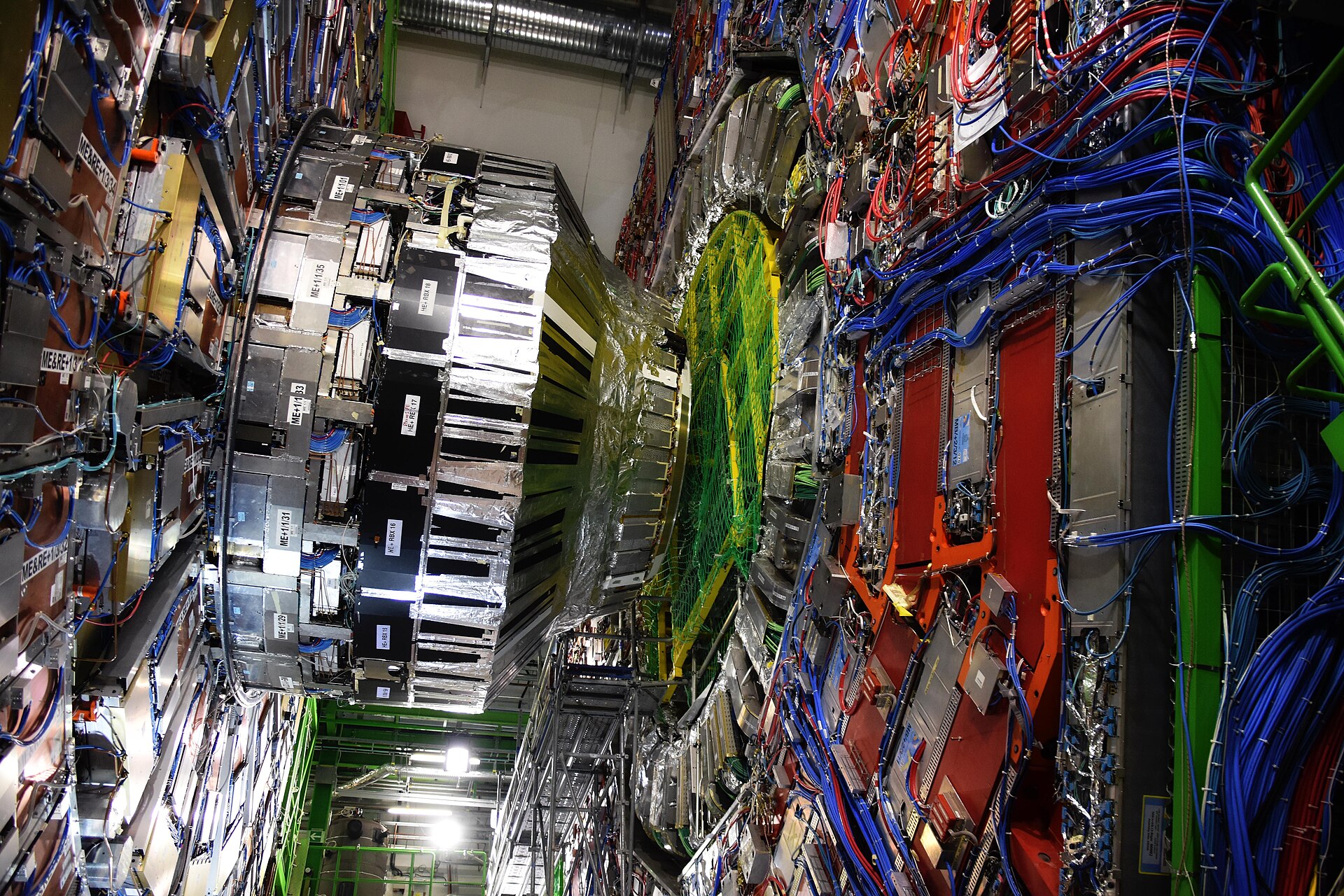
The CMS detector provides context for reconstructing high-energy collision events and the top-quark correlations examined in the article.
SimonWaldherr · Image source · CC BY-SA 4.0

On 7 October 2026, CMS described new top-quark polarization and spin-correlation studies presented at the TOP2026 workshop. Those preliminary conference results join a research program whose striking earlier achievement was the observation of entanglement between a top quark and an antiquark. Another important development, reported in March 2026, independently tested an excess near their production threshold. The connection between these stories is physical rather than merely fashionable: spin information helps identify how the pair was produced, while production dynamics affect the predictions used to interpret that information. Understanding the chain matters more than treating every result as a fresh declaration that quantum mechanics is mysterious.
Spin survives as a pattern in decay products
A top quark disappears too quickly for an experiment to place it in a conventional spin-measuring device. Instead, physicists infer its spin statistically from the directions of particles produced in its decay. The weak interaction makes those directions informative. Across a large sample, an angular distribution can distinguish different underlying spin populations. The measurement therefore concerns an ensemble reconstructed through a detector and a physical decay model. A single spectacular collision image does not reveal whether a pair’s joint quantum state was entangled.
This resembles estimating the orientation of a hidden rotating source from the directions of emitted signals, although the top-quark problem is quantum mechanical. Both the individual distributions and their joint relationships matter. If each particle separately appears unpolarized, the pair can still have strong correlations. Conversely, a correlation alone does not establish entanglement. Two ordinary dice glued together can produce correlated outcomes without requiring a quantum description. The relevant test must rule out an appropriate set of separable quantum states, not merely demonstrate that two measured quantities are statistically related.
A witness has a definition and a domain
In the CMS threshold analysis published in 2024, an entanglement-sensitive observable called D was measured as −0.480, with asymmetric uncertainties of about 0.03. In that analysis and its defined region, values below −1/3 establish entanglement; the reported significance against the non-entangled hypothesis was 5.1 standard deviations. The ATLAS observation used its own fiducial definition and reported a different central value. Their numbers should not be averaged casually, because the event selection and the level at which a quantity is defined are part of the observable.
A witness is a carefully chosen quantity for which some values cannot arise from separable states under the analysis assumptions. It can demonstrate entanglement without reconstructing every element of the full joint density matrix. This economy is useful but bounded. A witness may be sensitive only in a certain region, and failing to cross its boundary does not prove that every state in the sample is separable. In the same way, a thermometer designed for a limited temperature range can deliver decisive information inside its range without becoming a universal description of the object being measured.
Why almost stationary top pairs are special
The production threshold is the energy region near the minimum needed to create a top–antitop pair. Near threshold, their relative motion is slow enough that repeated strong interactions can substantially influence the production process before the particles decay. This does not mean stable top-quark atoms can be collected and stored. The relevant state is transient, and the finite top lifetime remains essential. Theoretical calculations must address competing formation, interaction and decay times rather than import an ordinary atomic picture unchanged.
ATLAS reported a threshold enhancement in July 2025, using angular information to improve discrimination and comparing predictions with and without non-relativistic effects. On 25 March 2026, CMS described a further confirmation in events containing one lepton and jets, with an excess above five standard deviations. That final state differs from the earlier two-lepton channel and provides a statistically independent check. The collaboration interprets the excess as consistent with a short-lived top–antitop bound-state contribution. The significance belongs to the defined excess relative to the tested model, not to every possible theoretical description of the region.
Entanglement and a threshold excess are distinct claims
An entanglement observation asks about the pair’s quantum spin state. A threshold study asks whether the observed production pattern requires contributions absent from a baseline model. The questions overlap because different production mechanisms can populate different spin configurations, but neither observation logically replaces the other. Adding a threshold contribution can improve a simulation’s angular predictions without changing the mathematical meaning of entanglement. Likewise, observing entanglement does not by itself identify a particular binding potential or prove the size of a proposed quasi-bound component.
An independent mixture example makes the relationship clearer. Imagine that process A produces one angular distribution and process B another. If a simulation underestimates the fraction of B, its prediction for the combined distribution will be wrong even when both component shapes are correct. A fit can then confuse a change in mixture with a change in a spin parameter unless it has additional information. Measuring energy dependence, separate decay channels and complementary angles helps resolve that ambiguity. This is a general inference issue, not an assertion that the published observations have failed their own validation.
Uncertainty correlations can further change a comparison. If two angular bins shift together under a calibration variation, treating their errors as independent exaggerates the amount of separate information. Conversely, a shape change that moves one bin up and another down may be much more constraining than an overall normalization shift. A usable measurement therefore needs its definitions and correlated uncertainty information alongside its headline value.
What the October 2026 update does and does not say
The CMS TOP2026 announcement includes a Run-2 study of top polarization and pair spin correlations in dilepton events. The official summary says the comparison tests Standard Model production and reveals some differences between data and predictions. It identifies the analysis as TOP-23-006 and links a Physics Analysis Summary. At the October 2026 cutoff, the appropriate description is a newly presented preliminary measurement. The announcement is not a basis for assigning an invented discovery significance, declaring a new entanglement record or asserting that an unknown interaction has been found.
The useful next question is where the differences occur and how robustly they survive alternative predictions, uncertainty treatments and reconstruction tests. Many precision collider comparisons depend on perturbative order, parton shower descriptions and the mapping from measured objects to a specified particle-level quantity. Agreement in one projection can coexist with disagreement in another. Publishing multidimensional information and correlations between bins allows independent theorists to ask whether one modification improves the whole description. This is more discriminating than selecting the most unusual-looking point from a long list of plots.
A quantum probe, not a quantum computer
These measurements make high-energy collisions a laboratory for quantum information concepts, but they do not demonstrate a usable top-quark processor. Computing would require controlled preparation, operations, readout and error management across a device. A short-lived, statistically reconstructed pair in a collider answers a different question. Nor is an entanglement witness automatically a loophole-free Bell test. Bell inequalities bring additional conditions about measurement choices, independence and the experimental arrangement. The vocabulary of quantum physics is shared, but the operational claims must be kept separate.
The frontier is nevertheless substantial. Combining independent decay channels, improved near-threshold theory and broader spin measurements can establish which quantum features are robust and where production models need revision. Precision here is not only about smaller error bars: it includes stating the physical region, defining the reconstructed quantity and distinguishing direct observation from interpretation. The latest verified additions through 18 October 2026 strengthen that program. They offer new information about a fleeting pair’s joint state and strong-interaction environment, while leaving both practical quantum computing and claims of new fundamental particles to experiments designed to test those separate possibilities.
Sources & further reading
Primary papers, project documentation, and research releases used in this article. Publication dates below refer to the sources themselves.
- Observation of quantum entanglement in top-quark pairs using the ATLAS detectorATLAS Collaboration / arXivPublished Checked
- Observation of quantum entanglement in top quark pair production in proton-proton collisions at √s = 13 TeVCMS Collaboration / arXivPublished Checked
- Bound to be discovered? ATLAS explores top-quark interactions near thresholdATLAS CollaborationPublished Checked
- CMS observes another indication of a momentary union of the heaviest quarks, now in the lepton + jets final stateCMS CollaborationPublished Checked
- CMS at TOP 2026CMS CollaborationPublished Checked
FOLLOW THE QUESTION
Explore physics