PHYSICS
Why T2K and NOvA Combined Their Neutrino Data
The joint 2025 oscillation fit and new 2026 interaction studies show how complementary experiments sharpen neutrino physics without settling every question.
Research checked
Newest cited publication
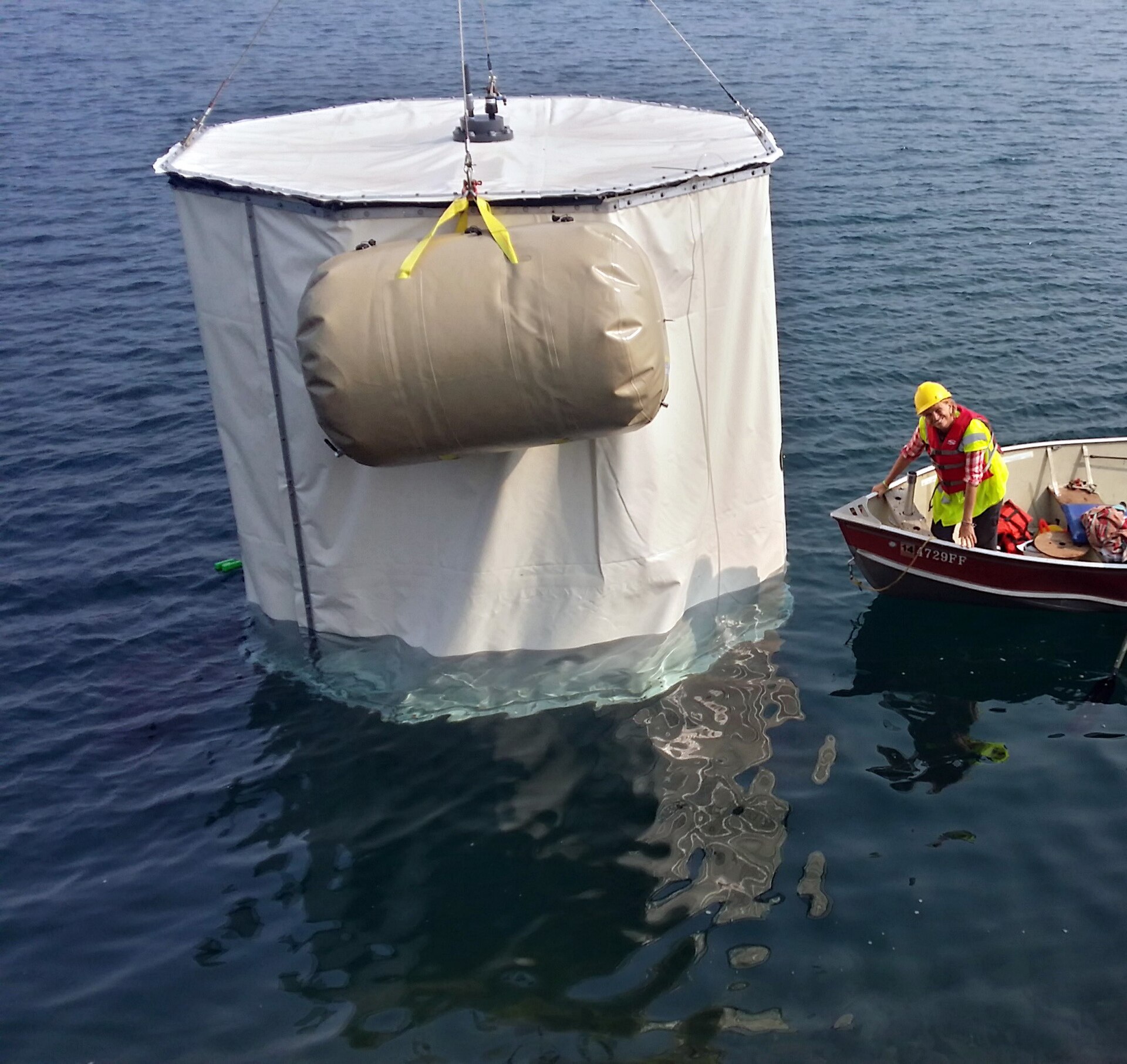
A CHIPS detector deployment supplies general experimental context. The joint result combines data from the separate T2K and NOvA instruments.
Jerry Meier (University of Minnesota), via UCL Mathematical and Physical Sciences · Image source · CC BY 2.0

Two experiments can become more informative together even when their individual headlines seem to pull in different directions. On October 22, 2025, the T2K and NOvA collaborations published their first joint neutrino-oscillation analysis in Nature. The result combined their detailed statistical models rather than averaging a pair of best-fit numbers. It sharpened the atmospheric squared-mass splitting while leaving the mass ordering unresolved. Its suggestion of charge-parity violation depended on assuming the inverted ordering. The 2026 work checked for this article adds progress on interaction modeling and experimental inputs, rather than a newly verified joint discovery. The lasting lesson is that scientific complementarity resides in the shape of allowed explanations, not merely in how many events two experiments can add together.
The two experiments ask related questions under different conditions
T2K sends a beam from J-PARC in Japan to Super-Kamiokande, about 295 kilometres away, with a characteristic neutrino energy around 0.6 gigaelectronvolts. NOvA uses a beam from Fermilab and a detector about 810 kilometres away, with energies around two gigaelectronvolts. Both examine muon-flavour disappearance and electron-flavour appearance. Their different distances, energies and detector technologies give them different responses to the same underlying oscillation parameters. That is the physical basis for a useful combination.
An analogy is locating an object by intersecting two long, narrow position bands. Either band alone permits many locations. If they cross at a useful angle, their overlap is much smaller. If they lie parallel, a second measurement may add precision without resolving the main ambiguity. Oscillation fits create analogous allowed regions in a space of mixing angles, mass differences and phases. Different experimental conditions change the orientation and shape of those regions. The joint result uses that geometry, not a popularity vote between two central values.
A joint analysis is more than a weighted average
The collaborations combined likelihoods and explored a shared Bayesian posterior over physical parameters, while retaining their experiment-specific detector and interaction descriptions. They cross-checked the combined inference with their separate fitting frameworks. A likelihood describes how compatible a chosen model is with observed data; a posterior also incorporates the stated prior information. Keeping that distinction visible matters when the probability landscape has multiple separated regions, physical boundaries or nonlinear relationships.
For a simple invented case, imagine one experiment permits a phase near either 20 degrees or 160 degrees, while another prefers values near 150 degrees. Averaging the first experiment’s two possibilities into a central value of 90 degrees would invent support where little existed. Combining their full likelihoods instead favors the compatible region near 150–160 degrees. Real neutrino fits contain several correlated parameters and periodic phase coordinates, making this caution more than a technical nicety. The shape of uncertainty is part of the result.
The CP statement has an essential condition attached
The published joint analysis found no strong preference for normal or inverted mass ordering. It reported evidence of leptonic charge-parity violation if inverted ordering is assumed within the three-flavour framework. Removing that condition changes the claim. The data do not establish unconditional discovery of CP violation. A result can exclude CP-conserving phase values within one mass-ordering hypothesis while allowing them within another that remains plausible. This is a statement about different branches of the same inference.
Conditional reasoning appears throughout science. A test might strongly distinguish two explanations if a background rate is fixed, but become less decisive when that rate is uncertain. It is misleading to quote the stronger conditional conclusion while omitting the unresolved assumption. In neutrino physics, future mass-ordering information could change how existing phase constraints are interpreted. Such a change would not necessarily mean the old data were wrong; it could mean another experiment supplied information needed to choose the relevant branch.
A sharper mass-squared separation is already a substantial result
Under normal ordering, the joint paper reports Δm²32 at approximately 2.43 × 10⁻³ eV², with an asymmetric uncertainty of roughly 0.03–0.04 × 10⁻³ eV². That quantity controls an important oscillation frequency. It is a difference of squared masses, not the mass of one individual neutrino and not the sum of all neutrino masses. Its improved precision contributes to consistency tests even while the phase and ordering questions remain open.
To see the distinction algebraically, take two fictional masses of three and five arbitrary units. Their squared-mass difference is 25 minus nine, or 16 units squared. Masses of zero and four units produce the same squared-mass difference. Measuring the difference alone therefore cannot determine both absolute masses. Oscillation experiments need other kinds of mass information for that purpose. A precise frequency measurement can nevertheless tightly restrict combinations of parameters and help future experiments tune their analyses to the physically relevant energy and distance scales.
Shared physics does not mean every uncertainty is identical
The joint analysis had to examine which systematic effects should be correlated between the experiments. Beam production, interactions with nuclei and detector response each have different relationships across the two facilities. Some physical mechanisms are shared, yet the experiments use different models, energies and measurement techniques. The paper tests the impact of plausible correlation choices rather than simply assuming that every shared label represents one common nuisance parameter. Its conclusions are limited to the exposures and model descriptions studied.
A familiar example is combining two thermometers. Their random readout noise may be independent, while an error in the reference standard used to calibrate both is shared. Averaging reduces independent noise but cannot erase a common calibration offset. Conversely, treating genuinely independent offsets as identical can also misrepresent uncertainty. In a joint physics fit, the goal is a defensible model of which variations move predictions together, which move them separately and how strongly the data constrain each possibility.
The 2026 frontier includes better control of neutrino interactions
A T2K collaboration preprint submitted June 12, 2026 describes how its ND280 near detector constrains the incoming flux and neutrino–nucleus interaction model. It includes alternative-model robustness tests and a prospective study of improved near-detector acceptance. These checks matter because neutrino energy is inferred from the particles produced when a neutrino strikes a nucleus. Nuclear effects can shift energy into poorly observed particles or alter the apparent interaction category. An inaccurate interaction description can distort an oscillation spectrum.
An April 9, 2026 conference contribution also discusses recent T2K oscillation and cross-section work, including data with a gadolinium-loaded far detector. It is a conference preprint summarizing a programme, and should not be relabeled as a new combined T2K–NOvA fit. The relevant progression is methodological: new event information and better interaction constraints can make later oscillation analyses more robust. Whether a particular update materially changes a phase interval must be established in the actual published fit, rather than inferred from a detector upgrade’s existence.
What a convincing next conclusion would require
A stronger joint analysis needs sufficiently informative data, validated mappings between models, and statistical tests that remain reliable as systematic errors become more prominent. A phase preference can become stronger, weaken or move when those inputs improve. That is why a result should be accompanied by its data exposure, external constraints, ordering assumptions and alternative-model checks. Reporting only a preferred phase value would hide the conditions under which the preference was obtained.
My inference is that this collaboration provides a useful template for the next generation of neutrino experiments. Complementary measurements become scientifically powerful when teams combine the uncertainty structure as carefully as the event samples. As of October 18, 2026, the evidence reviewed here supports a precise joint mass-splitting result, an unresolved ordering, conditional CP information and active work on better experimental inputs. The outstanding questions remain exciting because the experiments have identified concrete measurements capable of resolving them, not because every suggestive trend is already a discovery.
Sources & further reading
Primary papers, project documentation, and research releases used in this article. Publication dates below refer to the sources themselves.
- Joint neutrino oscillation analysis from the T2K and NOvA experimentsNOvA and T2K Collaborations / NaturePublished Checked
- Joint neutrino oscillation analysis from the T2K and NOvA experimentsT2K ExperimentPublished Checked
- Constraining Neutrino Interaction Uncertainties for Neutrino Oscillation Measurements at the T2K ExperimentT2K Collaboration / arXivPublished Checked
- Recent Neutrino Oscillation and Cross-Section Results from the T2K ExperimentNick Latham / arXiv; NuPhys2026 contributionPublished Checked
FOLLOW THE QUESTION
Explore physics