ENGINEERING
Self-healing concrete needs a performance test, not a disappearing crack
An August 2026 polymer-cement experiment reports repeated healing at low additive loading. The engineering test is what sealing restores, and under which conditions.
Research checked
Newest cited publication
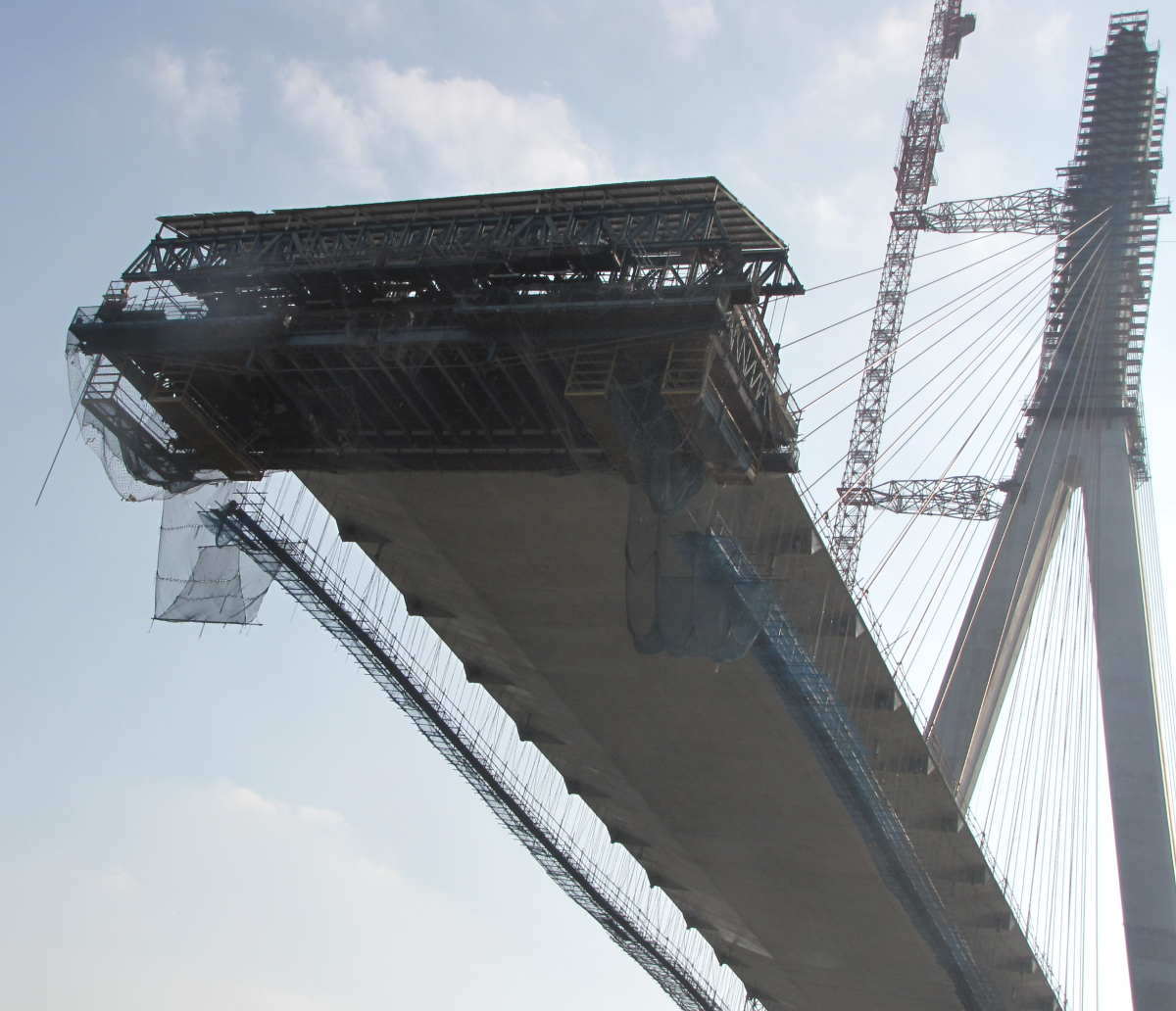
Concrete bridge construction illustrates the scale and load-bearing role of the material. The image does not demonstrate self-healing behavior.
Bill Bradley (Billbeee) / Wikimedia Commons · Image source · CC BY 2.5

A photograph of a crack closing is a powerful way to describe self-healing concrete. It is also an incomplete specification. A surface can become less visible while the material remains mechanically weakened, and a partially filled crack can substantially reduce leakage without restoring its original strength. An August 2026 Nature Communications paper makes this distinction particularly interesting: a very small polymer addition enabled repeated healing in cement specimens, with imaging and mechanical tests used together. Other recent work explores bacteria and synthetic microbial partnerships. These are different mechanisms with different resource needs. The productive engineering question is therefore not whether concrete can heal in some sense. It is which function returns, how reliably, and whether the benefit survives realistic exposure and manufacturing conditions.
What the August 2026 experiment demonstrates
Chao Zeng and colleagues report a cement composite containing less than 0.15 percent polymer by mass. A three-polymer complex forms reversible interactions with itself and cement hydration products. Imaging showed redistribution into cracks, while loading-and-healing experiments recorded recovery across repeated cycles. Under the paper’s specified severe loading protocol, maximum reported recoveries reached 62 percent in compression and 59 percent in direct tension. These are laboratory results for the tested composite and procedures, not evidence that a damaged bridge can regain full capacity without intervention.
The important conceptual change is reversibility. A one-use capsule releases a finite inventory when a crack intersects it; a reversible molecular interaction can potentially disengage and reconnect more than once. That does not create unlimited healing material or eliminate the need for favorable transport conditions. It changes which constraint engineers should examine. The useful next question becomes how many cycles remain effective after aging, drying, leaching, and chemically aggressive exposure, rather than simply whether the first visible crack closes.
Sealing, stiffness, and strength answer different questions
For a water-retaining wall, reduced leakage may be the most useful outcome. For a load-carrying element, residual strength and deformation capacity matter. For an instrumented component, a change in stiffness may affect vibration even when ultimate strength remains acceptable. These quantities should be reported separately because their relationship depends on crack geometry and the material that fills the opening. A soft filling can obstruct a water path while transferring little tensile force across it.
Imagine a specimen whose original compressive capacity is forty megapascals. After damage it carries twenty, and after a healing interval it carries thirty. One possible recovery metric describes the regained ten megapascals relative to the twenty lost, giving fifty percent. Another reports the healed capacity relative to the original, giving seventy-five percent. Neither arithmetic is wrong, but they communicate different things. This invented example shows why a comparison must reproduce the paper’s definition, loading history, age-matched control, and test geometry before ranking materials by a recovery percentage.
The environment supplies more than a background condition
The 2026 study uses surface observations, internal X-ray imaging, and mechanical tests rather than equating a photograph with restored capacity. Its interpretation includes water-assisted polymer movement. That makes the tested moisture state part of the reported result. Low additive loading does not remove this environmental dependency.
This suggests a simple way to organize future experiments. Hold the crack geometry approximately constant while varying humidity, wetting duration, temperature, and the age at first damage. Then repeat the test after drying and rewetting. A mechanism that works only when water is continuously available may still suit a tank or buried structure, but its value for a sheltered, dry interior is different. Testing the intended exposure is more informative than asking whether one laboratory condition represents an average building climate.
Biological healing has a different materials budget
A 2025 comparative study in Innovative Infrastructure Solutions tested concrete mixes incorporating different bacterial systems, including a hybrid combination. The experiments included mechanical measurements, absorption, permeability, and microscopy. The authors associate the resulting improvements with mineral precipitation and explicitly call for longer-term environmental and life-cycle evaluation. This supports further investigation of microbial healing; it does not demonstrate decades of autonomous performance in a deployed structure.
The mechanism has a resource balance. Organisms need conditions that permit survival or reactivation, a route to the crack, and chemicals from which a solid mineral can form. If those ingredients are consumed, the healing capacity changes. Designers should therefore ask where the nutrients and calcium originate, which by-products accumulate, and whether the protective carrier survives mixing. A biological route can have advantages without being independent of its environment. Comparing it with a polymer route means tracking different inventories, not assuming the same crack-closure photograph represents the same process.
The 2025 lichen-inspired approach tests a supply problem
Texas A&M’s May 2025 account of work led by Congrui Grace Jin describes a synthetic partnership between cyanobacteria and filamentous fungi. The intended division of labor is to generate nutrients using light and support the formation of crack-filling minerals. The institution reports laboratory growth and mineral production under challenging conditions. The proposal addresses a real limitation of some biological approaches: repeatedly supplying nutrients from outside the material. It remains a research route, rather than a general-purpose construction product.
A useful independent question is where this partnership can receive light. A shaded crack deep inside a thick wall presents a different energy environment from a surface opening exposed to daylight. The distinction need not invalidate the approach; it may define its best application. A surface repair layer, an accessible facade, and a deeply buried element should have different test protocols. Designing around a biological system’s environmental requirements is more plausible than assuming every organism-material combination should work equally well everywhere.
A fair comparison starts before the crack is made
The simplest experimental trap is to compare a healed, older sample with a younger baseline. Cement continues reacting with water as it ages, so some strength gain can occur even without an engineered healing mechanism. A useful experiment therefore needs unmodified specimens with the same age, damage history, moisture exposure, and testing interval. It should also distinguish recovery caused by continued hydration from recovery associated with the added system. Replicates reveal whether an impressive result is typical or an outlier.
Crack control is equally important. A deliberately aligned fracture in a small disk is easier to characterize than a network of irregular cracks in reinforced concrete. Tests should record width, depth, connectivity, residual movement, and any material that was lost. A bridge joint that opens and closes during temperature cycles asks more of a healing agent than a stationary specimen. Reporting the hardest unsuccessful case, alongside the best successful one, would help engineers identify the application boundary instead of extrapolating from a single favorable image.
The durability claim needs a time horizon
My interpretation is that the strongest near-term opportunity may be selective use where sealing has high value and inspection remains possible. A modest reduction in water ingress could matter even without full strength recovery, provided the design does not count on unverified repair. The appropriate claim should name the restored function, the exposure, and the interval over which it was measured. That makes a useful partial improvement easier to recognize instead of forcing every experiment into a story about indestructible infrastructure.
The environmental argument also needs evidence. An additive has its own manufacturing impacts, and a longer service life is valuable only if the material actually delivers it. Future work can connect laboratory measurements with field monitoring, maintenance records, and consistent life-cycle boundaries. The August 2026 study advances repeatable healing at low loading, while microbial studies investigate alternative supply mechanisms. Their shared challenge is translating a visible repair into a measurable, durable service benefit. That is the performance test that should guide the next generation of self-healing concrete.
Sources & further reading
Primary papers, project documentation, and research releases used in this article. Publication dates below refer to the sources themselves.
- A molecular velcro self-healing cementNature CommunicationsPublished Checked
- Bacterial self-healing and mechanical strength enhancement in concrete: a comparative study of Bacillus subtilis, Bacillus sphaericus, and Escherichia coliInnovative Infrastructure SolutionsPublished Checked
- Cracking The Code: Deciphering How Concrete Can Heal ItselfTexas A&M UniversityPublished Checked
FOLLOW THE QUESTION
Explore engineering