ENGINEERING
Direct air capture needs a complete process balance
Heirloom’s 2025 engineering partnership and 2026 project outlook highlight the material handling, heat integration and verification needed for durable removal.
Research checked
Newest cited publication
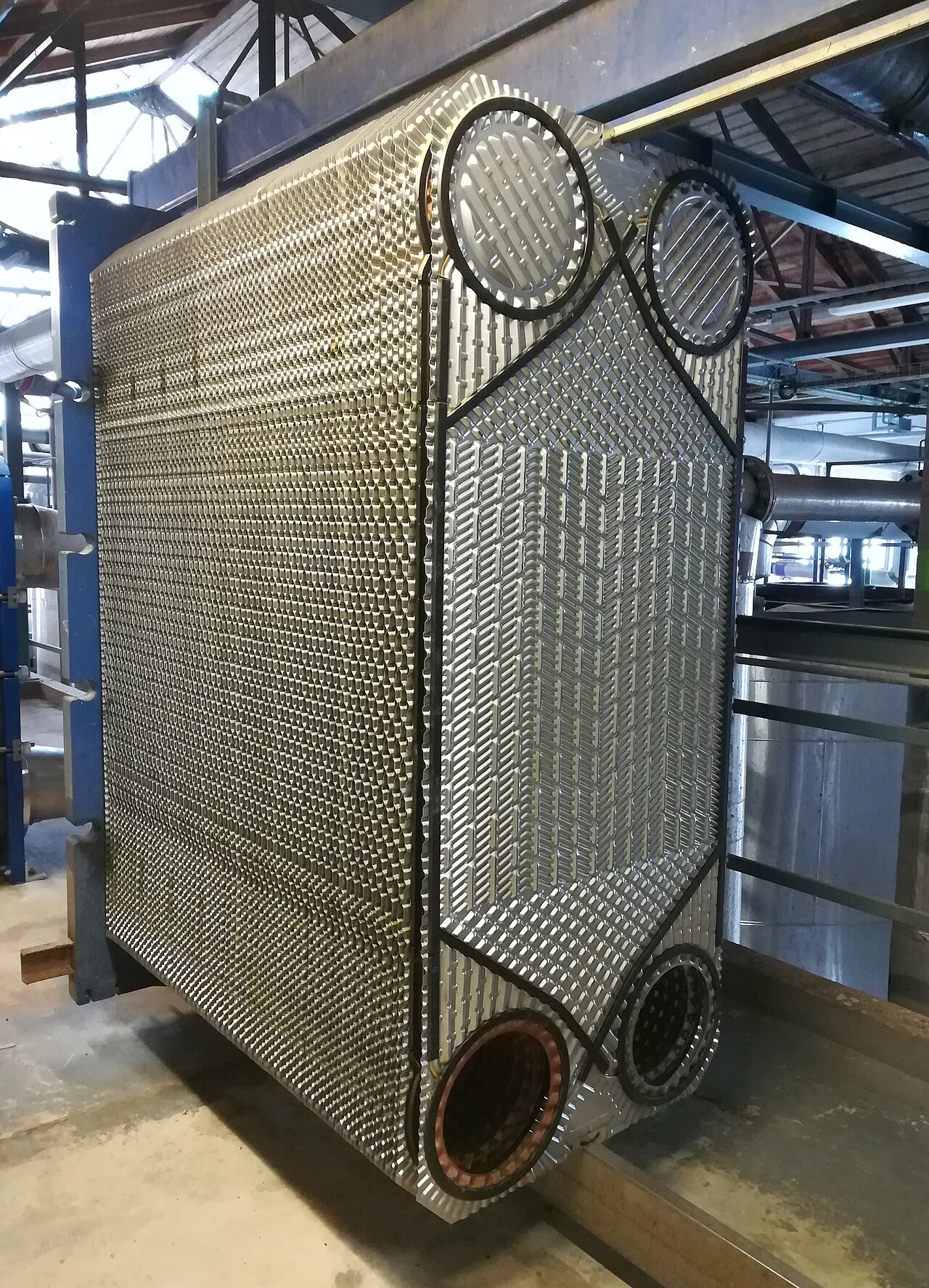
A plate heat exchanger illustrates one component family in a process heat balance. Direct air capture also requires the air handling, sorbent regeneration, and accounting described in the article.
RomanM82 / Wikimedia Commons · Image source · CC BY-SA 4.0

Capturing carbon dioxide from air is a separation process embedded in a much larger industrial system. A contactor has to encounter dilute gas, a material has to bind it, regeneration has to release it, and a storage pathway has to keep it from returning to the atmosphere. Recent announcements show direct air capture moving further into this infrastructure phase. Heirloom reported investments from the Development Bank of Japan and engineering company Chiyoda on December 2, 2025. Its July 17, 2026 commentary discussed proposed demand for permanent removals. Neither announcement is a measured capture-performance result. Their engineering significance lies in the pressure to build complete systems whose claimed removal survives an honest process balance.
Separate an operating facility from a development timeline
Heirloom’s project page distinguishes its Tracy, California facility, described as operational since 2023, from planned facilities in northwest Louisiana. The Louisiana page describes staged capacity and development dates; those plans should not be read as independently verified operating production. A projected 2026 date, viewed in October 2026, is still a projection unless supported by a commissioning or operational update. Nameplate capacity is also not the same as the amount of carbon dioxide captured, delivered to storage and verified during a completed reporting period.
This distinction is particularly important for a young industry because several different quantities can appear under the word removal. A plant may have equipment installed, material cycling, gas captured, gas transferred or a verified storage claim. Those milestones answer different questions. A transparent project update should connect them rather than substitute one for another. It should identify the boundary of the stated capacity and explain the assumptions behind annual output, including operating hours, material replacement, maintenance and the availability of the downstream storage route.
A mineral loop is also a solids-handling system
Heirloom’s technology description uses a calcium-based cycle. Carbon dioxide is driven from limestone in a kiln; the remaining calcium oxide is hydrated, and the resulting material is exposed to air to take up carbon dioxide before regeneration. That description explains the process concept. It does not by itself provide an independently measured plant energy balance or establish a universal cost. The company describes stacked trays and repeated cycling, which makes material handling a central part of the engineering problem alongside the chemistry.
Solid material must move between processing steps without excessive dust, loss or inconsistent residence time. Particle properties affect reaction access, packing and flow. A powder that behaves well in a small container may bridge in a hopper or distribute unevenly across a large tray. Moisture can help a reaction while complicating transport and drying. Engineers therefore need representative handling tests, not only laboratory uptake measurements. The useful material is the one that continues to work after many cycles through the actual conveyors, trays, hydration equipment and regeneration conditions.
Heat integration determines how much plant surrounds the contactor
Regeneration requires a heat source and a way to recover useful energy where feasible. The temperature level matters: low-temperature waste heat and high-temperature kiln heat are not interchangeable services. An apparent saving in one unit operation can also create a burden elsewhere, such as additional drying or more complex gas cleanup. A complete process model should track material and energy streams consistently across each step. Otherwise, an attractive contactor result can hide the equipment required to make its output usable.
A deliberately simple example illustrates the scale of a regeneration requirement. If a hypothetical process required 2 gigajoules of heat per tonne of captured carbon dioxide, capturing 1,000 tonnes per day would require 2,000 gigajoules per day. Dividing by 86,400 seconds gives an average thermal input of about 23.1 megawatts. This assumed demand is not a reported Heirloom value. It shows why an energy number must be translated into continuous plant services, equipment size and supply reliability before it can support a deployment claim.
Gross capture and net removal are different balances
A facility that captures one tonne of carbon dioxide does not necessarily remove one net tonne from the atmosphere. Energy supply, material manufacture, transport, construction and storage operations can create emissions that must be accounted for within the relevant assessment method. Material replacement and losses also matter over the operating lifetime. The correct comparison uses a clearly defined functional unit and consistent boundaries. Simply subtracting one conveniently available electricity figure from gross capture is unlikely to represent the whole system.
For illustration, suppose a project captures 1,000 tonnes and its attributed lifecycle emissions total 150 tonnes of carbon-dioxide equivalent under a stated accounting method. Before any additional deductions or uncertainties required by that method, the arithmetic net benefit would be 850 tonnes, not 1,000. These are hypothetical numbers. The example explains why operational metering and lifecycle assessment need to be connected. It also shows why clean energy matters twice: it must be physically available when the process needs it, and its attributed emissions affect the value of the removal being claimed.
A useful carbon product is not automatically permanent storage
Heirloom’s December 2025 announcement discusses both permanent storage and using captured carbon dioxide as a feedstock for fuels. Those are different destinations. Carbon incorporated into a fuel is generally released when the fuel is used, so it should not be described as the same durable removal service as verified long-term storage. A fuel pathway may still have a distinct emissions-reduction argument, but that argument needs its own boundary, energy inputs and comparison. The engineering plant and the climate claim must describe the same physical pathway.
For storage, the chain of custody runs beyond the capture outlet. Gas must meet the receiving system’s specifications, be transported or processed appropriately and reach a storage process with a defensible monitoring and accounting framework. Interruptions downstream can reduce realized capture even when the contactor itself is available. Intermediate storage may help with timing, but it introduces its own equipment and operating requirements. A complete reliability model therefore includes the handoff between organizations and the procedures used when one participant cannot accept the expected flow.
The next proof is a period of accountable operation
The July 2026 Heirloom commentary describes a proposed European framework for buying permanent removals and explicitly discusses further negotiation. It is evidence of the developer’s view of a policy proposal, not proof that future purchases are guaranteed or that a new plant has achieved its design target. From an engineering perspective, demand becomes valuable when it supports facilities that can produce measured, contractually acceptable removals. The relevant output is a verified service delivered over time, with uncertainty and deductions handled openly.
A strong future operating report would reconcile atmospheric capture, process losses, energy use, material replacement and verified storage for the same period. It would state downtime, measurement uncertainty and any difference between design capacity and achieved output. It would also explain which improvements were demonstrated in hardware rather than predicted by a model. The 2025 engineering partnership and 2026 development outlook make such reporting more consequential. Direct air capture becomes credible infrastructure when its entire process works together and its accounting remains intact through every handoff from ambient air to lasting storage.
Sources & further reading
Primary papers, project documentation, and research releases used in this article. Publication dates below refer to the sources themselves.
- Development Bank of Japan and Chiyoda invest in scaling Heirloom’s low-cost Direct Air Capture technologyHeirloomPublished Checked
- Carbon removal is entering the compliance eraHeirloomPublished Checked
- TechnologyHeirloomChecked
- ProjectsHeirloomChecked
FOLLOW THE QUESTION
Explore engineering