MATHEMATICS
When one fractal viewpoint sees an entire interval of distances
A 2026 version of a pinned-distance theorem shows how planar fractals above dimension 7/4 contain a viewpoint realizing every distance in an interval.
Research checked
Newest cited publication
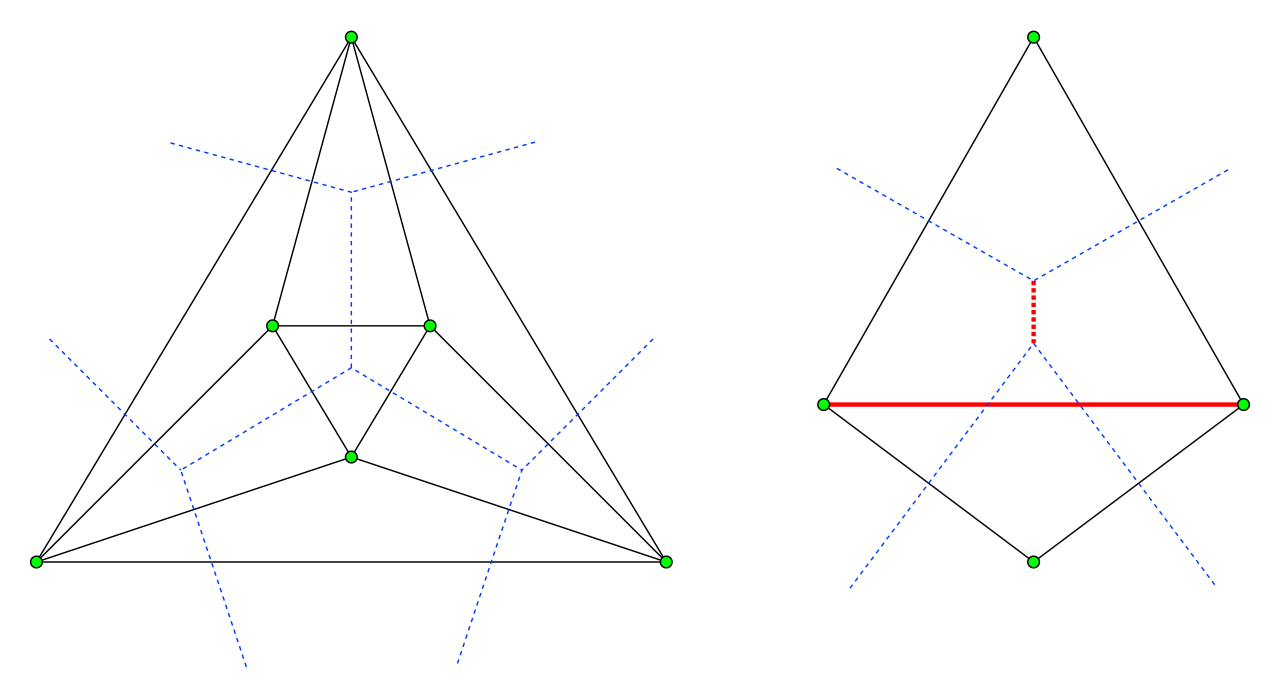
A planar point-set triangulation provides geometric background for thinking about distances. The fractal measures and pinned-distance theorem are described in the article.
David Eppstein / Wikimedia Commons. Wikimedia-generated PNG rendering of the SVG; no editorial changes. · Image source · Public domain (released by the creator)

Pick one point of a fractal and measure its distances to every other point. Could those distances cover an entire interval, with no gaps inside it? This is stronger than obtaining infinitely many distances or even a set of distances with positive length. Tainara Borges, Benjamin Foster, Yumeng Ou and Eyvindur Palsson give a nontrivial planar threshold for this pinned question. Their paper first appeared on March 19, 2025, and a revised version was posted on July 16, 2026. Its planar theorem applies when a compact set has Hausdorff dimension strictly greater than seven fourths.
Pinning changes the order of the question
The unpinned distance set collects distances between every pair of points in a set E. The pinned distance set fixes a point y and collects only distances from y to points of E. Allowing both endpoints to move gives many more opportunities. It does not follow merely from an unpinned interval that one fixed viewpoint sees the same interval: different distances could be supplied by different pairs.
A finite example makes the distinction concrete without pretending to model a fractal theorem. Place points at positions zero, one and three on a line. The unpinned positive distances are one, two and three. From the point zero, the positive distances are one and three; from one, they are one and two; from three, they are two and three. No single point sees all three positive distances. The infinite geometric problem requires additional structure to overcome this kind of changing-viewpoint obstacle.
What seven fourths guarantees
The planar result says that if compact E has Hausdorff dimension greater than 7/4, there exists a point y in E whose pinned distance set contains an interval. It does not assert the endpoint case of equality, nor does it say that every point works. The same paper proves a pinned-tree version with that planar threshold and gives a three-dimensional distance theorem above dimension 12/5. Those are the claims of this paper, rather than a claim about every subsequent improvement in the field.
Numerically, 7/4 is 1.75. A planar set of dimension 1.8 clears the stated assumption; a set of dimension exactly 1.75 does not. Dimension is not a percentage of the plane filled in. A dimension-1.8 set may still have zero ordinary area. The threshold expresses geometric complexity across arbitrarily fine scales, so a finite cloud of pixels cannot satisfy or refute it by simply looking dense.
Positive length can still leave gaps everywhere
An interval contains every real number between two distinct endpoints. A set of positive Lebesgue measure need not contain any interval. One way to see the distinction is to start with the unit interval and remove a dense open collection of short intervals whose total length is less than one half. The remaining closed set has positive measure, yet contains no interval because every interval meets the removed dense open set.
That construction is an explanatory argument rather than a distance-set example from the research paper. It demonstrates why replacing the phrase nonempty interior by positive measure would weaken the conclusion. Likewise, proving that a distance distribution has an integrable density does not automatically make that density continuous. Regularity matters: if a continuous nonnegative density is positive at one point, it stays positive on some neighborhood of that point. Such persistence is what can turn analytic information into an actual interval.
Why a wave equation enters a distance problem
Fixing a radius t and a center y means examining a circle or sphere. If a measure records the fractal's mass, averaging it over spheres detects how much mass occurs near particular distances. As t changes, these spherical averages are related to the propagation of waves. Harmonic analysis can therefore translate estimates about oscillatory functions into statements about distance distributions.
The earlier theorem of Guth, Wang and Zhang proves a sharp square-function estimate for the cone in three-dimensional frequency space and obtains local smoothing for the wave equation in two space dimensions plus time. Local smoothing controls a wave after averaging over a time interval; it is not a claim that arbitrary rough initial data become smooth at every fixed instant. That distinction is useful even in an elementary picture. A sharp moving peak can be large at each time while spending only a short time near any particular location. Averaging over time sees information that an isolated snapshot misses.
From averaged regularity to configurations
Borges and coauthors expand a framework for using local smoothing beyond an earlier L-two setting, accommodating more general L-p estimates. Their tree argument must distribute derivatives through an induction instead of paying the full regularity cost again at every edge. The proof is technical, but its organization explains why adding more vertices does not simply force a worse planar dimension threshold for each fixed finite tree.
Separate work on wave-equation local smoothing, revised in January 2026 by Gan, He, Li and Wu, illustrates the continuing development of the analytic input. Its abstract distinguishes sharp results in odd spatial dimensions on compact Riemannian manifolds from improvements in even dimensions and Euclidean estimates. This should not be read as an automatic replacement for every input in the distance paper. To transfer a new wave estimate, its operator class, exponent range and derivative gain must match the hypotheses actually needed for the geometric conclusion.
A family of edge lengths rather than one distance
A tree is a connected graph without cycles. If one vertex is pinned to a point of E, the remaining vertices are placed in E and each edge records a distance. For a tree with n edges, the configuration set lives in n-dimensional edge-length space. Having nonempty interior means that some open region of edge-length choices is realizable. It does not mean that every arbitrary assignment of lengths is possible.
The absence of cycles explains why trees offer a natural next test. Starting at a root, each new vertex can be attached by a single new edge. A triangle, by contrast, closes a cycle and couples a new choice to two existing endpoints. Even before analysis enters, triangle inequalities impose dependencies that are absent from an unconstrained list of edges. The new pinned-tree theorem is consequently a substantial extension with a clear combinatorial boundary. It gives a method for obtaining stable families of configurations from thin sets, while leaving separate questions about endpoints, optimal dimensions and more strongly coupled configurations visible.
A small continuity argument explains the target
To isolate the regularity issue, suppose a distance distribution has a continuous nonnegative density g and g takes a positive value c at radius r. By continuity there is a positive width h such that the density differs from c by less than c divided by two whenever the radius differs from r by less than h. Throughout that smaller interval the density is at least c divided by two. Every open subinterval there has positive distributional mass, so every radius in the interval belongs to the support of the distance distribution.
For a compact geometric set, the pinned distance set is itself compact because distance is a continuous function. Consequently it contains that support. This elementary chain explains why the analytical target is useful: regularity plus a nonzero density can force an interval of actual distances. The difficulty lies in obtaining the required regularity from a singular fractal measure with a fixed pin. A finite histogram cannot substitute for that step. Bins can appear uniformly occupied even when the limiting distribution has gaps below the chosen bin width.
Sources & further reading
Primary papers, project documentation, and research releases used in this article. Publication dates below refer to the sources themselves.
- Nonempty interior of pinned distance and tree setsarXivPublished Checked
- A sharp square function estimate for the cone in ℝ³arXivPublished Checked
- On local smoothing estimates for wave equationsarXivPublished Checked
FOLLOW THE QUESTION
Explore mathematics