MATHEMATICS
Can a Finite Computation Certify High-Dimensional Percolation?
A September 2026 preprint gives a semi-decision route to mean-field percolation, separating a finite certificate from an unconditional theorem in every dimension.
Research checked
Newest cited publication
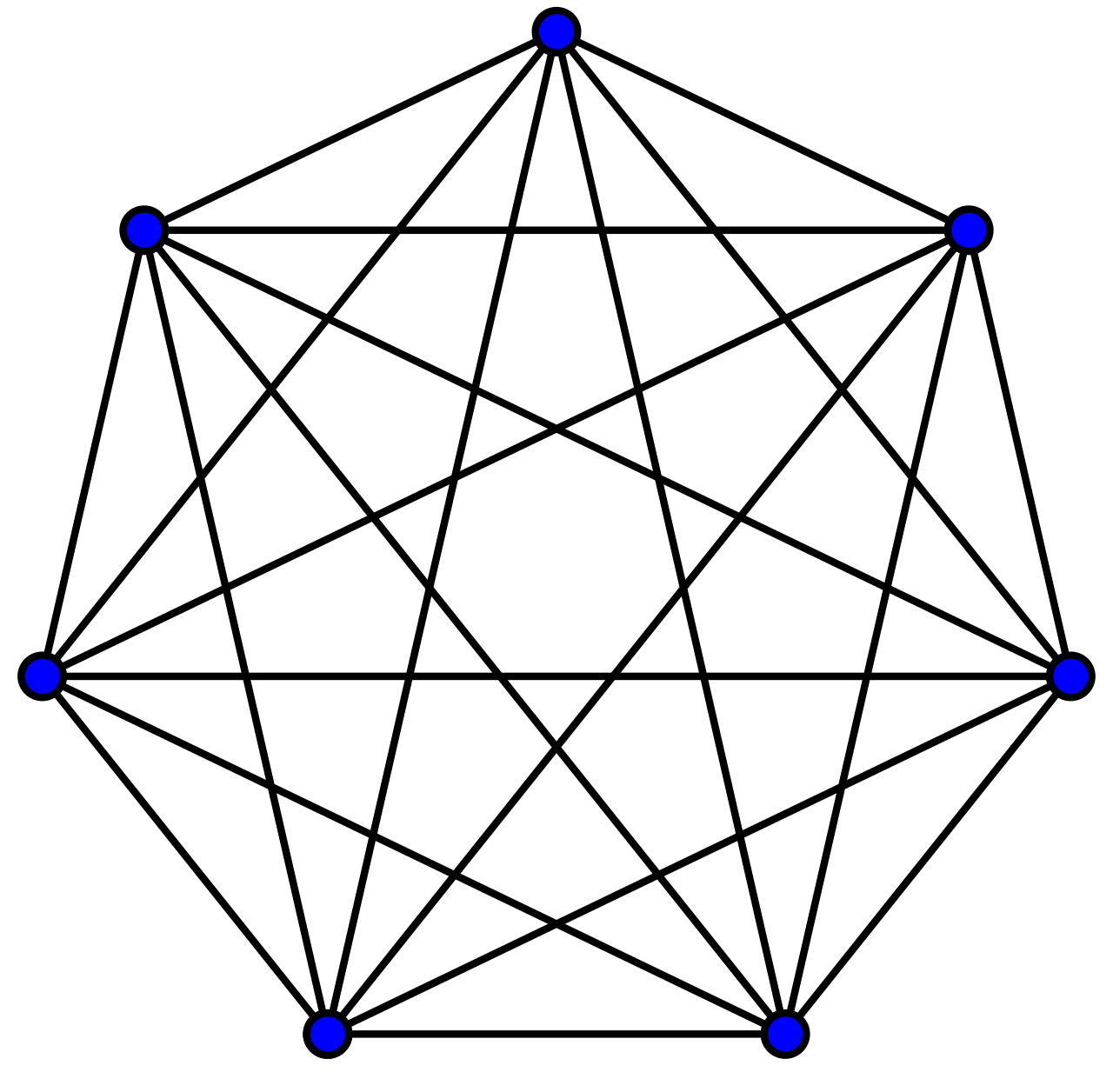
The complete graph K7 illustrates vertices and edges as basic combinatorial objects. Percolation instead randomly retains connections in the lattice settings described in the article.
David Benbennick / Wikimedia Commons. Wikimedia-generated PNG rendering of the SVG; no editorial changes. · Image source · Public domain (released by the creator)

A computer can inspect a million random networks and still fail to prove what happens on an infinite lattice. The obstacle is logical as much as computational: a large finite cluster is not an infinite cluster, and an apparent power law over several scales may eventually change. Arthur Blanc-Renaudie’s preprint, submitted on 17 September 2026, addresses a sharper question. Can an infinite-volume prediction about high-dimensional percolation have a finite certificate whenever the prediction is true? The paper develops a Markovian renormalisation method and obtains a semi-decidability statement. This is an unusually direct bridge between probability theory and computation, but understanding it requires keeping existence of a certificate separate from finding a useful certificate quickly.
What is connected, and with what probability?
In Bernoulli bond percolation, each allowed edge is open independently with probability p. Two vertices belong to the same cluster when an open path connects them. On the lattice of integer points in d dimensions, the two-point function at x is the probability that the origin connects to x. Summing that function over x gives the expected size of the origin’s cluster, usually called susceptibility. These quantities ask different questions: an individual connection can be unlikely while there are enough possible destinations to make the expected cluster very large.
Consider an illustrative finite star with four leaves. Its center has expected cluster size 1 + 4p, because each leaf is present precisely when its own edge opens. At p = 1/2 the expectation is three, despite there being no possible infinite cluster. Enlarging a finite computation therefore needs a theorem controlling the missing exterior. The paper of Duminil-Copin and Tassion from 10 February 2015 supplies relevant background: below the nearest-neighbor critical threshold, connection probabilities to distance n decay exponentially in n.
A certificate, conditional on an initialization
Blanc-Renaudie studies dimensions d greater than six, allowing a finite interaction range L, including nearest-neighbor bonds when L equals one. The preprint relates a quantitative two-point bound at a subcritical probability with sufficiently large susceptibility to the critical asymptotic form A times distance to the power 2 minus d. Its threshold function is computable. The resulting semi-decision procedure can eventually verify the mean-field asymptotic if it holds. It need not terminate when the asymptotic fails.
The author explicitly does not supply a completed numerical proof for the remaining nearest-neighbor dimensions seven through ten, or a practical running-time guarantee. That limit is central to the result. A mathematical procedure may require constants so large that direct implementation is unrealistic. The advance is a mechanism turning suitable finite information into an infinite-volume conclusion. It is neither a claim that a simulation has already settled every dimension nor a test that always returns yes or no.
A scaling picture for a critical dimension
A simple calculation helps explain why dimension enters the discussion. Suppose, for intuition, that the critical two-point function decays like distance to the power 2 minus d. A shell of radius r contains roughly r to the power d minus one lattice points. Multiplying the shell count by the connection probability gives a contribution proportional to r. Summing to radius R then grows like R squared. This is a consistency calculation under an assumed decay law, not a proof that the assumption holds.
More delicate diagrams involve several connections meeting and returning. Each summation adds volume, while each connection factor contributes decay. Whether the resulting large-scale integral converges depends on dimension. This is how a geometric-looking threshold can appear in estimates about correlations. Counting paths independently would miss it: two candidate routes can share edges and influence the same cluster. The obstacle is not lack of enough random samples, but the need to control these dependencies at arbitrarily large distances.
Why remember the previous cluster?
An original toy model makes the value of memory clear. Imagine a process that advances through connected rooms, but can never enter a room already blocked by the room it just left. If the model records only the current doorway, it may overestimate available moves. If it records the preceding room as well, some immediate exclusions become explicit. More history can improve fidelity, although it also enlarges the state space and makes analysis harder.
The research’s actual construction represents paths at a slightly higher opening probability through pointed clusters at a lower probability, retaining adjacent-cluster correlations in a Markovian description. The toy room story is not that construction, and does not reproduce its error estimates. Its purpose is to explain the modeling choice: independence is an approximation that can become expensive, whereas an enlarged state can encode dependence as a transition rule. A Markov chain need not mean the original lattice edges have stopped interacting; it can mean sufficient information has been put into each state.
Simulation, interval bounds and a stopping rule
Suppose an estimator reports a connection probability of 0.003 with sampling uncertainty 0.0002. A theorem requiring an upper bound below 0.0031 has not been verified by that point estimate. The uncertainty interval crosses the threshold. A rigorous certificate would need guaranteed bounds, including finite-volume truncation errors and every numerical approximation entering the criterion. Independent simulation can guide where to search, but its statistical confidence level is a different kind of statement from a deterministic proof certificate.
Semi-decidability also has a distinctive time asymmetry. Picture enumerating larger boxes and increasingly accurate rational bounds, stopping whenever a sufficient inequality is certified. If the required certificate exists, some finite stage will find it. If no certificate exists, the same search may continue indefinitely. Silence after a week therefore does not mean the conjecture is false. This logical distinction survives improvements in hardware. Better algorithms can shorten searches, but cannot turn an unproved stopping guarantee into a theorem by running longer.
One rigorous exterior estimate can be derived without sampling. A nearest-neighbor self-avoiding path of length n from the origin has at most 2d choices for its first edge and at most 2d minus one at every later edge. There are therefore at most 2d times (2d minus one) to the power n minus one candidate paths. Each specified path is open with probability p to the power n. A union bound gives an upper bound of 2dp times [(2d minus one)p] to the power n minus one for the existence of such an open path. When (2d minus one)p is below one, this decays geometrically. The estimate is deliberately crude and does not establish the near-critical initialization in the new paper. It shows, however, how a finite calculation can be supplemented by a rigorous tail bound, and why improving that bound near criticality requires more than drawing additional random configurations.
A wider 2026 picture of random connectivity
A separate preprint submitted on 9 April 2026 by Shirshendu Chatterjee, Pranav Chinmay, Jack Hanson and Philippe Sosoe studies k-point functions in sufficiently high-dimensional critical percolation. For fixed distinct macroscopic points, it proves convergence to an explicit constant after the common-cluster probability is multiplied by an appropriate power of scale. That is a statement about several specified vertices sharing one cluster. It should not be substituted for a two-point certificate or read as automatically covering every dimension above six.
These developments reveal complementary demands on a theory of connectivity. Pair probabilities describe how influence travels; joint probabilities describe how branches fit together; finite criteria explain which information can certify an infinite prediction. For someone building a computational project, the next useful deliverable would be an explicit, independently checkable initialization bound with documented exterior errors. For a reader following the field, the main question is equally concrete: which dependence has been controlled, which assumptions remain, and exactly what finite evidence is enough?
Sources & further reading
Primary papers, project documentation, and research releases used in this article. Publication dates below refer to the sources themselves.
- Markovian renormalisation for percolation in high-dimension: Semi-decidability of mean field behaviorarXivPublished Checked
- Convergence of k-point functions in high dimensional percolationarXivPublished Checked
- A new proof of the sharpness of the phase transition for Bernoulli percolation on ℤᵈarXivPublished Checked
FOLLOW THE QUESTION
Explore mathematics