MATHEMATICS
How random directions illuminate spiky convex bodies
A 2026 revision confirms Hadwiger’s illumination bound for cap bodies in every dimension, combining random directions with controlled computation.
Research checked
Newest cited publication
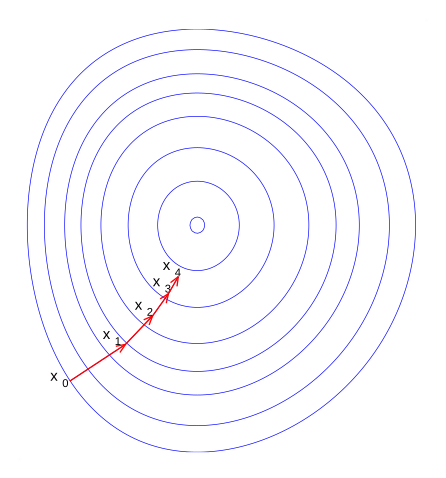
An optimization contour diagram illustrates how a geometric objective guides a search; the cap-body result uses the random-direction argument explained in the article.
Zerodamage, based on Oleg Alexandrov / Wikimedia Commons. Unchanged original image. · Image source · Public domain (released by the creator)

A small change in a shape can make illumination surprisingly difficult. A perfectly smooth ball has no sharp tips; a ball carrying carefully arranged spikes can demand many directions of incoming light. A paper by Andrii Arman, Jaskaran Singh Kaire and Andriy Prymak, submitted on October 29, 2025, and revised on August 18, 2026, confirms Hadwiger’s conjecture for the specific class of cap bodies in all dimensions. It combines probabilistic geometry with computer-assisted linear programming in dimensions four through fifteen. The general conjecture remains open. Understanding the result requires keeping three distinctions straight: a cap body is not any spiky object, a random proof is not a simulation claim, and an asymptotic estimate is not a bound for every dimension.
A restrictive way to add spikes
Start with a ball and one external point. Their convex hull is a ball with a conical extension toward that point, called a spike or cap. Form the union of finitely many such spikes based on the same ball. Only when this union is convex does it belong to the cap-body class discussed here. Taking the convex hull of a ball and arbitrary external points is not an interchangeable construction: the hull can insert additional material between spikes that was absent from their union.
That restriction imposes useful separation on the spikes’ base caps on the sphere. An intuitive consequence is that difficult tips cannot be installed independently at every direction and height. Making one extension broad restricts how another can sit nearby while preserving the required convexity. The proof uses this geometry to control how many obstructions of different angular sizes can coexist. The point is not merely that the surface has a round part; it is that its nonsmooth features obey a shared global organization.
Why the conjecture contains the number 2ⁿ
Hadwiger’s covering conjecture asks whether every n-dimensional convex body can be covered by at most 2ⁿ smaller positive homothetic copies of itself. Positive homothety means scaling by a factor between zero and one and translating, without inserting an arbitrary rotation or reflection. An equivalent formulation counts directions that illuminate all boundary points. The cube motivates the exponential target: it has 2ⁿ vertices, and a smaller similarly oriented cube cannot contain two distinct original vertices because they differ by a full side length in at least one coordinate.
The corner argument supplies a lower-bound obstruction; a suitable collection of smaller corner cubes supplies the matching covering. Most shapes need not be as demanding. The new cap-body theorem gives a strict improvement below 2ⁿ in dimensions at least three, which fits the conjecture’s expectation that affine cubes are extremal. The conclusion is restricted to this class. There is no logical step from confirming a broad-looking family of rounded spiky bodies to confirming the conjecture for every polytope or every convex body.
Random directions followed by targeted repair
The useful probabilistic principle is that an average can certify an arrangement’s existence. Suppose, purely as a toy model, there are twenty difficult features and a randomly rotated group of directions misses any specified feature with probability one half. Three independent rotations leave that feature missed with probability one eighth. The expected number of missed features is therefore 2.5. Some choice of rotations must miss at most two features; otherwise every choice would miss at least three and the average could not be 2.5.
The example needs independence between successive random rotations, not independence between different features. Linearity of expectation adds their miss probabilities without that stronger assumption. One can then add a specially chosen direction for each residual feature. The actual paper develops this random-selection-and-repair strategy with regular simplices and cross-polytopes. Its geometric probabilities and feasible feature counts must be proved, so the toy calculation is an explanation of the logic rather than a derivation of the published numerical bounds.
The three-dimensional milestone is exact
Arman, Kaire and Prymak’s earlier paper, submitted on July 11, 2025, revised in January 2026 and listed in Discrete Mathematics in 2026, establishes that the illumination number of the class of three-dimensional cap bodies is six. A rotated tetrahedron supplies four directions, with two further body-dependent directions completing the construction. The class-level statement means every body in the class can be handled with six and some bodies require that many. It does not mean every individual cap body has illumination number six.
For comparison, a ball itself is a much easier member of the general landscape. A worst-case theorem must cover difficult examples without assigning their difficulty to all examples. This distinction is common in optimization: the maximum running time over inputs of a given size need not describe a typical input. Here it prevents a tempting but incorrect reading that adding even a tiny single spike necessarily raises the required count to six.
Why the middle dimensions need separate work
Earlier research by Arman, Bondarenko, Prymak and Radchenko, published in Mathematika on March 25, 2025, obtained strong high-dimensional bounds for cap-body illumination by combining spherical covering and packing estimates. Its asymptotic upper bound has exponential base 1.19851 for sufficiently large dimensions. That is powerful, but the phrase sufficiently large can hide an unknown or inconvenient threshold. It does not automatically settle every dimension between a low-dimensional theorem and the asymptotic regime.
The later paper makes the bridge explicit. For moderate dimensions it bounds the expected number of missed caps through linear programming, with computer assistance in dimensions four through fifteen. For large dimensions it gives a direct analytic estimate. The August 2026 revision’s four-dimensional bound is eleven, already below the conjectural target of sixteen. The goal is an exhaustive logical bridge between regimes, not simply a more attractive limiting exponent. Different tools can be appropriate on the two sides of that bridge.
A small expected remainder certifies a real choice
An expectation argument can be stated more generally. Let U be the integer number of uncovered features after the initial choice of directions. If the proof establishes that the expected value of U is strictly less than k plus one, some outcome has U at most k. Otherwise every possible outcome would have U at least k plus one, contradicting the average. This elementary step is why a noninteger estimate can lead to an integer illumination guarantee.
The strict inequality is essential. An average equal to three does not ensure an outcome with at most two; the random variable could equal three for every outcome. Likewise, a small average does not say that a single unexamined random draw will work. A constructive randomized procedure would need a way to recognize success and a bound on the chance of obtaining it. The existence theorem instead needs only one successful arrangement. Keeping those goals separate helps explain how probabilistic methods can establish a rigorous universal statement while leaving practical search costs and explicit coordinates as additional questions.
The certificate matters more than a lucky picture
Sampling many rotations and finding a promising arrangement would suggest a candidate for one body. A uniform theorem has to cover all admissible bodies, including those never sampled. The computational part therefore belongs to a mathematical reduction: geometric inequalities constrain possible cap configurations, and an optimization problem bounds what can remain unilluminated. Floating-point output by itself would not explain why no missed extreme configuration violates those inequalities.
At the research cutoff, the all-dimensional work is treated here as the cited revised preprint, while its three-dimensional predecessor has an explicit journal reference. This article does not independently reproduce the computational certificate or upgrade a preprint’s status. The result’s conceptual advance is nevertheless clear: random structured directions can cover most obstructions at once, separation controls how many remain, and targeted repair finishes the job. Combining geometry, probability and finite optimization can settle an entire special class without pretending that its assumptions have disappeared.
Sources & further reading
Primary papers, project documentation, and research releases used in this article. Publication dates below refer to the sources themselves.
- Hadwiger's conjecture for cap bodiesarXivPublished Checked
- Illumination number of 3-dimensional cap bodiesarXivPublished Checked
- On a Gallai-type problem and illumination of spiky balls and cap bodiesLondon Mathematical Society / WileyPublished Checked
FOLLOW THE QUESTION
Explore mathematics