MATHEMATICS
The algebra hidden in a fractal shadow
Morris and Sert’s 2026 revision reveals why projections of self-affine fractals can depend on matrix algebra and can lose regular local dimension.
Research checked
Newest cited publication
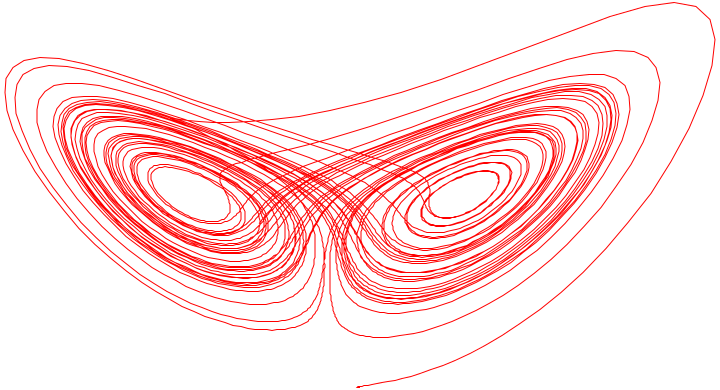
A Lorenz-attractor trajectory illustrates how complicated geometry can arise from simple rules; the self-affine sets studied here have a different construction.
Cepheus / Wikimedia Commons. Unchanged original image. · Image source · Public domain (released by the creator)

A fractal's shadow can be simpler than the fractal, but the simplification is not governed by dimension alone. Self-affine fractals are built from repeated linear distortions and translations, so projecting them also interacts with an accumulating history of matrices. Ian Morris and Cagri Sert's paper, first posted on February 6, 2025 and revised on July 7, 2026, develops a theory of these projections. Its examples reveal exceptional shadows organized by algebraic structure and measures whose projected local dimensions need not agree almost everywhere. These are precise failures of plausible general expectations, rather than pictures of unusually complicated silhouettes.
Anisotropy is the starting point
An affine map takes a point x to A times x plus a translation vector. If A contracts all directions, several such maps can generate a compact attractor by repeatedly replacing a shape with smaller transformed copies. A self-similar construction scales all directions equally within each copy. A self-affine construction may squeeze one direction much more strongly than another, and its preferred directions can change as maps are composed.
For a simple calculation, a diagonal matrix with entries one third and one tenth maps a unit square to a rectangle with those side lengths. Applying it twice gives side lengths one ninth and one hundredth. Covering the resulting rectangle by small squares depends on both lengths, not just its area. This is why singular values, which measure directional stretching, are natural quantities in dimension theory. The example explains the geometry; it is not presented as one of the paper's exceptional constructions.
A shadow theorem needs its quantifiers
Morris and Sert extend a Falconer-type theory for dimensions of typical self-affine sets to linear images. Their results relate exceptional projections to algebraic varieties preserved by the group generated by the linear parts. The setting is more delicate than a universal assertion that every projection has dimension equal to the smaller of the original dimension and the target dimension. Different assumptions address different families of maps and projections.
The word typical refers to a specified measure on a parameter space. It does not mean that every attractive computer-generated fractal is included. Suppose a theorem holds for almost every translation vector while the matrices are fixed. That statement allows exceptional translations. A theorem about almost every projection direction uses a different parameter space. Interchanging these two quantifiers can silently strengthen a result. Keeping them separate is necessary before asking whether a particular hand-picked shadow is covered.
Independent work sharpens the comparison
De-Jun Feng and Yu-Hao Xie posted a closely related paper on the same day in February 2025, with a further revision dated March 4, 2026. For fixed invertible linear maps with norms below one half and a fixed projection subspace, they obtain dimension formulas for almost every choice of translations. The formulas use a pressure function involving both the matrices and the target subspace.
Their abstract also separates several kinds of measures. Local dimensions of projected ergodic measures exist almost everywhere for typical translations, but need not be constant almost everywhere. For Bernoulli product measures, and more generally a specified supermultiplicative class, exact dimensionality does hold typically. The exception is therefore not a license to declare all projected fractal measures irregular. Different hypotheses restore different regularities. Comparing the two 2025–2026 projects shows how much information is hidden inside the short phrase a natural measure on a fractal.
A dimension can exist without being one number everywhere
Local dimension measures the rate at which mass in a small ball decreases as the ball shrinks. If mass near a point behaves like radius to a power a, that local dimension is a. Exact dimensionality means that the limiting exponent exists and has one common value at almost every point with respect to the measure. Existence of a limit at almost every point is weaker: different positive-mass regions could have different limits.
A transparent toy example puts half the total mass uniformly along a line segment and half uniformly over a separate square. Near typical points on the segment, mass decreases proportionally to radius. Near typical square points, it decreases proportionally to radius squared. Both local limits exist, but they differ. The example is not claimed to satisfy the invariant-measure assumptions of the new research. Its role is to explain exactly which extra assertion is contained in the word exact, before considering the more subtle self-affine constructions.
Forgetting coordinates can change the statistical structure
Feng's earlier theorem proves exact dimensionality for measures obtained by coding ergodic symbolic dynamics through a contracting affine system. The coding map sends an infinite sequence of symbols to a point of the attractor. This is sometimes also called a projection, but it is not the same operation as taking an additional linear shadow in Euclidean space. The newer counterexamples concern that additional operation.
Morris and Sert construct invariant measures that are exact-dimensional before a lower-dimensional linear map is applied, yet fail to remain exact-dimensional afterward. Intuitively, forgetting a coordinate can merge fibers carrying different amounts of information. A coarse statistic of a process does not necessarily retain all regularity properties of the full process. That intuition is explanatory rather than a proof: the construction must still reconcile the phenomenon with ergodicity and the algebra of its affine maps. The result matters precisely because those compatibility requirements rule out easy examples such as an arbitrary mixture of unrelated pieces.
What a simulation would need to show
An algebraic variety is a set described by polynomial equations. The appearance of such sets among exceptional projections indicates organized geometry rather than a random list of unlucky viewing angles. A matrix group can preserve structure in higher-dimensional spaces even when no obvious single line is fixed. This is one reason that checking only visible symmetries of a plotted attractor can miss the relevant obstruction.
A numerical experiment could generate long matrix products, estimate directional contraction, project many sample points and compare covering counts across scales. It would be useful for forming conjectures, but it would not establish an almost-everywhere theorem or an asymptotic local dimension. Every finite plot has a smallest resolved scale. Apparent straight lines in a log-log graph can change beyond that scale, and small exceptional parameter families can be missed by random sampling. The current research supplies rigorous statements where those limitations matter. The broader lesson is that fractal shadows remember how the object was made: matrix dynamics, choice of measure and projection direction all enter the answer.
Two checks before interpreting a complicated projection
Some basic inequalities are available before any deep projection theorem. A linear map is Lipschitz, so it cannot increase Hausdorff dimension, and its image cannot have dimension greater than its rank. Thus a projection onto a line has dimension at most one regardless of how complicated the original set is. The interesting issue is obtaining a matching lower bound and understanding failure of that lower bound. A drawing that shows a dense-looking interval only addresses the upper ceiling very poorly; it does not establish what happens at arbitrarily small scales.
Even the toy mixed-dimensional measure illustrates a subtle point about almost everywhere. Each component has positive measure, so neither can be discarded as a null exceptional set. By contrast, a measure can have a few visually striking support points with unusual local behavior while still being exact-dimensional, because the exceptional points may carry zero mass. Set dimension, support geometry and almost-everywhere local dimension are therefore separate objects. The newer self-affine examples matter because they distinguish these objects within a dynamically organized construction, where one cannot choose components independently and retain all the hypotheses.
Sources & further reading
Primary papers, project documentation, and research releases used in this article. Publication dates below refer to the sources themselves.
- Projections of self-affine fractalsarXivPublished Checked
- Dimensions of orthogonal projections of typical self-affine sets and measuresarXivPublished Checked
- Dimension of invariant measures for affine iterated function systemsarXivPublished Checked
- Projections of self-affine fractalsUniversity of WarwickPublished Checked
FOLLOW THE QUESTION
Explore mathematics