PHYSICS
The 2015 Bell Tests: Closing Two Loopholes Without Opening a Faster-Than-Light Channel
In 2015, Delft, NIST, and Vienna closed major Bell-test loopholes using different systems. Their results constrain local models without enabling instant messages.
Research checked
Newest cited publication
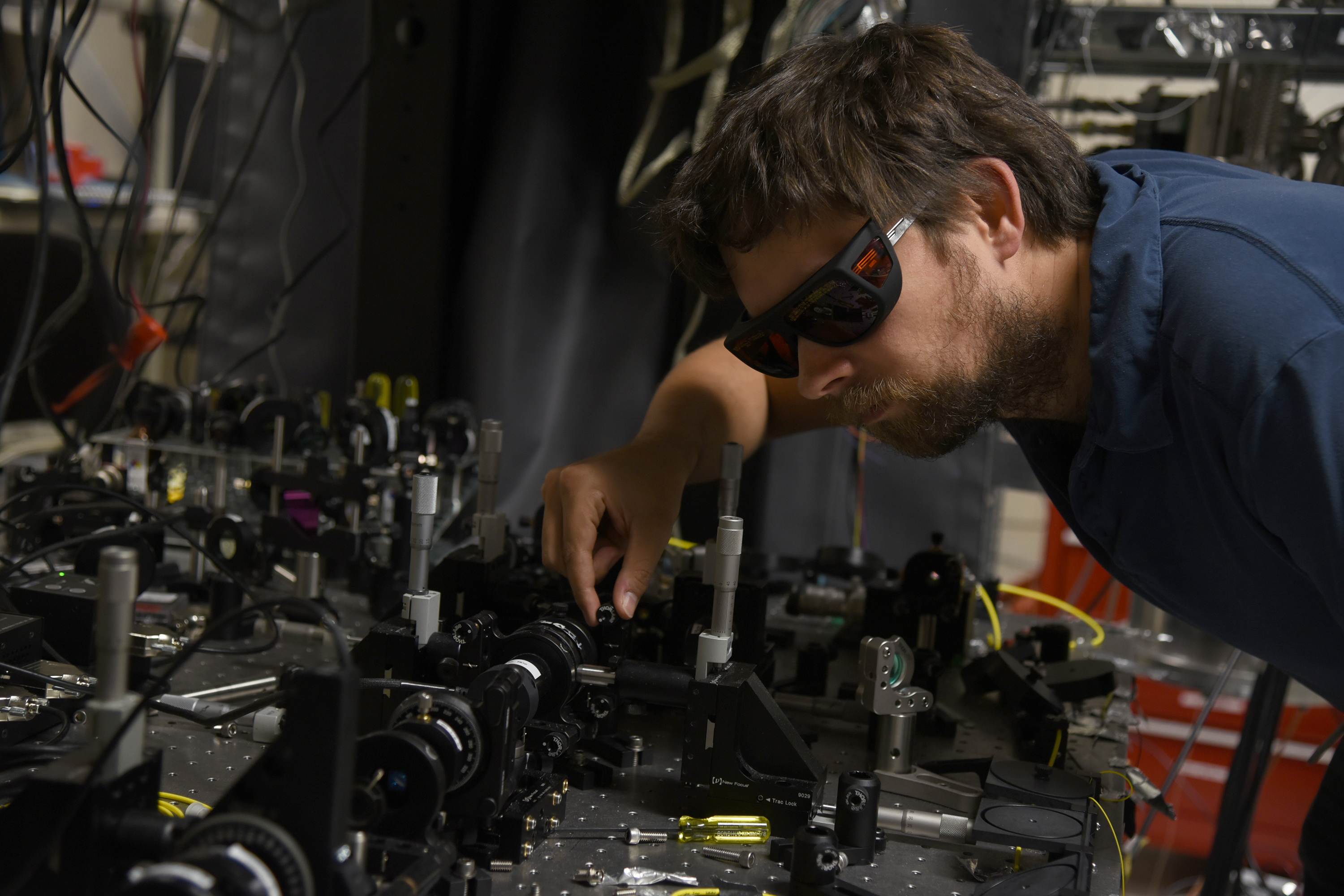
NIST physicist Krister Shalm stands beside the photon-source apparatus used in the institute’s 2015 Bell test, one of the independent experimental approaches discussed in the article.
J. Burrus/NIST · Image source · NIST public-information reuse permission
In 2015, three experiments brought a long argument about quantum mechanics into a particularly demanding laboratory regime. A Delft team tested distant electron spins; teams associated with NIST in the United States and with Vienna tested entangled photons. They combined strong correlations with experimental arrangements designed to close the detection and locality loopholes simultaneously. The Delft preprint appeared on August 24, while the two photon papers appeared on November 10; all three results were published in 2015. They did not demonstrate controllable faster-than-light communication. They tested whether separated measurement outcomes could be explained by a specified class of local models when experimental selection and timing no longer supplied the usual escape routes.
A simple bound follows from local response rules
Consider two stations, each choosing between two measurement settings and recording an outcome of plus or minus one. Label the first station's possible responses a0 and a1, and the second station's responses b0 and b1. A local hidden-variable model allows shared information from the common past, but each response depends only on that information and its own station's setting. The usual test also assumes that the setting choices are statistically independent of the shared variables relevant to the measured systems.
For any fixed set of four local responses, the combination a0 times (b0 plus b1) plus a1 times (b0 minus b1) is either plus two or minus two. One bracket vanishes because b0 and b1 are each plus or minus one; the other bracket has magnitude two. Averaging gives the CHSH inequality: the absolute value of E00 plus E01 plus E10 minus E11 cannot exceed two, where each E is an outcome correlation for one setting pair. CHSH names Clauser, Horne, Shimony, and Holt. Stochastic local rules can be treated as mixtures of response assignments, so adding ordinary local randomness does not evade the bound.
Lost events and possible communication are different problems
The detection loophole arises when the recorded events might be an unrepresentative subset of all relevant trials. If a device can fail to register precisely those cases that would spoil a desired correlation, the detected sample can violate a Bell inequality even though the underlying local model obeys its proper bound. Older experiments often needed a fair-sampling assumption to exclude that possibility. Improving efficiency or designing an appropriate event-ready experiment changes what can be concluded without that extra assumption.
The locality loophole concerns influences traveling between stations during the measurement process. Choosing settings and obtaining outcomes within suitable spacetime windows can make the relevant events spacelike separated: a light-speed signal cannot connect them in the available time. A 1998 experiment by Gregor Weihs and collaborators had already demonstrated Bell violation under strict locality conditions. The 2015 advance was not inventing every ingredient anew, but bringing the important protections together. Fast switching cannot compensate for outcome-dependent losses, and efficient detectors cannot compensate for slow, communicating measurement stations. Each failure mode requires its own physical remedy and its own verification.
Delft used a herald to define trials before reading spins
The Delft experiment placed electron spins in diamond defects at sites separated by approximately 1.3 kilometers. Photons linked the remote systems through an entanglement-generation procedure, and a successful herald identified when a spin-pair trial was ready. The spin outcomes could then be read efficiently after fast random setting choices. Crucially, selecting successful preparation events is different from retaining only favorable measurement outcomes. The trial definition had to be arranged so that the herald did not depend on the later setting choices or results.
The paper reported 245 trials and a CHSH value of 2.42 with a quoted uncertainty of 0.20. Its hypothesis test also allowed memory in the devices. These figures describe a limited, carefully defined data set, not an unlimited statement about every possible theory. The separation supplies a useful timing scale: light takes about 4.34 microseconds to cross 1.3 kilometers in vacuum. That number alone does not close locality. The actual analysis must place setting generation, outcome recording, and their uncertainties into the spacetime arrangement. Efficient spin readout addressed sampling, while distance and speed addressed the possibility of ordinary communication.
NIST and Vienna reached the target with photons
The two later 2015 reports used entangled photon pairs and fast polarization measurements. Shalm and collaborators at NIST combined a high-quality source with efficient low-noise detection and spacelike separation of the relevant events. Their analysis examined how imperfect predictability of setting choices affected statistical conclusions. Giustina and collaborators in Vienna separately combined an optimized photon source, rapid setting generation, and efficient superconducting detectors. These were distinct experiments, with different apparatus and analyses; they should not be collapsed into one institution's achievement.
The photon approach placed special pressure on collection and detection efficiency, because losing photons can reopen the sampling problem. Detector improvements were therefore part of the logical strength of the result, not merely a way to collect more data per hour. A source also needs high-quality entanglement: greater efficiency does not help if other imperfections wash out the correlations. The experimental task is to balance source preparation, optical transmission, detector performance, random setting generation, and the permitted spacetime windows. Success requires all of them to work together in a Bell test whose inequality and statistical analysis match the actual trial and outcome definitions.
A violation is a statistical rejection under stated conditions
An idealized CHSH game makes the numerical gap easier to understand. The stations receive uniformly selected input bits and win when the parity of their output bits equals the product of the inputs. Any fixed local strategy can satisfy at most three of the four input cases, giving a maximum average success probability of 75 percent. Suitable quantum measurements can reach about 85.4 percent. These percentages describe the ideal game with its specified rules, rather than the actual fraction of successful trials in any of the three 2015 experiments.
Finite experiments need a statistical test because random variation can push an observed estimate beyond a bound. A p-value measures how surprising a result at least as extreme would be within the tested null-model class and analysis conditions. It is not the probability that locality is true after seeing the data. Choices about trial definitions, setting bias, stopping, and possible device memory must be reflected in the test. A stronger-looking significance number cannot be compared sensibly across experiments without those conditions. The Delft and photon results were persuasive together because different physical implementations attacked the same local-model restriction while closing the principal experimental escape routes.
The conclusion does not remove every assumption
Quantum correlations do not let an observer select a distant outcome or send a chosen message instantaneously. Each station sees locally random results; the distinctive joint pattern becomes accessible when the two records are compared through an ordinary communication channel. Changing one measurement setting does not, in the quantum description, change the other station's outcome distribution into a readable signal. Bell violation is a restriction on possible explanations of the joint statistics, not a demonstration that a useful information channel outran light.
The result also depends on measurement independence, the assumption that the relevant hidden variables are not statistically correlated with the setting choices. Superdeterministic proposals reject that independence and therefore are not logically excluded by a Bell test merely because its random generators are fast. Likewise, the word loophole-free refers to closing the main experimental loopholes within specified assumptions, not to proving an assumption-free metaphysical conclusion. The 2015 experiments made the scientific constraint much sharper: local causal models satisfying the tested independence and trial conditions could no longer appeal to detector losses or ordinary between-station communication to reproduce the observations. That is a precise achievement with consequences for quantum foundations and carefully qualified device-independent information protocols.
Sources & further reading
Primary papers, project documentation, and research releases used in this article. Publication dates below refer to the sources themselves.
- Experimental loophole-free violation of a Bell inequality using entangled electron spins separated by 1.3 kmarXiv; B. Hensen and collaboratorsPublished Checked
- A strong loophole-free test of local realismarXiv; Lynden K. Shalm and collaboratorsPublished Checked
- Significant-loophole-free test of Bell's theorem with entangled photonsarXiv; Marissa Giustina and collaboratorsPublished Checked
- Violation of Bell's inequality under strict Einstein locality conditionsarXiv; Gregor Weihs and collaboratorsPublished Checked
- Loopholes in Bell Inequality Tests of Local RealismarXiv; Jan-Åke LarssonPublished Checked
FOLLOW THE QUESTION
Explore physics