PHYSICS
Einstein’s light quanta turned the photoelectric effect into an energy test
Einstein’s 1905 energy relation connected light frequency to escaping electrons; Millikan’s later tests separated a successful law from debates about light.
Research checked
Newest cited publication
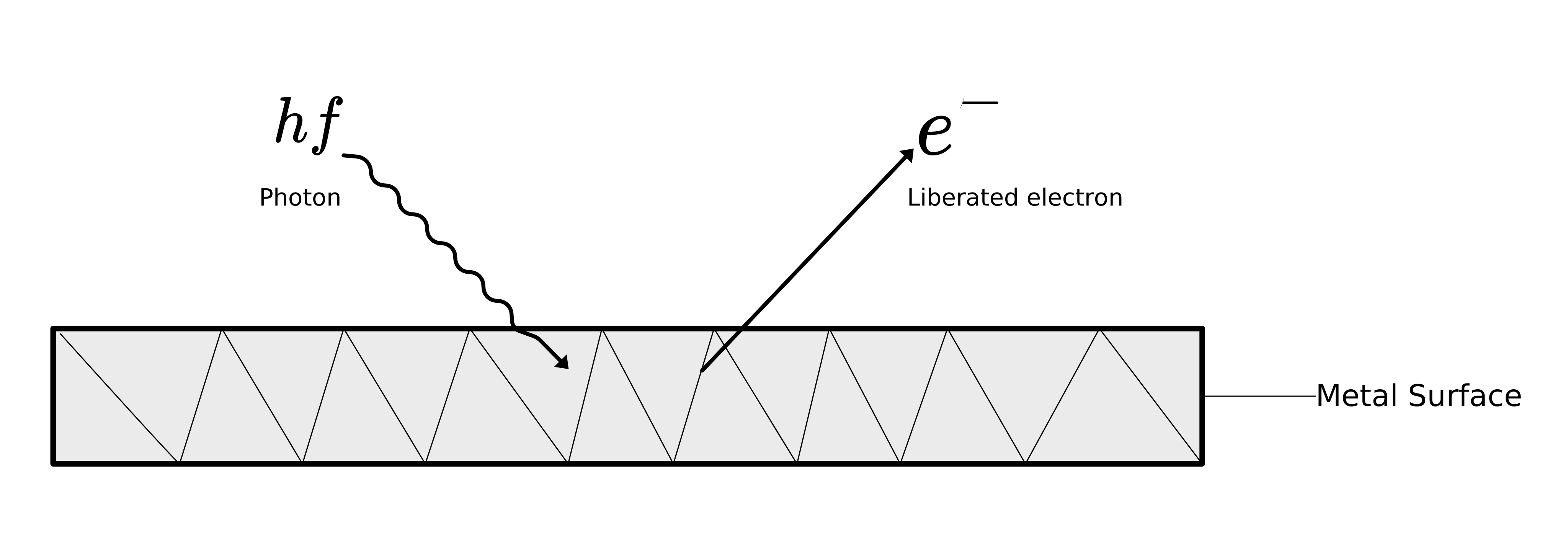
A modern schematic illustrates light ejecting an electron from a metal surface. It introduces the photoelectric mechanism whose energy and frequency relation Einstein explained using light quanta.
Infinitehoax · Image source · CC0 1.0

Brighter light supplies more energy, but that does not mean it always makes each emitted electron more energetic. The distinction became central to Einstein’s 1905 proposal that light exchanges energy in discrete amounts proportional to frequency. His photoelectric relation offered a specific test: changing the colour of incident light should change the maximum electron energy along a straight line. The proposal was not an experiment performed by Einstein, nor did its first publication instantly settle the nature of light. Measurements, material preparation and arguments about interpretation followed. Separating the 1905 hypothesis from the later tests reveals why the photoelectric effect became a landmark in quantum physics.
Current and electron energy answer different questions
Philipp Lenard’s 1902 investigation examined light-induced electron emission using electric fields and collected charge. Its observations helped establish the puzzling separation between the quantity of emitted electricity and the energies of emitted electrons. Einstein explicitly referred to that work. The relevant challenge was not simply that ultraviolet light could discharge a surface. A theory had to explain why changing illumination intensity and changing frequency affected different observables. A measurement of total current alone could not supply the complete answer.
Current counts charge arriving per unit time. Electron energy determines whether an electron can overcome a retarding electric potential. A detector may therefore record a larger current with the same upper energy limit, just as a road can carry more vehicles without increasing the speed of the fastest one. The analogy concerns two different measurements, not the microscopic mechanism. In an experiment, geometry, collection efficiency and surface condition can change the current even when the incident light is well characterised. Distinguishing the number of collected electrons from their energy distribution is the first step toward a meaningful test.
A quantum supplies energy in proportion to frequency
In his 1905 paper, Einstein proposed a heuristic picture in which light energy could behave as localised quanta. Applying that idea to electron emission, he assigned a quantum an energy h times frequency. If an electron acquired that energy and required work to escape the material, the maximum remaining kinetic energy would equal h times frequency minus the escape work. The familiar modern notation is Kmax = hν − φ. Here φ is a work function and ν is frequency. Einstein’s paper offered this as a testable consequence, not a direct observation of individual photons.
The maximum matters. Electrons originate in different microscopic situations and can lose energy before reaching the surface, so not every emitted electron receives the maximum kinetic energy. The work function summarises a material’s energy cost for removal under specified conditions; it is not a universal constant shared by all metals. The simple relation consequently predicts a common slope when maximum energy is plotted against frequency, but different intercepts for different surfaces. This separation is unusually useful experimentally. A slope can test a universal energy scale while an intercept describes material-dependent removal energy, provided extraneous voltage offsets are controlled.
Stopping potential turns energy into an electrical measurement
An electron with charge magnitude e loses kinetic energy e times V when climbing a retarding potential difference V. In an ideal photoelectric setup, the stopping-potential magnitude Vs obeys eVs = Kmax. Combining the two relations gives Vs = (h/e)ν − φ/e. That equation says what an experiment should plot and what the slope should mean. It does not mean that every measured voltage is already corrected for differences between electrode surfaces. Contact potentials, unwanted illumination and a small background current can shift the apparent endpoint.
Millikan’s paper published on 1 March 1916 reported a sustained experimental test of the energy–frequency relation and a photoelectric determination of Planck’s constant. His apparatus addressed surface preparation and the spectral purity of the illuminating light. The latter issue follows directly from the test: even a small amount of higher-frequency contamination can produce more energetic electrons and distort a maximum-energy measurement. The important achievement was quantitative agreement across controlled measurements, not merely drawing a straight line through two convenient points. The 1916 publication consolidated work that had been reported in earlier stages, so it should not be treated as the first day any supporting measurement existed.
A threshold calculation explains why brightness is insufficient
For example, take an ideal surface with work function 2.30 electronvolts. An electronvolt is the energy acquired by one elementary charge across one volt. A 400-nanometre photon has energy about 3.10 electronvolts, so the maximum electron energy in the simple model is about 0.80 electronvolts and the stopping-potential magnitude about 0.80 volts. At 600 nanometres, photon energy is only about 2.07 electronvolts, below the assumed work function. The corresponding threshold wavelength is about 539 nanometres. These numbers describe a chosen model surface, not a claim about the exact work function of a historical specimen.
At fixed frequency above threshold, raising optical power raises the number of available quanta rather than their individual energy. With 400-nanometre illumination, one nanowatt corresponds to roughly two billion incident photons per second. If one in ten yielded a collected electron, the current would be about 32 picoamperes. The assumed collection probability makes this a scale estimate. Doubling that power would double the estimate while leaving the ideal stopping potential unchanged. Ordinary single-quantum emission below threshold cannot be rescued merely by adding more such photons. Very intense multiphoton processes and heating involve additional mechanisms outside this simple regime.
A confirmed relation did not settle every picture of light
Millikan’s Nobel lecture, delivered on 23 May 1924, is a valuable primary account of the distinction between accepting the measured law and accepting an entire microscopic interpretation. He described the success of the energy–frequency relation while continuing to discuss difficulties reconciling localised light quanta with interference. The lecture postdates the 1916 paper and reflects the state of his argument at that later moment. It would therefore be misleading to turn the experimental confirmation into a story in which all physicists immediately adopted the same complete photon theory in 1905.
The distinction remains sound scientific practice. A successful equation may follow from a broad conceptual framework, but checking one consequence is not equivalent to checking every statement in the framework. Conversely, discomfort with an interpretation does not invalidate a reproducible quantitative relationship. Here the observations constrained energy transfer very sharply, while interference still demanded a description of spatial propagation and probability. Modern quantum theory addresses those questions together. The historical value of the photoelectric relation is that it supplied a clear experimental target during a period when the larger theory was still being assembled.
The lasting insight was a precise question about energy transfer
The simplest photoelectric equation is deliberately limited. Real surfaces can have contamination, spatially varying work functions and a distribution of electronic states. Electrons may scatter before escaping, and measured currents depend on the apparatus. None of those complications makes the ideal relationship useless. They tell an experimenter which part of the spectrum should define the maximum energy, which offsets require calibration and which operating conditions are appropriate for the comparison. A useful law survives by identifying its domain and its corrections, rather than by claiming to describe every illuminated material without qualification.
Einstein’s contribution was to connect a radical energy-transfer hypothesis with a measurable dependence on frequency. Lenard’s experiments supplied crucial constraints, and Millikan’s later work tested the quantitative relationship with sustained attention to experimental error. The pieces belong to different dates and different roles. Keeping them distinct preserves the central achievement: brightness and colour became separate controls for asking how light gives energy to matter. That question could be posed in voltages, frequencies and reproducible measurements, allowing quantum physics to advance through a demanding numerical test rather than an appealing metaphor alone.
Sources & further reading
Primary papers, project documentation, and research releases used in this article. Publication dates below refer to the sources themselves.
- Über einen die Erzeugung und Verwandlung des Lichtes betreffenden heuristischen GesichtspunktAnnalen der Physik / Universidad Nacional de La Plata archivePublished Checked
- Ueber die lichtelektrische WirkungAnnalen der Physik / Universität des Saarlandes archivePublished Checked
- A Direct Photoelectric Determination of Planck's "h"Physical Review / CaltechAUTHORSPublished Checked
- The electron and the light-quant from the experimental point of viewNobel Foundation / Columbia University archivePublished Checked
FOLLOW THE QUESTION
Explore physics