PHYSICS
The 1995 condensates turned a cold atomic gas into a quantum laboratory
Rubidium and sodium experiments in 1995 established dilute-gas Bose–Einstein condensation, opening precise tests of quantum statistics and interactions.
Research checked
Newest cited publication
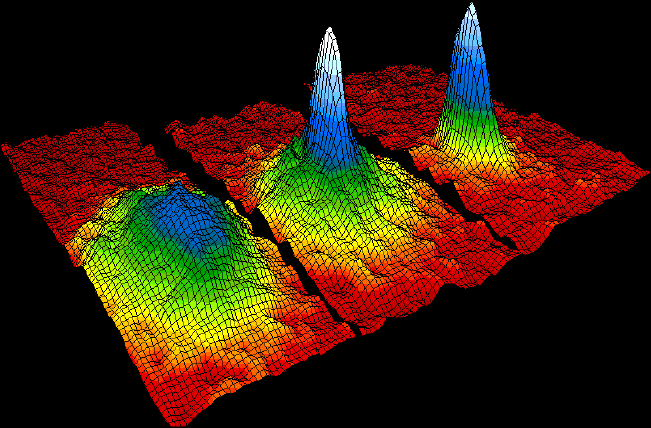
The historic 1995 JILA graphic shows a narrow rubidium-atom peak emerging from a broader thermal distribution, providing the characteristic signature of Bose–Einstein condensation discussed in the article.
NIST/JILA/CU-Boulder · Image source · Public domain in the United States (NIST work)


Cooling a gas ordinarily makes its atoms move more slowly. In 1995, two experiments showed that cooling could also change how a large collection of atoms occupied quantum states. A narrow component appeared inside a broader thermal cloud, signalling a Bose–Einstein condensate. The breakthrough was not that every atom stopped or that separate atoms physically fused into one giant particle. A substantial population shared a collective quantum mode that experimenters could prepare and examine. The rubidium experiment associated with Eric Cornell and Carl Wieman and the sodium experiment led by Wolfgang Ketterle reached that regime through different trapping strategies. Their differences helped establish a field of controlled quantum gases rather than a single spectacular temperature record.
A new component appeared inside the rubidium cloud
The Science report published on 14 July 1995 was written by M. H. Anderson, J. R. Ensher, M. R. Matthews, C. E. Wieman and E. A. Cornell. It described a magnetically trapped, evaporatively cooled rubidium-87 gas. A narrow low-velocity component emerged on a broad thermal distribution, grew rapidly with further cooling and expanded anisotropically. Together these observations supported condensation. The authors reported first appearance near 170 nanokelvin. That temperature belongs to their experiment and inference procedure; it is not a universal temperature below which any sample becomes a condensate.
A distribution matters more than a single average. Imagine a class whose average travel time decreases because everyone becomes slightly faster. Compare that with a class in which a distinct group suddenly arrives together while everyone else retains a broad spread of times. The averages could resemble each other, but the underlying organisation would differ. In an atomic cloud, imaging after release reveals an expanding spatial distribution related to the initial motion and interaction energy. A newly occupied mode can therefore create a distinct component. The image measures density after a specified sequence; it does not directly photograph an abstract wavefunction or independently establish every possible form of coherence.
Condensation is about how quantum states are counted
Bosons are particles whose quantum statistics permit many identical particles to occupy the same single-particle state. In the ideal-gas description, cooling reduces the population that can be accommodated in excited states at equilibrium. Below the relevant transition, an extensive population accumulates in the lowest mode. This is condensation in state space. It does not require the ordinary liquid droplets produced when water vapour condenses, and it is not equivalent to placing distinguishable classical balls at the bottom of a container. Quantum indistinguishability changes the counting of possible many-particle arrangements.
An accessible scale is the thermal de Broglie wavelength: Planck’s constant divided by the square root of twice pi times atomic mass times Boltzmann’s constant times temperature. As temperature falls, that wavelength grows. Comparing it with the spacing between atoms indicates when treating each atom as a separate classical trajectory becomes inadequate. Cornell and Wieman’s later Nobel account describes the long experimental pursuit behind the dilute-gas transition. The account is a retrospective by participants, published in Reviews of Modern Physics in 2002, rather than another 1995 announcement. The ideal-gas picture supplies a starting model; the experiments still required finite traps, collisions and real atoms.
A threshold depends on density as well as temperature
For a uniform ideal gas in three dimensions, the equilibrium threshold is approximately n times the thermal wavelength cubed equals 2.612, where n is number density. Take rubidium mass as approximately 1.443 × 10⁻²⁵ kilograms and a density of 10¹⁹ atoms per cubic metre. At 100 nanokelvin the wavelength is about 0.59 micrometres and the dimensionless product is about 2.1. At 80 nanokelvin it is about 0.66 micrometres and the product is about 2.9. These values illustrate crossing a quantum-statistical threshold by reducing temperature while holding density fixed.
This calculation deliberately describes a uniform ideal gas, not a reconstruction of either 1995 apparatus. A harmonic trap has a varying density, and its critical temperature also depends on atom number and confinement frequencies. Interactions and the finite size of the cloud modify the comparison further. The units provide a useful check: density has units of inverse volume, so multiplying by a wavelength cubed produces a pure number. A very low temperature alone says little without a density or confinement scale. Conversely, squeezing a gas harder may increase collision losses before it creates a useful condensate. The experimental task was to reach favourable phase-space density while keeping atoms alive long enough to equilibrate.
Atoms had to escape selectively without losing the whole gas
Evaporative cooling removes atoms from the energetic tail of a distribution. Elastic collisions then redistribute the remaining energy and produce a colder sample. The mechanism resembles cooling a drink by evaporation only at the level of selective energy removal; the trapped gas has its own collision rates and quantum-state constraints. Removing every fast atom at once would be counterproductive if too few remained to collide and re-equilibrate. Cooling therefore requires a balance among confinement, collision rate, loss and the controlled lowering of an escape threshold.
The sodium report published on 27 November 1995 by K. B. Davis and colleagues at MIT used combined magnetic and optical forces. The authors reported a millionfold increase in phase-space density within seven seconds of evaporative cooling. The reported condensates contained up to 500,000 atoms, and a bimodal distribution appeared below roughly two microkelvin. This was a separate implementation led by Ketterle, not the rubidium apparatus with a different label. Its larger samples and different trapping solution showed why controlling loss channels was as consequential as achieving a lower thermometer reading.
Sharing a mode does not remove atomic interactions
An ideal Bose gas neglects interactions between particles. It is mathematically useful, but it should not be interpreted as a literal statement that the observed atoms were freely penetrable objects with no forces between them. Quantum wavefunctions can overlap while the atoms retain internal structure and scatter from one another. In a dilute gas, a small scattering parameter can permit a controlled weak-interaction approximation. Weak does not mean irrelevant: collective density, cloud shape and expansion can remain sensitive to those interactions. A gas can be dilute enough for a tractable model yet interactive enough to equilibrate and display collective motion.
A subsequent experiment by Ensher and colleagues, published on 16 December 1996, measured ground-state occupation and energy as temperature varied. It found useful agreement with ideal trapped-gas predictions for the condensate fraction and a change in the energy curve near the transition. These were quantitative follow-up measurements, not substitutes for the 1995 observations. They illustrate the new scientific opportunity: a model could be compared against populations and thermodynamic behaviour, with discrepancies or corrections assigned to particular physical assumptions. Condensation is also distinct from a complete demonstration of superfluid transport; that requires evidence about response to motion or perturbations.
The decisive advance was a controllable many-body system
The rubidium and sodium results made complementary arguments. A distinctive emerging component and its expansion supplied evidence for a new regime. Different atoms and trap designs showed that the result was not tied to one accidental configuration. Later temperature-dependent measurements turned the regime into a platform for testing theory. Reading these steps separately prevents a common historical shortcut in which a single image is made to prove condensation, coherence, superfluidity and every later application simultaneously. Each property has its own measurement and assumptions.
The enduring lesson is that a many-body quantum effect became experimentally adjustable. Atom number, confinement, temperature and interaction conditions could be changed and their consequences examined. That is more powerful than merely producing a cold sample, because changing one control at a time creates tests between competing explanations. The 1995 condensates brought quantum statistics into a setting where a dilute gas could be prepared repeatedly and studied through accessible optical measurements. They did not eliminate complexity. They placed enough of it under control that theory and experiment could ask sharper questions of each other.
Sources & further reading
Primary papers, project documentation, and research releases used in this article. Publication dates below refer to the sources themselves.
- Observation of Bose-Einstein Condensation in a Dilute Atomic VaporScience / University of Queensland archivePublished Checked
- Bose-Einstein Condensation in a Gas of Sodium AtomsPhysical Review LettersPublished Checked
- Bose-Einstein Condensation in a Dilute Gas: Measurement of Energy and Ground-State OccupationPhysical Review LettersPublished Checked
- Nobel Lecture: Bose-Einstein condensation in a dilute gas, the first 70 years and some recent experimentsReviews of Modern PhysicsPublished Checked
FOLLOW THE QUESTION
Explore physics