PHYSICS
The 2012 Higgs Discovery: What ATLAS and CMS Actually Established
How the 2012 ATLAS and CMS observations revealed a new boson, why its decay channels mattered, and which Higgs properties still needed later tests.
Research checked
Newest cited publication
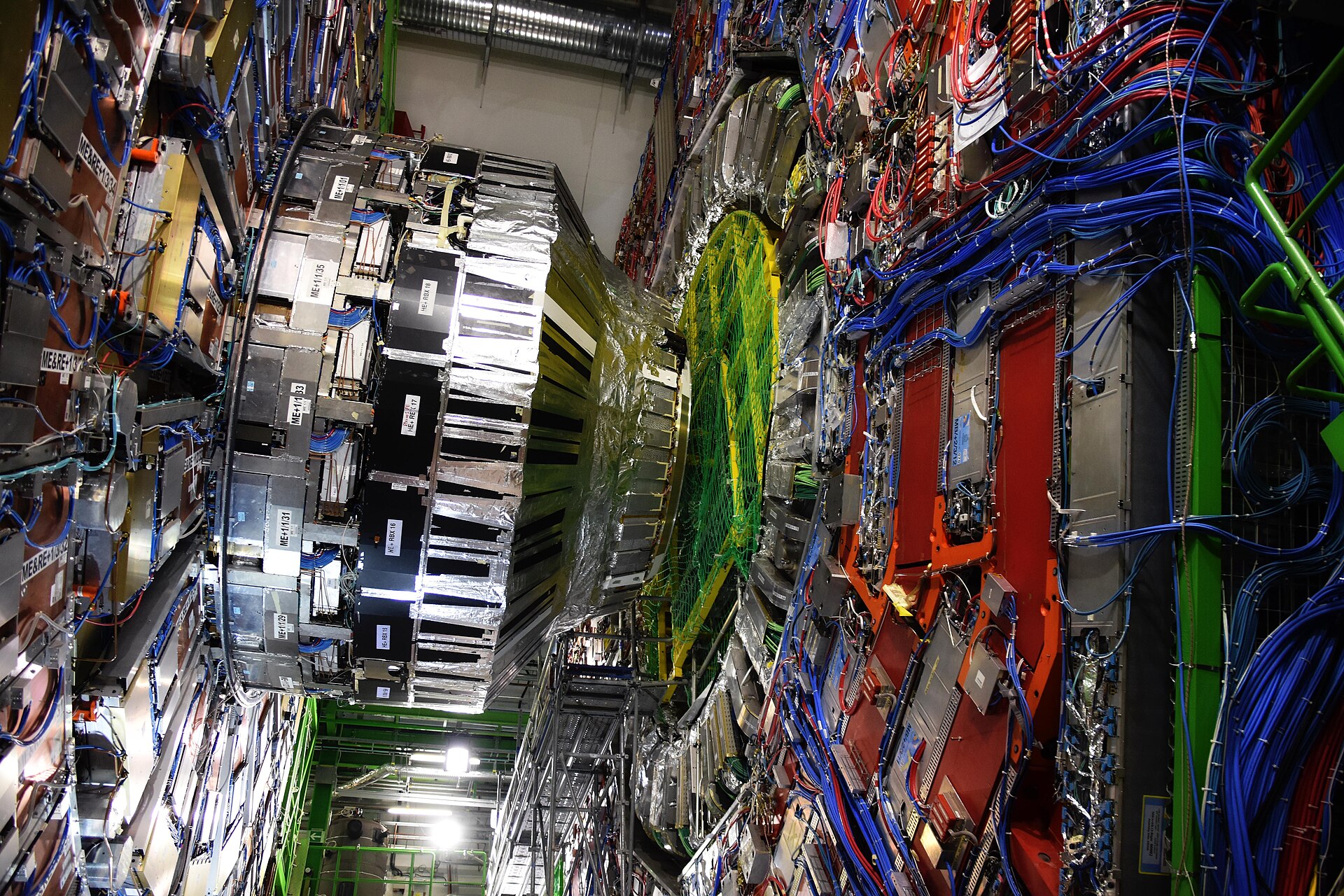
A 2019 photograph of the CMS detector provides a view of one of the experiments that reported a new boson in 2012. The discovery itself depended on collision data, reconstruction, and statistical comparisons.
SimonWaldherr · Image source · CC BY-SA 4.0

On July 4, 2012, CERN announced that two independent experiments had observed a new particle consistent with the long-sought Higgs boson. That careful wording captured both a discovery and an unfinished investigation. ATLAS and CMS had strong evidence for a new boson near 125–126 gigaelectronvolts, but finding a particle was not the same as measuring every property predicted for it. Their original discovery papers, posted on July 31, documented the collision data, reconstruction methods and statistical tests behind the announcement. Reading those papers alongside the later property measurements reveals why this was such an important result: a proposed explanation of elementary-particle masses had acquired a directly testable particle, while a large programme of tests remained open.
The field and its particle are related ideas
The electroweak theory links electromagnetism and the weak interaction. It must account for massive W and Z bosons while leaving the photon massless. In the Brout–Englert–Higgs mechanism, a field has a nonzero background value even in the vacuum. Interactions with that background give the W and Z their masses in a way compatible with the theory’s structure. A Higgs boson is an excitation of the field, rather than the background value itself. Detecting such an excitation provides a way to test the mechanism experimentally.
The distinction prevents an unfortunate image of particles struggling through a sticky substance. Rest mass is not friction, and a freely moving massive particle need not continually lose energy to the Higgs field. The background changes the relationship between the particle’s energy and momentum. The boson, by contrast, is a localized quantum excitation that can be produced in a collision and decay. Evidence for the boson therefore makes an otherwise invisible background mechanism accessible through measurable production and decay processes.
The experiments measured decay products
At the Large Hadron Collider, abbreviated LHC, proton collisions can produce short-lived particles that disappear before they reach detector layers. The experiments reconstruct them from their decay products. ATLAS combined several searches and reported a mass near 126.0 GeV, with separate statistical and systematic uncertainties of 0.4 GeV each. Its July discovery paper reported a local significance of 5.9 standard deviations. These were results from a statistical population of collision events, not a claim that every attractive event display unambiguously contained a Higgs boson.
The essential operation is to collect events with a suitable final state and calculate a candidate mass from their measured energies and momenta. Ordinary processes also produce those final states. A new unstable particle can add a localized excess to the mass distribution. Detector resolution broadens the feature, while selection criteria affect both signal and background. The scientific claim depends on the distribution and its uncertainties. A picture of one event illustrates the reconstruction; it cannot supply the complete population-level evidence by itself.
Why two photons can reveal a massive parent
CMS found its strongest excesses in the two-photon and four-lepton final states, which offer good mass resolution. Its original paper reported a mass near 125.3 GeV and a local significance of five standard deviations. A Higgs boson can decay through intermediate Z bosons into four charged leptons, where electrons and muons leave identifiable detector signatures. It can also decay into two photons through quantum processes involving other particles. The rarity of a channel can be offset by the clarity with which its products reconstruct the parent mass.
For example, imagine two photons each carrying 62.5 GeV of energy. If they travel in exactly opposite directions, their momenta cancel, their total energy is 125 GeV and the pair has an invariant mass of 125 GeV/c². If the angle between the same-energy photons is only 60 degrees, the pair’s invariant mass is instead 62.5 GeV/c². Both values follow from m²c⁴ = 2 E1 E2 (1 − cos θ). The example shows why measuring directions matters and why massless photons can jointly carry the invariant mass of a massive parent.
Five sigma answers a specific statistical question
CERN’s July 4 announcement described preliminary five-sigma observations and explicitly said that identifying the particle’s precise nature required more data. The later July papers incorporated the analyses prepared for publication. Their quoted significances quantify how unusual the observed excess would be under a specified background-only model. They do not directly state the probability that the Standard Model is true, the probability that a particular recorded event is a Higgs decay, or the chance that an experiment made an unknown instrumental mistake.
A local significance considers a specified candidate mass. Searching across many possible masses creates additional opportunities for background fluctuations to look interesting, so experiments also examine the wider search context. More fundamentally, a small statistical fluctuation probability is only persuasive when the background description, calibration and event selection are credible. Increasing the data sample cannot repair a biased energy scale automatically. The discovery threshold therefore accompanies detailed checks rather than replacing them. The agreement between channels and experiments supplied information that a single significance number could not express.
Why two different detectors mattered
ATLAS and CMS studied collisions from the same accelerator but used separate detector systems, calibrations and analysis implementations. An instrumental effect peculiar to one apparatus would have to explain why another apparatus saw compatible evidence in a similar mass region. Different decay channels also confront different backgrounds and reconstruction errors. A mass feature supported by several partially independent routes is harder to attribute to one overlooked feature of the detector or analysis.
This independence should not be exaggerated into a claim that every uncertainty was unrelated. The experiments shared a collider environment, and some theoretical predictions entered both interpretations. Independence is a property to inspect within the evidence chain. Detector-specific effects can be checked against another detector, while common theory assumptions need different tests. The important achievement was a mutually reinforcing structure of observations: separate apparatuses and different final states pointed toward a new boson whose properties could then be investigated systematically.
The Higgs does not supply every kind of mass
Within the Standard Model, interactions with the Higgs field also give quarks and charged leptons their elementary rest masses through Yukawa couplings. That does not mean all the mass of familiar matter is simply the sum of Higgs-generated constituent masses. A proton is a composite, strongly interacting system. Most of its mass reflects the energy of quarks and gluons and their strong-interaction dynamics, rather than just the rest masses of its quark constituents. The distinction follows from treating total energy as a source of a system’s invariant mass.
It is equally misleading to say that the 2012 observation measured every fermion’s coupling. The discovery channels established a new particle and supported its compatibility with the Higgs interpretation. Testing how it interacts with different fermions required further measurements. Neutrino mass poses additional questions beyond the minimal Standard Model. A successful Higgs discovery therefore answered a central question about electroweak symmetry breaking without becoming a universal explanation of every mass parameter or every form of matter.
Observation began the identity tests
A July 2013 ATLAS paper tested the particle’s spin and parity using angular and other kinematic information in several decay channels. Its data favored the Standard Model’s spin-zero, positive-parity interpretation over the specific alternative models examined. This was a further measurement, not something that should be silently projected backward into the July 2012 announcement. Rejecting a set of tested alternatives also differs from proving that no conceivable nonstandard particle could produce similar observations.
The enduring lesson is that discovery and identification are connected stages. The 2012 data established a new boson where a Higgs-like particle could plausibly appear. Subsequent measurements asked whether its quantum numbers and interactions matched the proposed mechanism. Each more precise answer created room for a more demanding comparison. The historical importance of the result lies in that progression: an elegant field-theory proposal became a particle that experiments could produce, measure and challenge, without ending the search for deeper explanations.
Sources & further reading
Primary papers, project documentation, and research releases used in this article. Publication dates below refer to the sources themselves.
- Observation of a new particle in the search for the Standard Model Higgs boson with the ATLAS detector at the LHCATLAS Collaboration / arXiv; Physics Letters BPublished Checked
- Observation of a new boson at a mass of 125 GeV with the CMS experiment at the LHCCMS Collaboration / arXiv; Physics Letters BPublished Checked
- CERN experiments observe particle consistent with long-sought Higgs bosonCERNPublished Checked
- Evidence for the spin-0 nature of the Higgs boson using ATLAS dataATLAS Collaboration / arXiv; Physics Letters BPublished Checked
- The origins of the Brout-Englert-Higgs mechanismCERNChecked
- Ab-initio Determination of Light Hadron MassesS. Dürr et al. / arXiv; SciencePublished Checked
FOLLOW THE QUESTION
Explore physics