PHYSICS
The 1919 Eclipse Test: Measuring a Tiny Deflection Without Proving Everything
The 1919 eclipse compared displaced star images with gravitational predictions. Explore the geometry, plate calibration, conflicting datasets, and limits of the test.
Research checked
Newest cited publication
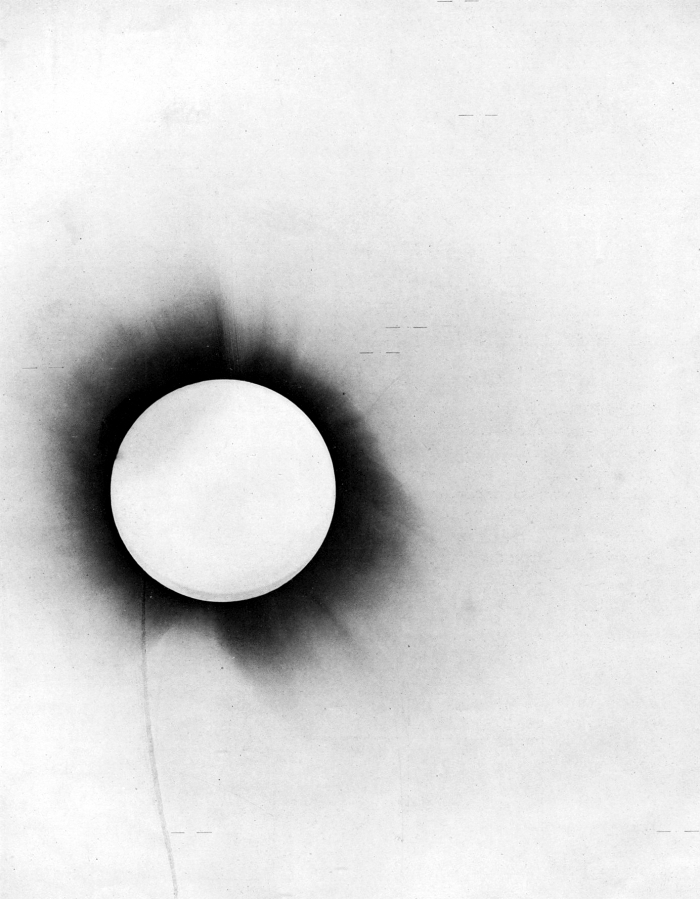
A negative obtained with the four-inch lens at Sobral during the eclipse of May 29, 1919, was reproduced in the 1920 expedition report. Measuring background-star positions tested the predicted deflection of starlight.
Sobral eclipse expedition; F. W. Dyson, A. S. Eddington, and C. Davidson (1920 report) · Image source · Public domain in the United States (published 1920)


On May 29, 1919, two eclipse expeditions tried to measure a displacement far smaller than the apparent width of the Sun. Their photographs became a celebrated test of general relativity, but the underlying achievement was more specific than an instant proof of Einstein's entire theory. Researchers compared stellar positions, calibrated photographic scales, and judged datasets with different instrumental problems. The detailed report by Frank Dyson, Arthur Eddington, and Charles Davidson was published on April 27, 1920. Its conclusions are worth reading alongside its qualifications. The historical experiment illustrates both the power of a quantitative prediction and the care required when a small physical signal resembles a change in the measuring instrument.
Light bending was not a single unchanged Einstein prediction
Einstein's 1911 paper on gravity and light predicted a solar deflection using an early application of the equivalence principle. That was not yet the completed general theory of relativity. His 1916 foundation paper described the later framework and a larger deflection, about 1.7 arcseconds for a ray passing the solar limb. The eclipse program aimed to distinguish the full relativistic value, conventionally about 1.75 arcseconds, from alternatives including no bending and approximately half that amount. Merely detecting any displacement would therefore leave an important theoretical question unanswered.
The physical change was a new account of gravity. In general relativity, matter and energy affect spacetime geometry, and freely propagating light follows paths determined by that geometry. Saying that gravity bends light is a useful shorthand, but it hides what an observer must actually measure. A telescope detects the arriving direction of a ray and associates that direction with an apparent point on the sky. The test concerns how that point differs from the position inferred without the Sun near the line of sight.
A star can appear farther from the Sun when its light bends toward it
The expeditions observed from Sobral in Brazil and Príncipe off western Africa. During totality, the Moon obscured the bright solar disk, allowing nearby background stars to be photographed. Reference photographs supplied a comparison field. The relevant information was not a visible curve traced by a light beam, but small differences between stellar image positions in different observations. An eclipse made those measurements possible by suppressing glare; it did not magnify the deflection itself.
To understand the sign, imagine receiving a ray that has passed close to the Sun and turned inward on its journey. Trace its final incoming direction backward as a straight line, as an observer ordinarily does to locate a distant object. That extrapolated direction places the star farther from the apparent solar center. The path bends toward the mass while the apparent stellar displacement is outward. Confusing those two descriptions can make a correct lensing diagram seem to predict the wrong effect.
An arcsecond becomes a microscopic displacement
An arcsecond is one three-thousand-six-hundredth of a degree. For small angles, a telescope with focal length f produces an image displacement approximately f times the angular change in radians. Consider a telescope with an illustrative focal length of 3 meters. A deflection of 1.75 arcseconds is about 8.48 millionths of a radian, giving an image movement of approximately 25.5 micrometers. The half-deflection alternative would move the image by about 12.7 micrometers. Those are small separations even before weather, optics, and photographic measurement enter the experiment.
The formula does not mean that every photographed star should move by the limb value. In the weak-field approximation, deflection decreases approximately inversely with the ray's distance from the solar center. A ray passing at twice the solar radius has about half the limb deflection. An analysis therefore fits a radial pattern and reports a coefficient normalized to the limb. Distinguishing the coefficient from an individual star's actual displacement is essential when interpreting the historical results.
The report preserved the disagreement
The final report gave a limb-normalized deflection of 1.98 arcseconds from Sobral's four-inch instrument and 1.61 arcseconds from Príncipe. Their quoted probable errors were about 0.12 and 0.30 arcseconds respectively. A separate Sobral astrographic dataset gave 0.93 arcseconds and received much less weight because of instrumental concerns. These are three distinct reductions, rather than three interchangeable confirmations. The report's stated probable errors should not silently be relabeled as modern one-standard-deviation uncertainties.
The general statistical lesson extends beyond this expedition. Suppose two thermometers share a calibration error while a third has an identified mechanical fault. Averaging all three readings equally would not produce a neutral answer; it would impose an unjustified error model. Equal weighting assumes something about the reliability of each input. Unequal weighting also needs justification. A credible account should therefore preserve both the conflicting result and the physical reasons for judging its reliability, instead of treating agreement with a favored theory as a sufficient reason to prefer it.
A camera change can imitate part of the pattern
The Sobral astrographic observations encountered a change in image quality and complications in establishing the photographic scale. The report discussed these problems rather than simply concealing the discordant result. That does not make every historical decision immune to criticism. It means an assessment should examine the optical and calibration evidence, not infer either flawless certainty or misconduct from a disagreement between the reported numbers.
Imagine a star image lying 20 millimeters from a plate's reference center. A scale change of one part in a thousand moves that image by 20 micrometers, comparable to the illustrative gravitational shift calculated above. The patterns are not identical: a simple scale error increases with distance from the reference center, whereas the gravitational signal depends inversely on distance from the Sun. Stars distributed across a suitable field can help separate them. With a narrow or poorly measured field, however, the fitted parameters can become strongly correlated.
Precision requires independent checks on the apparatus
Averaging many photographs can reduce random measuring scatter. It cannot automatically remove a common focus or scale error affecting all of them. In a simple model, let each plate have independent position noise of 10 micrometers and a shared calibration uncertainty of 8 micrometers. Averaging 25 plates reduces the independent component to 2 micrometers, but the combined uncertainty remains about 8.25 micrometers after the variances are added. Reporting only the reduced scatter would make the result look much more secure than the model permits.
This distinction explains why reference observations and apparatus checks can be more valuable than merely accumulating exposures. A useful check constrains a parameter that the main observations cannot determine cleanly. The weak-field light-deflection calculation supplies a specific spatial pattern, but a theory's specificity does not calibrate a camera. The measurement still requires evidence about the mapping from angles to plate positions. A persuasive test connects those two tasks without allowing agreement with the prediction to replace the instrumental evidence.
A milestone can be important without being final
The weighted historical result supported the larger relativistic deflection within the experiment's limits. It did not establish every prediction of general relativity, exclude every competing gravitational framework, or make further measurements unnecessary. A much later example shows how the program continued: a paper published on September 25, 2003 used radio links with the Cassini spacecraft to constrain gravitational effects on propagating signals. That experiment examined radio-frequency shifts associated with the solar gravitational time delay, rather than repeating the eclipse's photographic procedure.
The continuity lies in testing related consequences through a different measurement chain. Improved precision becomes especially informative when its dominant errors differ from those of earlier experiments. The 1919 eclipse remains a landmark because it brought a distinctive gravitational prediction into contact with stellar-position measurements under difficult conditions. Reading its actual report preserves that accomplishment while revealing the calibration work beneath it. The experiment helped make curved spacetime empirically credible; the continuing network of tests made the theory much more thoroughly accountable.
Sources & further reading
Primary papers, project documentation, and research releases used in this article. Publication dates below refer to the sources themselves.
- Über den Einfluß der Schwerkraft auf die Ausbreitung des LichtesAlbert Einstein / Annalen der Physik; original-paper facsimile archived at ZenodoPublished Checked
- Die Grundlage der allgemeinen RelativitätstheorieAlbert Einstein / Annalen der Physik; original-paper facsimile archived at ZenodoPublished Checked
- A determination of the deflection of light by the sun's gravitational field, from observations made at the total eclipse of May 29, 1919F. W. Dyson, A. S. Eddington, and C. Davidson / Philosophical Transactions of the Royal Society; original-report facsimilePublished Checked
- A test of general relativity using radio links with the Cassini spacecraftB. Bertotti, L. Iess, and P. Tortora / NaturePublished Checked
FOLLOW THE QUESTION
Explore physics