MATHEMATICS
Fermat’s Last Theorem: Why an Impossible Equation Led to Modularity
The 1995 proof turns a hypothetical integer solution into an elliptic curve, combining semistable modularity with Ribet’s earlier level-lowering theorem.
Research checked
Newest cited publication
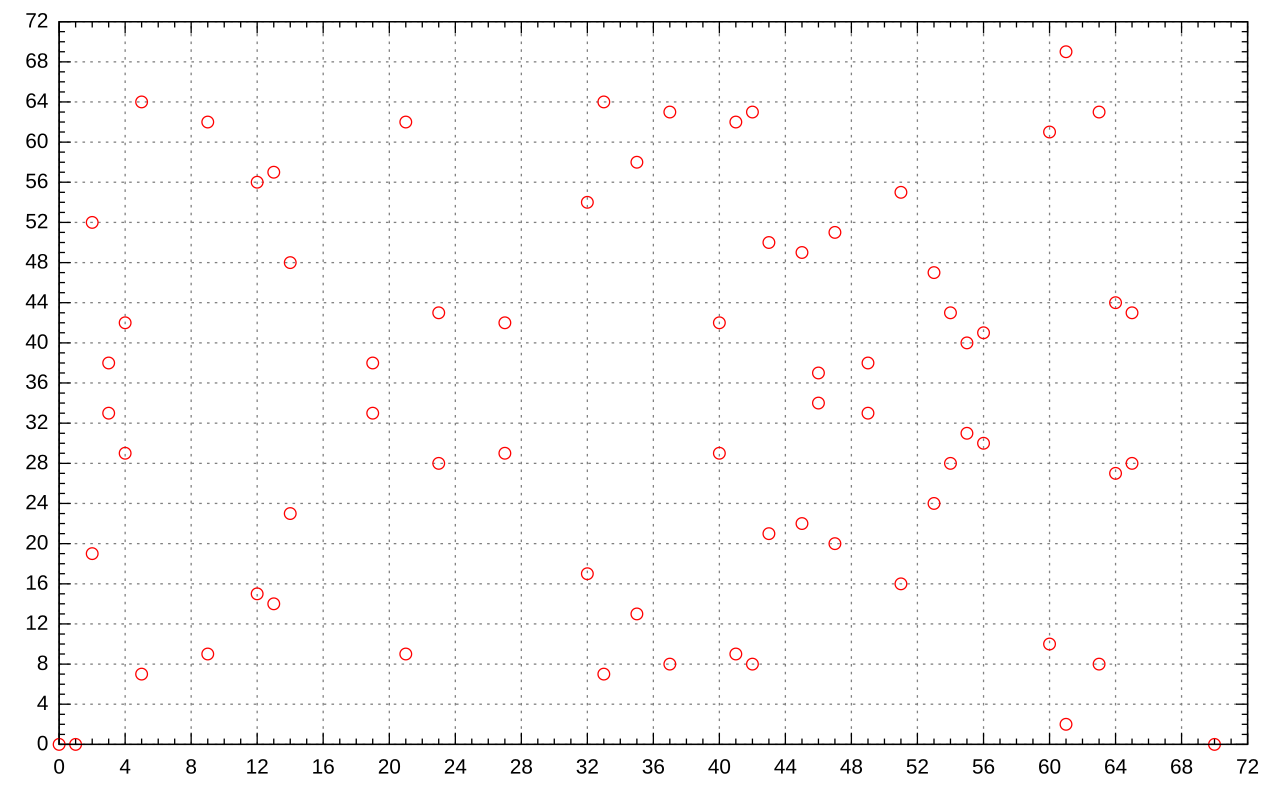
Points on an elliptic curve over the finite field with 71 elements introduce an arithmetic-geometric object central to the proof strategy. The image is an elementary illustration rather than the curve attached to a hypothetical Fermat counterexample.
Trshaffer / Wikimedia Commons. Wikimedia-generated PNG rendering of the SVG; no editorial changes. · Image source · CC0 1.0

Fermat’s Last Theorem forbids a familiar-looking equation: for an integer exponent n greater than two, no positive integers a, b and c satisfy a to the power n plus b to the power n equals c to the power n. The decisive proof did not come from manipulating that equation alone. It passed through elliptic curves, modular forms and the symmetries of algebraic numbers. Andrew Wiles’s paper and the companion paper with Richard Taylor appeared in the May 1995 Annals of Mathematics. Their achievement established the semistable modularity needed to finish an earlier reduction by Kenneth Ribet. Understanding that chain explains why a result far broader than the original equation supplied exactly the missing contradiction.
The domain is part of the theorem
The restriction to positive integers matters. At exponent two, 3² + 4² = 5² gives a counterexample to the analogous prohibition. Over positive real numbers, 1 plus 1 equals the nth power of the positive nth root of two for every n, so there is no comparable obstruction. Allowing zero also gives trivial solutions. Fermat’s theorem concerns exact integer arithmetic, rather than the approximate equality of measured lengths or values on a calculator.
It is enough to treat exponent four and odd prime exponents. If n has an odd prime divisor p, a solution at exponent n gives one at exponent p by replacing each variable with its n/p power. For example, a sixth-power solution would give a cube solution. If n has no odd prime divisor, it is a power of two; because n exceeds two, it is divisible by four. A twelfth-power solution also gives a fourth-power solution. These reductions organize the possible exponents without proving the remaining prime cases.
Why a long search cannot close the problem
A program could test every triple below a chosen bound and report no solutions. That establishes only a finite statement. Raising the bound preserves the same logical gap, because the theorem contains no largest permitted integer. A proof must provide a reason that excludes every possible counterexample, including one larger than any computer could store. Exact computations can support that reasoning, but a successful search is not automatically a substitute for it.
The distinction appears even in simpler arithmetic. Testing the expression m² + m + 41 at a few small nonnegative integers suggests an impressive supply of primes. At m = 40 it equals 1,681, which is 41². This is not an argument about Fermat’s equation; it illustrates why a pattern over tested inputs does not control all inputs. The modular approach supplied a structural obstruction instead of asking an ever larger search to stand in for a universal statement.
Build a curve from the hypothetical solution
For a primitive hypothetical solution with odd prime exponent p at least five, set A = a to the power p and B = b to the power p. Consider the cubic equation y² = x(x − A)(x + B). Its three displayed roots are 0, A and minus B. They are distinct because the original integers are positive. Adding the point at infinity produces an elliptic curve over the rational numbers. This is the Frey-curve construction used in the reduction; the required normalization at the prime two needs care.
The discriminant of this displayed model is 16A²B²(A + B)². Under the hypothetical equation, that becomes 16 times (abc) to the power 2p. The calculation explains why the arithmetic of the curve is tightly connected to the proposed integer solution. It does not by itself prove the required reduction properties. After the standard parity and integral-model adjustments, the curve falls into the semistable class relevant to the argument. A hypothetical arithmetic exception has therefore produced a very restricted geometric object.
Two theorems pull the curve in opposite directions
Semistability means that at each prime the elliptic curve has good or multiplicative reduction, rather than additive reduction. Wiles’s Theorem 0.4 proves that every semistable elliptic curve over the rationals is modular. In this setting, modularity links the curve to a weight-two modular form, bringing two ways of encoding arithmetic into agreement. The theorem covers the hypothetical Frey curve after the necessary normalization. It does not require the stronger assertion that every rational elliptic curve is modular.
Ribet’s 1990 paper supplies the incompatible conclusion through level lowering. Under the hypothetical Fermat solution and modularity, its torsion representation would have to arise from a weight-two cusp form at level two. The required space has no nonzero forms. Thus the proposed curve cannot be modular, while semistable modularity says it must be. The contradiction removes the hypothetical solution. The older exponent-three and exponent-four cases complete the reduction to all n greater than two.
A coarse symmetry picture is only a beginning
A Galois representation records how field symmetries act on torsion points of an elliptic curve. Reduction modulo a prime gives a finite-resolution picture; a prime-adic representation retains compatible information at every prime-power resolution. Matching the coarse picture does not automatically identify the richer one. For example, 1 and 4 agree modulo three, but their squares behave differently modulo nine: 1² is 1, whereas 4² is 7. A constraint valid at one resolution can fail at the next.
Modularity lifting studies when a suitably constrained representation above a modular residual one must also be modular. The local arithmetic and irreducibility hypotheses in such theorems are essential. Wiles’s argument starts from particular residual modularity results and uses a 3–5 switch to handle a remaining case. These ingredients should not be summarized as a rule that every representation agreeing with a modular object modulo three is automatically modular. The proof succeeds by controlling which lifts are allowed.
Point counts give a concrete glimpse of the arithmetic that modularity organizes. On the curve y² = x³ − x over the field with five elements, the five possible x-values yield respectively one, one, two, two and one y-values. Adding the point at infinity gives eight points. The associated trace is 5 + 1 − 8 = −2. A modular form attached to this curve must reproduce such traces at good primes. Agreement at a few primes is useful evidence, but the theorem establishes the arithmetic relationship beyond a finite comparison.
Why the companion paper matters
The deformation ring R organizes allowed lifts of a residual Galois representation. A Hecke algebra T encodes operators acting on modular forms and the associated arithmetic data. A natural comparison links these constructions. Proving the required isomorphism, often summarized as R = T, establishes that the permitted deformation theory is accounted for by modular forms. Taylor and Wiles’s companion work proves the complete-intersection property for the particular Hecke algebras in their argument; it is not a theorem about every ring called a Hecke algebra.
A small algebraic analogy helps explain the emphasis on relations. Specifying a generator u with u² = 0 permits expressions c + du. Adding the relation u = 0 removes the d-direction altogether. Both presentations have a generator with the same name, but they describe different objects. Comparing ring structures therefore requires controlling relations as well as listing generators. The analogy does not reproduce the deformation argument. It explains why a precise ring-theoretic result can settle an arithmetic question that initially looks unrelated to algebra presentations.
The lasting achievement is the bridge
Wiles’s own introduction distinguishes the 1993 announcement from the completed argument: it describes the incomplete Euler-system construction and the later return to the complete-intersection approach. The Taylor–Wiles author manuscript is dated October 7, 1994; the two journal papers followed in May 1995. This history belongs to the finished proof, rather than changing the current theorem’s status. Fermat’s Last Theorem is proved. The lesson is that a universal impossibility can emerge from a carefully matched chain of conditional constructions, with every dependency ultimately discharged.
Sources & further reading
Primary papers, project documentation, and research releases used in this article. Publication dates below refer to the sources themselves.
- Modular Elliptic Curves and Fermat's Last TheoremAnnals of Mathematics; journal copy hosted by Rutgers UniversityPublished Checked
- Ring Theoretic Properties of Certain Hecke AlgebrasRichard Taylor and Andrew Wiles; author manuscript of the 1995 Annals of Mathematics article, hosted by Stanford UniversityPublished Checked
- On modular representations of Gal(Q̄/Q) arising from modular formsInventiones Mathematicae; author archive at University of California, BerkeleyPublished Checked
FOLLOW THE QUESTION
Explore mathematics