MATHEMATICS
Why Rank-Zero Elliptic Curves Unlock Modular-Curve Point Searches
A September 2026 revision turns maps to rank-zero elliptic curves into certified searches for rational points, with a carefully bounded level range.
Research checked
Newest cited publication
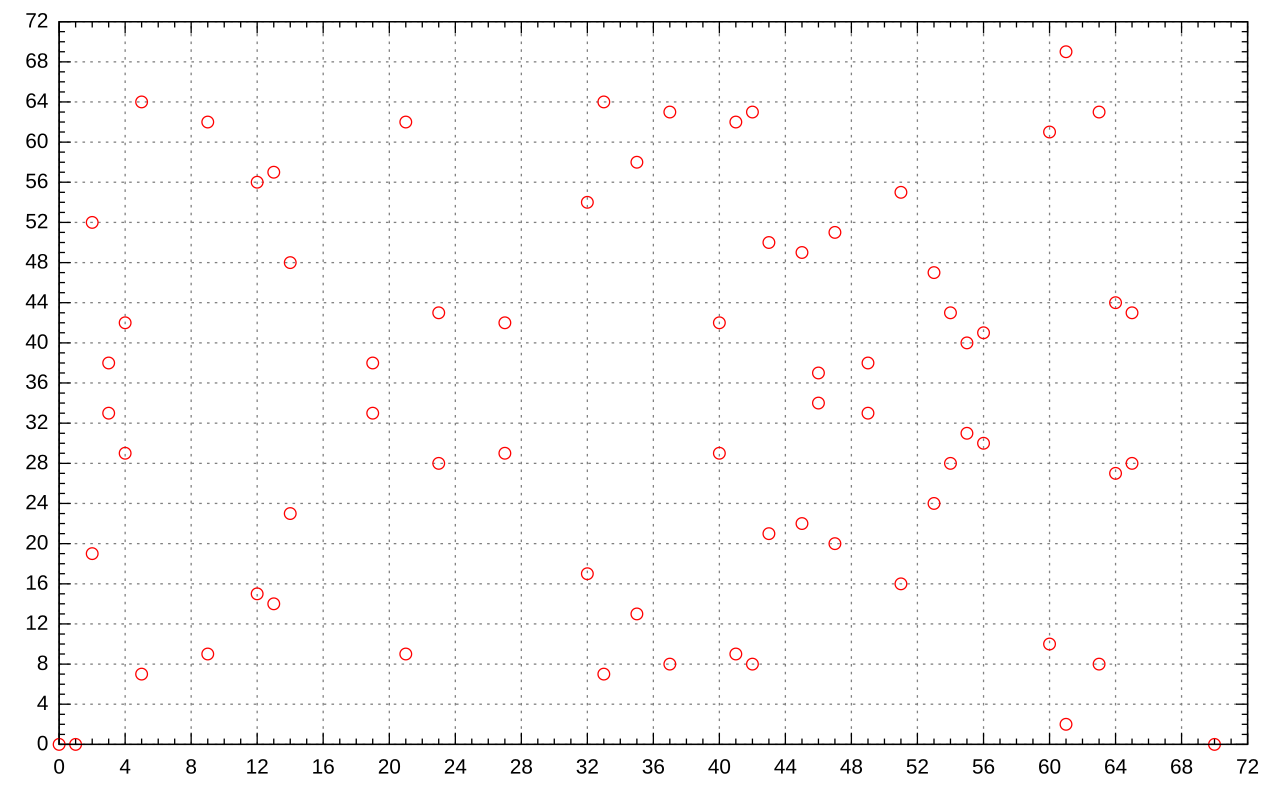
An elliptic curve over the finite field with 71 elements provides an elementary arithmetic-geometric example; the rational-point searches use the specific curves identified in the text.
Trshaffer / Wikimedia Commons. Wikimedia-generated PNG rendering of the SVG; no editorial changes. · Image source · CC0 1.0

A finite answer can remain impossibly difficult to find. Arithmetic geometry repeatedly encounters this distinction: a theorem may guarantee that a curve has only finitely many rational points without telling us how to list them. A 2026 preprint by Jacob Mayle and Jeremy Rouse addresses a substantial family through a useful detour. Rather than search the original curve indefinitely, map it to an elliptic curve whose rational points already form a finite, computable set. Their paper first appeared on January 23 and was revised on September 29. Its significance becomes clearer when the search, the certificate, and the coverage percentage are considered separately.
Turning symmetry restrictions into a curve
An elliptic curve is a nonsingular cubic curve equipped with a distinguished point, allowing its points to be added. Its coordinates need not stay rational when we ask for points killed by multiplication by an integer N. Nevertheless, field symmetries permute those torsion points in an organized way. A Galois representation records that action. Choosing a basis for the N-torsion makes the action look like invertible two-by-two matrices with entries calculated modulo N.
Here is an elementary illustration of why matrices enter. Two independent directions, P and Q, generate a two-dimensional finite grid. A symmetry sends P and Q to new combinations, such as P + Q and Q. Recording those two images gives a matrix; composing symmetries multiplies matrices. This example illustrates the bookkeeping, rather than asserting that every chosen matrix occurs for a particular elliptic curve. A modular curve packages a specified restriction on the permitted matrices into a geometric parameter space. Rational points on that parameter space then constrain which elliptic curves realize the restriction.
Even the smallest finite field gives a useful counting check. Over the field with two elements, a first nonzero column has three choices. A second column independent of it has two choices, giving six invertible two-by-two matrices. This is a count of the ambient matrix group, not a claim that all six symmetries occur for every elliptic curve. The distinction between an allowed group and the image actually realized by arithmetic is exactly what the modular-curve parameter problem is designed to retain.
What rank zero actually gives
The rational points of an elliptic curve form a finitely generated abelian group. The rank counts independent directions of infinite order, while a separate torsion subgroup accounts for points that repeat after finitely many additions. Rank zero removes those infinite directions. It does not mean that the curve has no rational points, and it does not mean that its real graph is empty or even small. The real points and rational points answer different questions.
For a purely group-theoretic illustration, compare the integers with the residues modulo five. Repeatedly adding one in the integers never repeats. Modulo five, the same operation cycles through five positions. A rank-zero rational-point group behaves like a finite collection of cycles, although its actual structure depends on the curve. Once that finite target group has been rigorously determined, every rational point upstairs must lie over one of its members. This converts an unbounded search into finitely many exact algebraic tasks.
Why checking every fibre can prove completeness
Suppose X maps nonconstantly to an elliptic curve E over the rational numbers. A rational point of X has a rational image because the map is defined over the rationals. If E has only finitely many rational points, calculate the inverse image, or fibre, over every one. Each fibre of a nonconstant map between smooth projective curves is finite. Solving these fibres and retaining their rational solutions can therefore produce a complete list.
Consider a hypothetical map of degree four to a target with six rational points. Before rationality filtering, the six fibres contain at most twenty-four distinct geometric points, counted with the appropriate multiplicity bound. Some points may have irrational coordinates; some fibres may contain repeated points. The arithmetic work is determining which candidates descend to rational points, including points omitted by an affine chart. Twenty-four is only an explanatory bound for this invented example. It is not a statistic from the paper. The essential logical step is that no rational point can escape the exhaustive target list.
The difficult part is constructing the detour
Knowing that a useful map exists is weaker than possessing formulas that a computer can evaluate. One can recognize a promising elliptic factor in the Jacobian, the higher-dimensional group variety attached to a curve, yet still lack an explicit map from the original equations. Mayle and Rouse supply a method for constructing such maps and combine it with existing computations and results.
This distinction mirrors a familiar computational issue. Knowing that a polynomial factors is not equivalent to having the factors in hand. A map must also be verified on the actual curve: substituted coordinates must satisfy the target equation, and apparent denominators require careful handling. Numerical agreement at sampled points would be suggestive but could not certify an identity. Exact arithmetic and algebraic identities provide the needed bridge from geometric existence to a reproducible rational-point calculation.
Reading the coverage claim with its denominator
In the September revision, the authors treat a database of 804,450 modular curves of level at most 70, for the specified subgroup conditions: surjective determinant and containment of minus the identity. Of these, 797,591 admit a rank-zero elliptic target, and all but ten of that subset are resolved. Thus 797,581 curves are covered, exceeding 99 percent of this stated database. This is not a claim to have solved rational points on arbitrary algebraic curves, or every modular curve at every level.
A coverage percentage can conceal dependence among cases. If one curve maps to a useful target, curves covering it can inherit a useful map by composition. That is a mathematical advantage, not a defect, but it explains why counting database entries differs from counting wholly unrelated hard problems. For a reader assessing progress, both facts matter: an enormous finite collection receives rigorous answers, and its organization makes reuse possible. The remaining curves still contain genuinely difficult arithmetic.
A nearby result has a different logical status
A February 24, 2026 preprint by Maarten Derickx, Sachi Hashimoto, Filip Najman, and Ari Shnidman pursues a broader parameterization of rational points on modular curves. It assumes Zywina's effective form of the Serre uniformity conjecture. That assumption must remain attached when discussing the resulting global organization. A conditional parameterization and an explicit finite-level computation complement each other, but neither automatically changes the logical status of the other.
One way to distinguish them is to ask where the stopping rule comes from. A finite database fixes a boundary before the computation begins. A global classification needs a mathematical reason that only finitely many building blocks suffice across unbounded levels. An unproved uniformity statement can supply that reason conditionally. Understanding the dependency is more informative than treating every paper about modular curves as a single interchangeable advance.
The next useful question is about reusable certificates
The broader lesson is methodological. A successful arithmetic computation needs a complete search region, exact operations inside it, and a reason that nothing outside it can contribute. A rank-zero target can supply the first and third ingredients simultaneously. The target acts as a finite index of every possible image, while fibres recover the original candidates.
For future work, the practical questions include how reliably useful targets can be identified, how expensive explicit maps become as the source genus increases, and which alternative methods handle curves without such targets. Those are research questions, not conclusions established by a high coverage percentage. The 2026 work demonstrates how existing geometry can become an effective search certificate in a precisely specified setting. That is a more durable achievement than simply finding another long list of points.
Sources & further reading
Primary papers, project documentation, and research releases used in this article. Publication dates below refer to the sources themselves.
- Rational points on modular curves via maps to elliptic curves with rank zeroarXivPublished Checked
- Rational points on modular curves: parameterization and geometric explanationsarXivPublished Checked
- Elliptic curves over $\mathbb{Q}$ and 2-adic images of GaloisarXivPublished Checked
FOLLOW THE QUESTION
Explore mathematics