MATHEMATICS
A Steiner design on 42 points turns admissibility into a construction
A 2025 construction, published in 2026, resolves a small Steiner-design parameter set. Counting triples explains its 574 blocks and the role of symmetry.
Research checked
Newest cited publication
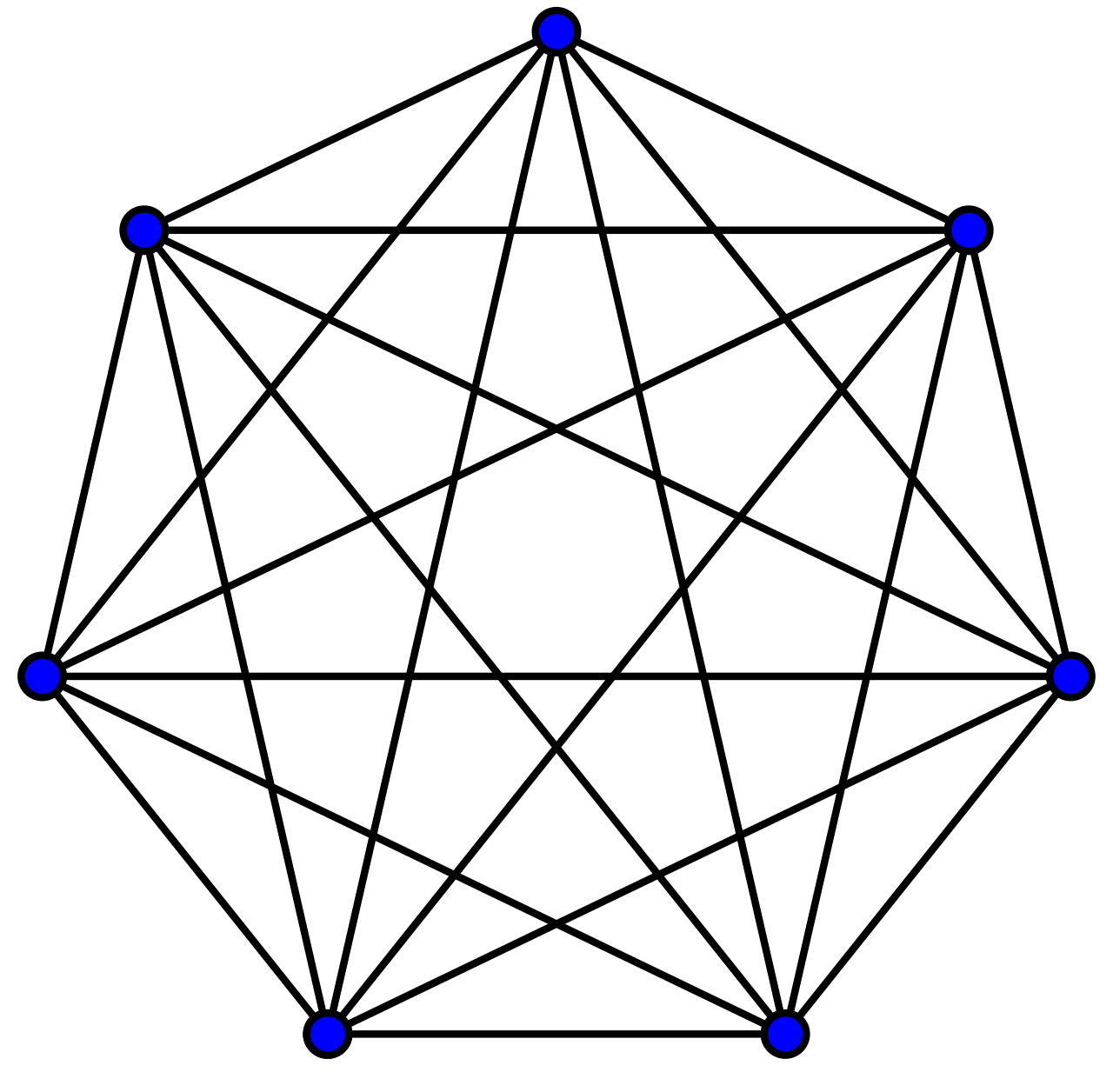
A small complete graph illustrates pairwise incidence as background for block designs; the 42-point construction uses the incidence rules described in the article.
David Benbennick / Wikimedia Commons. Wikimedia-generated PNG rendering of the SVG; no editorial changes. · Image source · Public domain (released by the creator)

A combinatorial design asks for a collection of overlapping groups with exact coverage, not merely approximate balance. The arithmetic can say that such a collection is possible without supplying even one example. Michael Kiermaier, Vedran Krčadinac and Alfred Wassermann crossed that gap for a Steiner system on 42 points with six points per block in a paper first posted on September 27, 2025 and listed in Designs, Codes and Cryptography in 2026. Their result illustrates why small explicit constructions remain valuable even after broad existence theorems have transformed design theory. We can inspect the parameters, derive their necessary counts and understand what a checkable certificate must contain.
Every triple appears exactly once
The paper constructs a Steiner system S(3,6,42). The notation means that the ground set has 42 points, every block has six points, and every three-point subset belongs to exactly one block. The authors also establish rotational Steiner quadruple systems on 46 and 92 points. Their method extends Steiner two-designs while prescribing extension groups. These are explicit existence results at particular parameters; they are not a classification of every design with those parameters or a claim that all admissible small parameter sets are now settled.
Think of points as labels rather than physical positions. A diagram may help show incidence, but distances and angles have no role in the definition. If two six-point blocks share three points, the common triple would occur twice and violate the rule. Sharing zero, one or two points can be allowed. This simple intersection test already gives a useful local check, although it is not enough by itself: a collection could avoid repeated triples while still leave some triples uncovered.
Why the construction must contain 574 blocks
There are 42 times 41 times 40 divided by six, or 11,480, unordered triples on the ground set. A six-point block contains 6 times 5 times 4 divided by six, or twenty, triples. Exact once-only coverage therefore requires 11,480 divided by twenty, giving 574 blocks. No search strategy can change that count. It follows directly from counting the same incidence pairs in two ways: each triple contributes once, and each block contributes twenty times.
The count alone cannot certify a design. Choose 574 arbitrary six-point blocks and their twenty-triple contributions might overlap extensively, leaving holes elsewhere. The total number of contributions would still be correct. A useful analogy is filling numbered boxes with tokens: having exactly as many tokens as boxes does not prove that each box has one token. Verification must check both the total and the distribution. In this case an integer counter for each of the 11,480 triples gives a particularly direct certificate test.
Each point and each pair impose further arithmetic
Fix a point. There are 41 choose two, or 820, triples containing it. Every block through that point covers five choose two, or ten, of those triples. Consequently each point belongs to exactly 82 blocks. Fix a pair instead. Forty possible third points must be covered, and a six-point block containing the pair supplies four of them, so exactly ten blocks contain each pair. These local requirements agree with the global count: 42 times 82 equals six times 574.
This explains the familiar divisibility conditions for designs. Required coverage numbers must be integers at every lower-dimensional level. If one of these ratios were fractional, no clever construction could repair it. But integral ratios are necessary conditions, not a universal small-size existence theorem. Many different local views must coexist in one collection of blocks. Arithmetic checks that each view has the right capacity; the construction has to make all those capacities compatible at once.
Removing one point exposes a two-design
Keep only the blocks containing a chosen point, then remove that point from each retained block. The remaining 41 points and 82 five-point blocks form S(2,5,41): every pair of remaining points was part of exactly one original triple with the removed point. This derived design is an immediate consequence of the definition. Reversing the operation is much harder. Adding a new point to all blocks of a two-design covers triples containing the new point, but says nothing yet about triples entirely among the old points.
Those remaining triples require additional six-point blocks whose coverage must fit the already fixed structure. This is where an extension problem differs from simply attaching a new label. The selected two-design constrains which larger blocks can be added without repetition. Two nonisomorphic two-designs with the same numerical parameters can present different extension possibilities. Thus searching over a suitable starting structure, together with compatible symmetries, is a genuine mathematical choice rather than a cosmetic rearrangement of an otherwise predetermined construction.
Groups compress a search without making it exhaustive
A permutation of the point labels is an automorphism when it sends blocks to blocks. If a construction is required to respect a chosen group of such permutations, one can select whole orbits of candidate blocks rather than examine every block independently. As a toy illustration, cyclic shifts of labels can generate several blocks from one representative. The saving can be substantial, but a symmetry restriction also excludes any design that lacks that symmetry. An unsuccessful restricted search therefore cannot prove unrestricted nonexistence.
For a positive result, symmetry gives an economical certificate. List a group and representative blocks, generate their orbits, remove duplicate blocks and check the triple counts. The final incidence verification is independent of how the representatives were discovered. One can also inspect a fully expanded block list, which trades compactness for simplicity. The authors provide their constructed systems in GAP-readable form through an associated data collection. That availability makes the new example more useful than a bare statement that a search succeeded.
Large-scale existence leaves specific small instances
Peter Keevash's existence work proves, for fixed design parameters and sufficiently large admissible ground-set size, that the natural divisibility conditions suffice. The phrase sufficiently large is the key difference from a statement about 42 points. An asymptotic theorem does not automatically identify which individual small instances lie beyond its threshold, nor produce a short human-readable construction at every admissible value. A newly resolved small system can therefore represent progress without contradicting the existence of a much broader general theorem.
Keevash's separate Counting designs paper investigates how many designs exist and develops randomized algebraic construction ideas. Counting, existence and explicit construction ask different questions. A theorem that many objects exist may not hand us the particular compact representation we want; conversely, one elegant example does not estimate the number of nonisomorphic designs. This separation is worth preserving in research reporting. The 42-point result is compelling because it supplies an actual missing object, while the broader theory explains why exact coverage is not confined to a few exceptional examples.
A small verification task with a large logical payoff
For this article, the numerical checks can be performed without sophisticated software: evaluate the three binomial-coefficient ratios and verify 574 blocks, 82 blocks per point and ten per pair. The supplied expanded block list can be checked more strongly by enumerating every triple in every block and confirming exactly one occurrence. It is essential to distinguish those two checks. The ratios verify necessary parameter arithmetic; checking the actual list verifies that this particular incidence structure meets the definition.
The wider lesson is that a construction and its verification need not have comparable difficulty. Discovering a globally compatible set of blocks may require symmetry, extensive computation and considerable insight. Once a concrete list exists, a short independent counting program can test the defining property exhaustively. Future work can ask about other unresolved parameters, automorphism groups, extension possibilities and the diversity of solutions. None of those questions is answered merely by reaching 574 blocks, but the explicit design supplies a reliable object with which to begin.
Sources & further reading
Primary papers, project documentation, and research releases used in this article. Publication dates below refer to the sources themselves.
- Steiner 3-designs as extensionsarXivPublished Checked
- The existence of designsarXivPublished Checked
- Counting designsarXivPublished Checked
FOLLOW THE QUESTION
Explore mathematics