MATHEMATICS
Smooth Euler implosions and the mathematics of coming back out
Two 2026 preprints connect smooth non-isentropic Euler implosions, conditional stability and reflected shocks, while carefully specifying the solution class.
Research checked
Newest cited publication
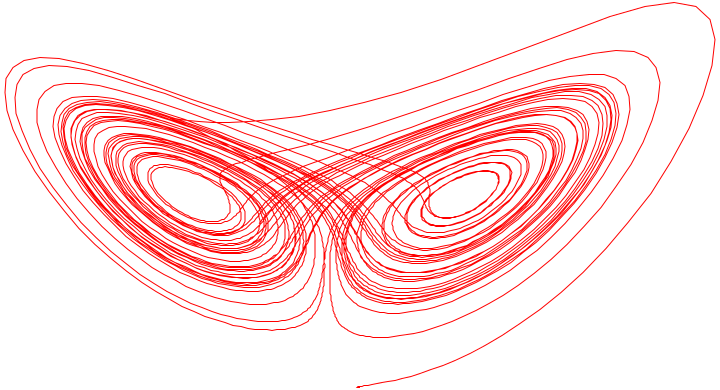
A Lorenz attractor illustrates nonlinear dynamical behavior. It is background imagery rather than a computed solution of the Euler implosion problem discussed here.
Cepheus / Wikimedia Commons. Unchanged original image. · Image source · Public domain (released by the creator)

An implosion focuses a flow toward a point; an explosion carries a disturbance outward. They sound like opposite experiments, but for a partial differential equation they can be two sides of a question about continuing past a singularity. A May 2026 preprint by Jiajie Chen, Steve Shkoller and Vlad Vicol constructs smooth non-isentropic implosion profiles for compressible Euler flow. A June paper, also with Giorgio Cialdea, studies a reflected shock continuation. These are mathematical results for specified ideal-gas models and symmetry classes, currently presented as preprints. Their interest lies as much in stability and admissibility as in the dramatic fact of concentration.
Density is a moving part of the equation
Compressible Euler flow evolves density, momentum and energy. Unlike an incompressible model, it allows density to change as material converges or expands. An ideal-gas relation closes the system using an adiabatic exponent γ greater than one. Entropy is another crucial part of the description. Isentropic reductions constrain its role, whereas the full system allows an entropy field that varies from place to place. “Non-isentropic” therefore signals a different model class, not a minor correction to the same scalar equation.
A material-volume calculation gives the basic focusing intuition. If a fixed amount of mass occupies a sphere whose radius halves, its average density grows by a factor of eight in three dimensions. That observation alone is not a singularity proof: pressure gradients may reverse the contraction, different regions can move at different rates, and the Euler evolution must satisfy all conservation laws simultaneously. It does show why an inward velocity field is not enough evidence. A rigorous implosion must balance the pressure and transport terms while controlling the shape of the concentrating region.
A changing flow can have a fixed profile
Self-similarity describes an evolving solution through a profile viewed in shrinking or expanding coordinates. For illustration, write a characteristic length as the time remaining to collapse raised to a positive power a. Halving the remaining time then multiplies that length by two raised to minus a. Rescale space by this length and separately rescale the fluid variables. A solution that looks stationary in those coordinates can still develop unbounded quantities in the original coordinates. Smoothness of the profile and smoothness through the physical collapse time are different statements.
Substituting such an ansatz into an equation changes derivatives in a controlled way. A time derivative now includes both a derivative of the amplitude scale and a term caused by the shrinking coordinate system. A spatial derivative contributes the inverse length scale. The exponents must make the terms balance, and the resulting profile equation still needs a solution with the right behavior at the center and far away. Dimensional balancing suggests candidates; it does not establish their global existence, positivity or stability. Those are separate steps in a rigorous construction.
What the new implosion construction adds
The May 1, 2026 preprint constructs smooth, radially or spherically symmetric, genuinely non-isentropic profiles with explicit similarity exponents. For the ground-state profile, its nonlinear radial stability statement includes a one-dimensional compatibility condition on initial data. For monatomic or diatomic gas parameters, the authors also characterize initial data leading to stability without imposing symmetry on the perturbations. The qualification matters: a symmetric reference solution can be tested against nonsymmetric disturbances, but that does not mean every nearby disturbance is allowed by the theorem.
Think of stability as a question about a neighborhood in a function space. A condition can cut that neighborhood down to a surface of acceptable initial states. Motion along the surface may return toward the reference profile, while motion away from it excites a growing mode. Even one scalar compatibility condition distinguishes unrestricted stability from stability on a selected set. In a dynamical problem, apparent growth can also reflect a shift in collapse time or center rather than a different physical mechanism. A precise proof must separate those coordinate freedoms from a genuine instability.
Continuing the solution through a reflected shock
The June 16, 2026 preprint’s main continuation theorem fixes three spatial dimensions, the N = 1 ground-state implosion and the ideal-gas range 1 < γ ≤ 3 + 2√2. It constructs an outward-propagating shock after collapse, with the continuation selected using conservation jump conditions and an entropy inequality. At each fixed positive time, its central density is unbounded but locally integrable, its pressure remains bounded and its temperature vanishes at the center. This is a structured weak continuation of the constructed solution, not restoration of a globally smooth flow. The authors expect extensions to other parameter regimes, but those are not part of this theorem.
Local integrability explains how an infinite pointwise value can coexist with finite mass nearby. A radial density behaving like r raised to minus α in three dimensions contributes mass proportional to the integral of r raised to two minus α. That integral is finite near zero when α is less than three. The calculation is illustrative and does not assert the paper’s particular exponent. It makes the distinction concrete: a weak formulation can still integrate conservation laws across a region even though a pointwise density or derivative no longer meets the requirements of a classical solution.
Integrability also depends on which physical quantity is being tested. A density can have finite local integral while its square has infinite integral, because squaring doubles the concentration exponent. Thus a weak mass balance does not by itself guarantee finite local square norm, bounded energy density or classical differentiability. Each claim needs its own estimate. This hierarchy explains why describing a continuation as a weak solution supplies specific information, rather than permission to treat every formally written expression as finite.
A jump needs more than an attractive picture
Across a shock, the flow variables jump, so derivatives cannot be interpreted classically everywhere. The Rankine–Hugoniot conditions require the jump in each conserved flux to match the shock’s motion and the jump in the conserved quantity. An entropy criterion then excludes continuations that have the wrong physical direction of dissipation. These constraints do real selection work. The June paper’s uniqueness claim should be understood within its constructed admissible self-similar continuation framework, rather than as a blanket uniqueness theorem for all multidimensional Euler weak solutions.
A simple conservation analogy is a moving boundary between two traffic densities. If more cars arrive than leave, the boundary moves; choosing an arbitrary speed would create or destroy cars. Conservation fixes a relation between the speed and the states on either side. Gas dynamics has several coupled conservation laws, so the matching is much richer. Still, the analogy explains why drawing an expanding front after collapse is insufficient. A valid reflected shock must meet algebraic jump constraints and also attach to solutions of the equations on both sides.
A different route begins with a shock-free flow
An October 22, 2025 preprint by Cialdea, Shkoller and Vicol provides a related but distinct construction: classical radial shock-free Euler data evolve to a preshock, then a shock, then a Guderley implosion and reflected blast. The revised version was posted November 7. This separates two stories that are easy to conflate. One follows a smooth non-isentropic profile into a point collapse; the other first forms a shock and later matches an imploding-shock profile. Both concern compressible Euler, and neither should be relabeled a proof about the unrestricted incompressible Navier–Stokes problem.
The useful next questions are correspondingly specific. Which stability conditions persist under changes of equation of state? How much symmetry can be removed? In what solution class is continuation selected? Can a numerical method reproduce the conservation balances while resolving the shrinking region? The 2026 constructions offer exact analytical targets for such questions. They also demonstrate a broader principle: singularity formation is not the end of mathematical description, but crossing it changes the language from smooth evolution to admissible weak continuation, and that change must be justified rather than hidden.
Sources & further reading
Primary papers, project documentation, and research releases used in this article. Publication dates below refer to the sources themselves.
- Smooth and stable Euler implosionsarXivPublished Checked
- A new class of Euler explosionsarXivPublished Checked
- Classical Euler flows generate the strong Guderley imploding shock wavearXivPublished Checked
FOLLOW THE QUESTION
Explore mathematics