ENGINEERING
Artificial muscle fibers move their pumps inside
A 2026 electrofluidic muscle combines fiber pumps with fluidic actuators, turning the supporting hardware into a central part of soft-robot design.
Research checked
Newest cited publication
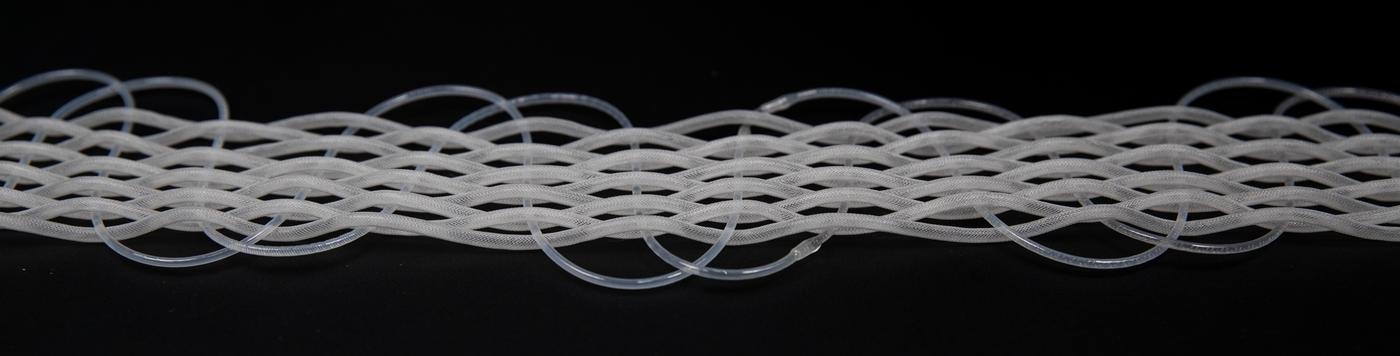
Woven electrofluidic muscles from the MIT Media Lab project show soft actuators and fiber pumps integrated into a textile structure.
Ozgun Kilic Afsar / MIT Media Lab · Image source · CC BY 4.0
Soft robots can look remarkably self-contained until the camera pulls back and reveals a compressor, fluid reservoir and bundle of tubes. A flexible actuator may be impressive while its support system prevents it from leaving a laboratory bench. The 2026 electrofluidic fiber-muscle project from MIT and Politecnico di Bari attacks that packaging problem. Its researchers put pressure generation into slender fibers and pair those pumps with fluid-driven muscles. The relevant advance is not that electricity directly makes a passive thread behave like biological tissue. Electrical energy still becomes fluid motion and then mechanical work. What changes is where those stages live and how the complete system can be arranged.
An electric field replaces the rotating pump mechanism
The team's April 9, 2026 MIT research release describes charge-injection electrohydrodynamic pumps. Electrohydrodynamics means that electrical forces act on a liquid. In these devices, injected charge transfers momentum to a dielectric fluid, creating pressure and flow without a mechanically rotating impeller. The pump is integrated with thin McKibben actuators: constrained fluid-filled structures whose dimensions change under pressure. This is a specific architecture with identifiable energy conversions, rather than a claim that all conventional motors have become obsolete.
The pump's lack of moving mechanical parts should be interpreted carefully. Fluid still moves, and the surrounding actuator still deforms. Electrical insulation, seals, connections and power conversion remain engineering responsibilities. A compact active fiber is also not an energy source: it needs electrical input. When comparing designs, I would draw a boundary around everything required to operate them. That includes the battery, voltage conversion, controller, working liquid and supporting structure. Otherwise, comparing a bare muscle fiber with a complete servo assembly rewards whichever system leaves more of its equipment outside the photograph.
A second muscle stores the fluid the first one needs
The Politecnico di Bari project's April 2, 2026 account explains the closed fluidic circuit. A pump transfers liquid between antagonistic actuators, so one contracts while its partner extends. The arrangement avoids an external open reservoir and provides a route toward compact integrated systems. The resemblance to paired biological muscles is useful, but the mechanism is engineered around fluid storage and transfer. A successful robotic demonstrator therefore shows how components cooperate, not that the resulting device reproduces the physiology or adaptability of living muscle.
There is an important packaging tradeoff hidden in that attractive symmetry. A joint that moves in two directions needs an arrangement that accommodates both the active pull and the returning fluid. Positioning the partner actuator changes the available installation space and the paths along which force acts. Suppose a designer routes a flexible pair around a hinge. The same contraction produces different joint torque as the effective moment arm changes with angle. This hypothetical example is simply the relation between force and lever arm; it explains why a fiber's linear pulling ability does not specify a complete robotic joint's performance.
The system needs a useful starting pressure
The MIT release identifies pre-pressurization as an important design variable. If pressure at the pump inlet becomes too low, cavitation can introduce vapor bubbles and disrupt operation. The researchers use an initial bias pressure to keep the circuit in a working regime. They also describe a tradeoff between response speed and attainable contraction as that bias changes. A preloaded circuit is thus more than a storage detail: its initial condition influences the actuator's operating envelope.
A helpful independent analogy is a bicycle brake hose that must transmit pressure without unwanted compliance. Here, however, deformation is intentional at selected parts of the circuit. A designer wants the muscle to change shape while other volumes remain predictable. Trapped gas, flexible connections and temperature-dependent behavior can all complicate that balance in a general hydraulic system. The implication is a testing question, not an allegation about this prototype: how consistently can a manufactured fiber pair be filled, pressurized and checked? If production units start in different states, a shared electrical command may not produce the same motion.
The 2023 pump work remains a useful baseline
An accepted author manuscript of the 2023 Science paper Fiber pumps for wearable fluidic systems describes stretchable tubing with embedded helical electrodes. It demonstrates pressure generation and applications in textiles. This older work is background to the 2026 muscle integration, not a second announcement of the same result. It helps explain why a pump can have a fiber form: the fluid conduit and electrical geometry are manufactured together rather than connecting an ordinary miniature pump to a long passive hose.
Manufacturing a continuous component can reduce the number of separate fittings, but it also makes quality inspection important along the component's length. A local geometric defect could change the electric field or restrict a passage. An engineering production study would therefore look for distributions across batches, not only the performance of a carefully selected specimen. It could measure pressure and flow at several operating points, inspect leakage and insulation, and repeat those checks after bending. These are proposed acceptance tests. They should not be confused with results already demonstrated by the 2026 team.
A woven arm demonstrates integration, not general-purpose assistance
The official MIT Media Lab overview shows woven muscle pairs and a battery-driven robotic arm. It also describes configuring the number of pumps and actuators to alter response and force. These demonstrations are directly relevant because they make the packaging claim tangible: pressure generation is part of the deformable assembly. The project page is public research documentation, and its videos show specific demonstrations. They are not clinical evidence for assistive clothing or proof of an all-day wearable product.
For a garment, useful force is only one requirement. The wearer also experiences weight distribution, stiffness when the device is inactive, heat, fit and resistance to natural movement. A mechanism that assists one joint position might resist another if its routing is unsuitable. An industrial robot poses a different set of questions: repeatability, duty cycle, repair, exposure to contaminants and the consequences of a punctured line. These applications should be evaluated separately. Their common need for flexible actuation does not make evidence transferable between a bench arm, an exoskeleton and a prosthetic interface.
Compare the same system boundaries
The project describes muscle-like power density, a useful indicator of work rate relative to component mass. It does not by itself determine efficiency, operating duration or the mass of a complete machine. A device can deliver a brief burst of substantial mechanical power while requiring a less compact electrical supply. Conversely, a slower task may value low noise and flexible routing more than maximum power. The sensible comparison therefore begins with a task definition and a consistent list of included components.
For illustration, lifting a one-kilogram mass through ten centimeters requires about 0.98 joules of gravitational work, using a rounded gravitational acceleration of 9.8 meters per second squared. Completing that lift in one second corresponds to 0.98 watts of average useful mechanical power during the lift. Electrical energy will exceed useful lifting work whenever losses are present. This example is not a measurement of the electrofluidic prototype. It shows why a power headline, a payload headline and a battery-life headline cannot be substituted for one another without timing, travel and system-boundary information.
The next milestone should make the support system visible
My reading of the combined evidence is that fiber-format actuation has gained a more coherent supporting architecture. The 2023 pump work established a flexible pressure source; the 2026 project integrates pressure generation, fluid transfer and paired actuation into a practical research demonstrator. That progression is valuable even while important product questions remain open. It gives engineers a concrete alternative to the familiar arrangement of soft mechanisms served by rigid equipment elsewhere.
A persuasive follow-up would publish complete operating mass, electrical input, mechanical output, thermal behavior and cycle-to-cycle variation together. It would include idle behavior and realistic interruptions, because a robot rarely performs one perfectly repeated movement forever. For wearables, independent testing would need an application-specific human protocol and appropriate safeguards; the component results alone cannot establish benefit. The current work is strongest as an architectural result: it moves the machinery that supports a soft muscle closer to the place where motion happens, making future complete-system comparisons possible.
Sources & further reading
Primary papers, project documentation, and research releases used in this article. Publication dates below refer to the sources themselves.
- A new type of electrically driven artificial muscle fiberMIT NewsPublished Checked
- Electrofluidic fiber muscles in Science RoboticsRobophysics Laboratory, Politecnico di BariPublished Checked
- Electrofluidic Fiber Muscles (Science Robotics)MIT Media LabChecked
- Fiber pumps for wearable fluidic systemsScience / EPFL accepted author manuscriptPublished Checked
FOLLOW THE QUESTION
Explore engineering