ENGINEERING
Why robot fingertips need replaceable skin, not just sharper touch
An August 2026 tactile-sensor preprint puts abrasion, gradual wear and replaceable cartridges beside the usual race for sharper robotic touch.
Research checked
Newest cited publication
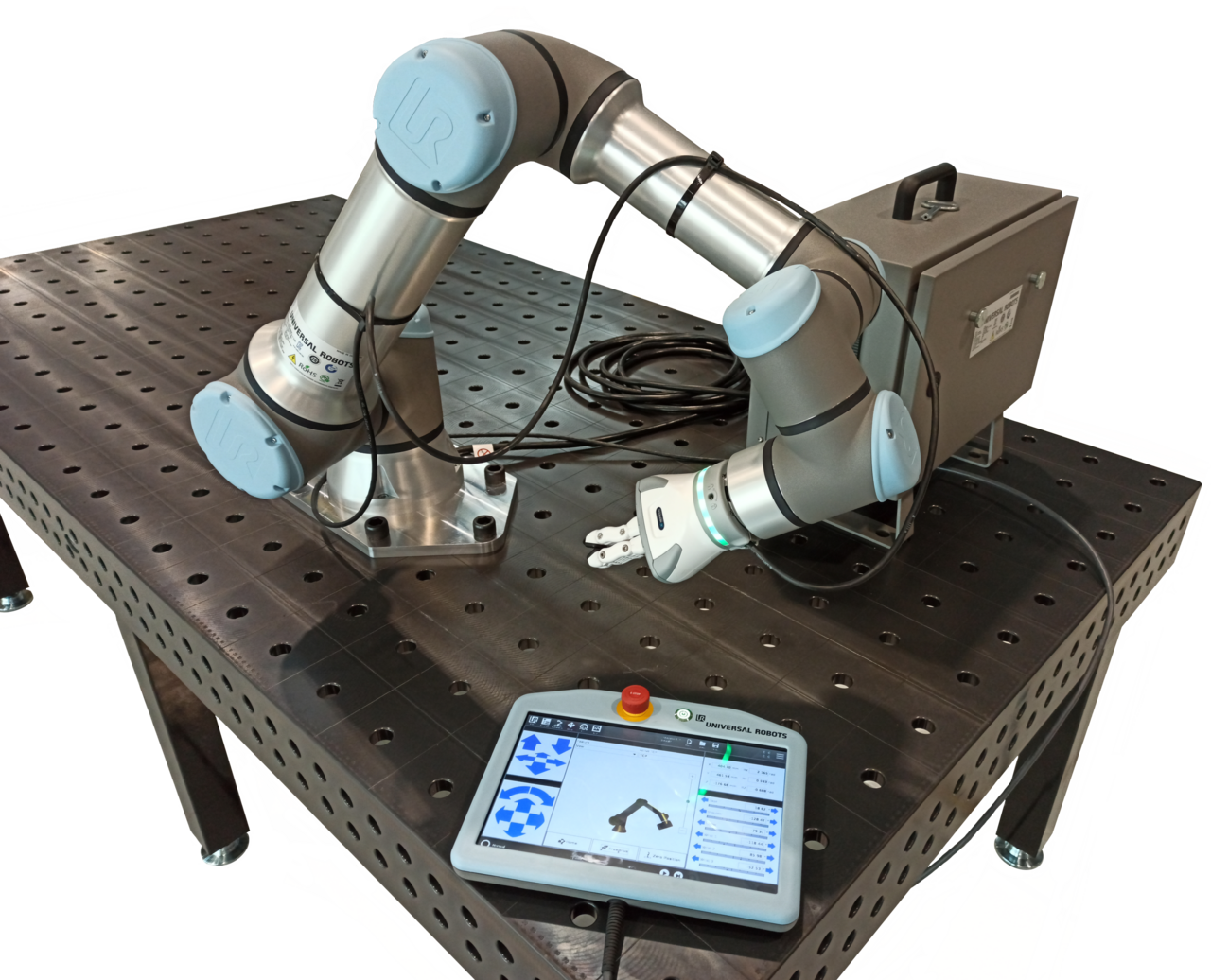
A UR16e industrial manipulator illustrates the robot hardware that tactile sensing can extend; the photograph does not show the new fingertip skin.
Auledas · Image source · CC BY-SA 4.0

A robot can have excellent touch perception on Monday and unreliable fingers by Friday. That possibility changes what a good tactile sensor means. Resolution describes information available when a device is healthy; an engineer also needs to know how that information deteriorates, how deterioration becomes visible, and how quickly a technician can restore the hand. An August 25, 2026 preprint by F. Richard Cottrell, Megha Tippur and Edward Adelson addresses that less glamorous side of robotic touch. Its replaceable, protected sensing surface is interesting because it treats wear as part of the instrument's architecture. The result is laboratory evidence about durability, rather than proof that robotic hands are ready for unrestricted industrial service.
The contact surface becomes a serviceable component
The preprint combines silicone gel, a textured thermoplastic polyurethane protective film and a replaceable cartridge. Its accelerated sanding test reached film rupture after roughly two to three hours, much later than the commercial comparison specimens. This is a laboratory endpoint, not a warehouse lifetime forecast. Testing the contact surface directly nevertheless makes durability more inspectable than a successful grasping video.
Consider the design choice independently of those particular numbers. A camera can remain expensive, precisely positioned and difficult to access while a contact cartridge is inexpensive and easy to exchange. Separating their maintenance schedules could avoid replacing an entire sensing assembly after superficial damage. The mechanical interface then becomes part of the measurement system. A replacement that sits slightly crooked, traps dust or changes the gel's preload may alter the image even if the camera is untouched. A practical cartridge therefore needs repeatable locating features and a quick check that the restored surface produces trustworthy measurements.
The camera watches deformation, not the outside world
Vision-based touch places a camera behind a deformable surface. Contact changes that surface, and internal illumination converts its changing geometry into a visible pattern. A February 14, 2025 Communications Engineering paper investigated the optical design of such curved fingertips using physically based rendering. Rather than guessing where lights should go, the authors modeled how geometry, materials and illumination affect the image. Their manufactured design improved surface-normal recovery relative to its expert-designed comparator. This is a separate result from the 2026 durability study: optical fidelity and resistance to wear answer different questions.
An ordinary photograph of an object and a tactile image are therefore different measurements. A shiny black component may be awkward for an external camera, yet its local shape can still deform an internally illuminated sensing surface. Conversely, a clear internal image can be mechanically misleading if two gels respond differently to the same applied load. Geometry, pressure and shear are related but distinct quantities. A depth reconstruction does not automatically provide an accurate force estimate; that conversion requires knowledge of material response, boundary conditions and calibration. Naming the measurement prevents a convenient image from silently becoming an unsupported claim about force.
A finger has more than one useful contact patch
The older GelSight Svelte work, accepted at the 2023 IEEE/RSJ International Conference on Intelligent Robots and Systems, provides another design axis. It used curved mirrors and a single camera to observe an extended finger-shaped surface. Its flexible backbone also made bending and twisting visible, enabling estimation of those loads from images. That experiment matters here as background: improving the survival of one fingertip is not the same engineering problem as covering a whole finger, and neither achievement alone supplies a complete hand.
A hand may pinch a small item at its tips, cradle a wide object along its fingers, or brace something against a palm. Protective skin that performs beautifully at one patch can still leave the rest of that hand effectively blind. Likewise, a rigid sensor housing can preserve optics while changing the compliance that made the grasp useful. My engineering inference is that durability should be mapped over actual contact locations and grasp modes. A single headline lifetime can conceal edges, seams and transitions where stress concentrates. Evaluating a replaceable skin only at its easiest central contact would miss precisely those installation details.
Read the endpoint before reading the improvement factor
All nine developed sensors remained usable when repetitive loading tests stopped on different days. Those are censored survival observations: they establish a lower bound rather than eventual failure time. The paper distinguishes first film rupture from loss of useful imaging. Its gradual-damage observations make that separation operationally relevant, although they do not establish a universal replacement interval.
Here is a deliberately hypothetical comparison. Suppose one sensor develops a visible scratch after ten hours and continues producing acceptable measurements for another ninety. A second remains pristine for twenty hours and then fails without warning. Ranking them solely by first visible damage favors the second; ranking them by useful operation or predictable maintenance may favor the first. The right endpoint comes from the task. A gripper inspecting delicate surfaces may reject any damaged skin, whereas a sorter may tolerate cosmetic wear while requiring dependable slip detection. Neither criterion is universally correct, so both should be stated before testing.
Wear can change the measuring instrument gradually
The optical-design paper establishes that the internal light path is sensitive to sensor geometry and material choices. An inference follows for maintenance: changes that accumulate in a protective surface deserve optical evaluation as well as mechanical inspection. A coating can survive without remaining perfectly uniform. A gel can preserve its outer shape while changing its response. That does not demonstrate that this particular protected fingertip suffers either problem; it identifies measurements needed before a durability improvement becomes a measurement-quality guarantee.
A useful acceptance procedure would press the repaired fingertip against reference shapes at several positions and loads. The aim would be to compare error distributions before and after service, rather than declare success because an image appears. Reference measurements should include repeatability: place the same object repeatedly and ask whether the output drifts or spreads. Tests involving sideways motion would probe a different condition from purely normal indentation. Separating these checks helps identify whether a change comes from optics, mounting or mechanics, and gives an operator a concrete reason to replace a cartridge before a grasp fails.
A durable fingertip still needs a deployment argument
None of the cited studies establishes universal resistance to oils, cleaning chemicals, sharp edges, hot components or mixed debris. Those environments can introduce failure mechanisms that a sanding drum and repeated probe do not reproduce. The 2026 work should be read as a focused prototype contribution, and the earlier papers as complementary experiments in optical design and coverage. Combining their ideas into one hand would itself require new construction, calibration and testing; the existence of separate papers does not show that such a combined product has been validated.
A convincing next demonstration would make the maintenance accounting visible. Report how many cartridges are used, how long replacement takes, how measurement quality changes, and how many attempted grasps fail before a maintenance alert. Publish the rejected data as well as successful examples. The practical opportunity is a hand whose contact surfaces can wear predictably while its expensive components remain stable. That would make tactile sensing easier to operate over repeated shifts. The August preprint brings attention to that problem, and its strongest lesson is methodological: a robot's sense of touch includes the parts that eventually need replacing.
Sources & further reading
Primary papers, project documentation, and research releases used in this article. Publication dates below refer to the sources themselves.
- A Durable Vision-Based Tactile Fingertip for Robotic ManipulationarXivPublished Checked
- Vision-based tactile sensor design using physically based renderingCommunications EngineeringPublished Checked
- GelSight Svelte: A Human Finger-shaped Single-camera Tactile Robot Finger with Large Sensing Coverage and Proprioceptive SensingarXiv / IEEE IROSPublished Checked
FOLLOW THE QUESTION
Explore engineering