ARTIFICIAL INTELLIGENCE
AlphaFold 3 and the Uncertainty of Molecular Interaction
The 2026 IsoDDE reports sharpen questions left by AlphaFold 3: what a molecular pose predicts, what confidence means, and how structure differs from function.
Research checked
Newest cited publication
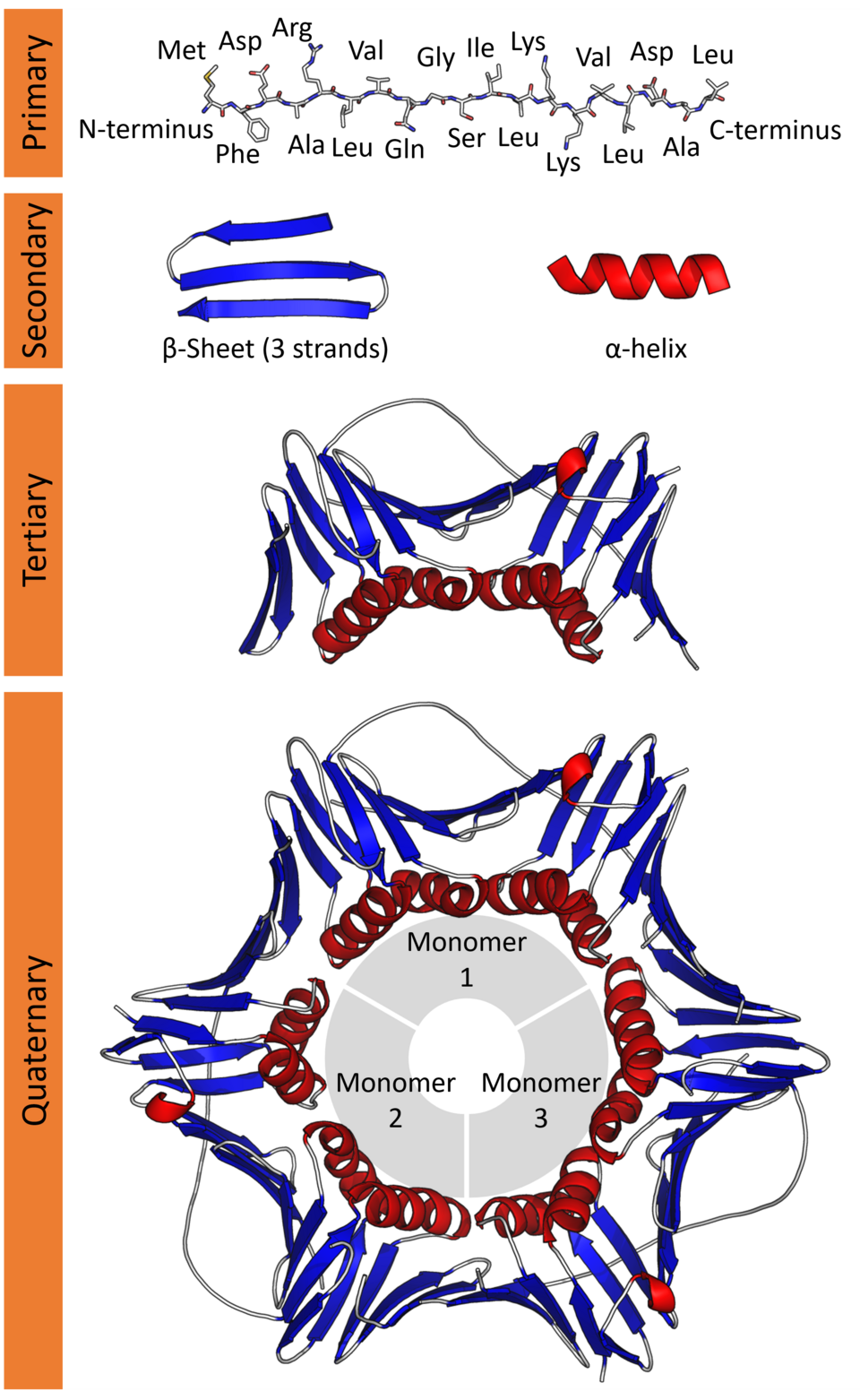
This diagram of protein structural organization provides background for molecular prediction; it is an independently created illustration rather than AlphaFold output.
Thomas Shafee · Image source · CC BY 4.0

Two molecules can fit together in a beautiful rendering without answering the question that motivated the rendering. Will they interact in solution? How strongly? Under which conditions? What happens in a cell? AlphaFold 3 made predicting biomolecular complexes substantially more capable when its Nature paper appeared on May 8, 2024. The current discussion has moved beyond celebrating a plausible pose. Isomorphic Labs' February 10 and September 29, 2026 updates on its Drug Design Engine, IsoDDE, put generalization, affinity, and experimental follow-up near the center of the story. These reports are a useful occasion to distinguish several kinds of uncertainty that can disappear behind a single molecular picture.
A pose is a proposed arrangement of atoms
AlphaFold 3 extends a unified prediction framework across proteins, nucleic acids, small molecules, and other molecular components. Its architecture includes a diffusion-based process that generates atomic coordinates. The 2024 paper evaluates structural agreement with experimental reference structures across different interaction classes. It also explicitly discusses stereochemical mistakes, overlapping atoms, and spurious order in disordered regions. A generated complex is therefore a scientific prediction with identifiable failure modes, rather than a photograph taken inside a cell.
An everyday geometric analogy helps. A key can align with the outline of a lock while still being the wrong key: thickness, mechanical tolerances, and how the parts move all matter. Molecular recognition is more complicated, but the analogy exposes the logical jump. An arrangement compatible with a pocket is only one part of an interaction claim. A structural model can make a proposed mechanism easier to inspect, identify a contact worth investigating, or reveal an obvious conflict. It cannot obtain every missing property merely by assigning coordinates to all the atoms.
Confidence has an object, and it is not everything
The original study connects confidence estimates with measured structural accuracy. Local confidence, interface confidence, and predicted alignment error answer related but different geometric questions. The paper also warns that sampling multiple random seeds does not reproduce the physical ensemble of conformations in solution. A collection of generated structures should not automatically be interpreted as a time series, an equilibrium population, or a probability distribution over every motion the molecule can make.
Consider an illustrative two-domain protein. Each domain could be predicted precisely while the angle between them remains uncertain. Describing the entire object as simply high confidence would hide that distinction. Conversely, an uncertain flexible tail may be irrelevant to a well-supported contact elsewhere. A useful figure would show confidence in relation to the specific proposed mechanism. If a claim depends on two residues meeting across an interface, uncertainty at that interface matters more than the average confidence of thousands of unrelated atoms. This is an interpretation principle, not a new performance result for AlphaFold.
Novel chemistry is a stricter test than familiar chemistry
Isomorphic Labs' February 2026 release emphasizes a generalization benchmark called Runs N' Poses, including systems with pockets and ligands unlike those in training data. The company reports more than twice AlphaFold 3's structure-prediction accuracy in its hardest similarity category. It also describes examples involving induced fit and cryptic pockets. These are claims about specified benchmark slices and examples. They should not be flattened into a universal statement that every molecular prediction became twice as accurate.
The scientific reason to separate familiar and unfamiliar cases is straightforward. Suppose a model sees many close relatives of one molecular family during training. Success on another relative could reflect useful interpolation without establishing performance on a genuinely different interaction. A test split by time helps, but related structures can span the cutoff. A split by sequence alone can also leave similar ligands or pockets on both sides. Strong evidence needs the target of novelty to be named: sequence, fold, binding site, ligand scaffold, chemical modification, or some combination. The company report is valuable to the extent that those distinctions remain inspectable.
Strength of binding is a separate prediction problem
The IsoDDE technical report addresses binding affinity as well as geometry, with evaluations on public benchmark datasets and a blind prediction task. This matters because a good pose and a good affinity estimate are different deliverables. The report presents the engine as a broader predictive system; it should not be read as merely attaching a new name to AlphaFold 3. It is a company technical report, and the reported comparisons should be examined with that publication status in view.
A simple thought experiment shows why affinity is not visually obvious. Imagine two candidate molecules whose atoms occupy almost the same positions in a binding pocket. One might lose a favorable interaction with water when it binds; another might pay a larger energetic cost to adopt that shape. Those possibilities illustrate missing information in an isolated picture. A research team comparing affinity predictions would need consistent assay definitions, units, and treatment of uncertainty. Mixing measurements from incompatible conditions can create an apparent model error that is partly a measurement mismatch. Conversely, a tidy numerical score cannot rescue an inappropriate experimental comparison.
It is also useful to separate a relative ranking from an absolute estimate. A model might correctly order a series of related compounds while shifting every predicted affinity by the same amount. Another model could have smaller average error while choosing the wrong top candidate. The preferable behavior depends on the scientific decision. An evaluation that reports both quantities would help researchers see whether the tool supports ordering, quantitative interpretation, or both.
A faster search still needs a truthful objective
In its September 29, 2026 update, Isomorphic Labs describes a design workflow that uses predictive models to search chemical space and then selects compounds for synthesis and laboratory testing. The company presents an experimental concentration-response example alongside its computational search account. This is more informative than a generated structure alone, but it is not clinical evidence. The release discusses preclinical work and preparing for clinical development; a reader should not silently turn those descriptions into demonstrated patient benefit.
The broader optimization problem has several objectives. A candidate can look favorable under one score while being difficult to synthesize, insufficiently selective, or poorly suited to the intended experiment. An optimizer may also exploit imperfections in the model judging its suggestions. My inference is that a useful design system should expose the trade-offs it is making and preserve diverse candidates, rather than repeatedly selecting near-duplicates with the best apparent score. Laboratory feedback is especially valuable when it challenges the scoring model instead of merely confirming the most obvious computational winners.
What a persuasive reproduction would preserve
The public AlphaFold 3 repository makes an inference pipeline available and separates the source-code license from model-parameter terms. It includes explicit cautions that outputs are theoretical predictions and require careful interpretation. Reproduction therefore involves both recording the computation and understanding which assets and conditions were actually used. The existence of code is a starting point for scrutiny, not a guarantee that every later comparison runs under identical settings.
A convincing independent evaluation would preserve the exact input entities, sequences, chemical identities, templates, data cutoffs, sampling budget, ranking procedure, and failed cases. It would report results across targets rather than selecting a few successful images. Most usefully, it would connect geometry to the next test: which contact, conformational change, or binding measurement would distinguish the predicted mechanism from an alternative? The current transition from AlphaFold 3 to broader 2026 design engines is exciting because the questions are becoming more demanding. The standard of evidence should grow with that ambition. A sharper image of a molecule is a beginning; a reproducible explanation of its interaction is the harder achievement.
Sources & further reading
Primary papers, project documentation, and research releases used in this article. Publication dates below refer to the sources themselves.
- Accurate structure prediction of biomolecular interactions with AlphaFold 3NaturePublished Checked
- AlphaFold 3 inference pipelineGoogle DeepMindChecked
- The Isomorphic Labs Drug Design Engine unlocks a new frontier beyond AlphaFoldIsomorphic LabsPublished Checked
- Accurate Predictions of Novel Biomolecular Interactions with IsoDDEIsomorphic LabsPublished Checked
- Building a new path to make medicines with AIIsomorphic LabsPublished Checked
FOLLOW THE QUESTION
Study engineering foundations